

WASHINGTON D.C. – In a move that could shatter 90 years of American political stability, the Supreme Court is currently weighing a case that strikes at the very heart of our republic: can a president fire anyone he wants?
On December 8, 2025, the nation’s highest court heard arguments in Trump v. Slaughter, a case born from President Trump’s decision to fire a commissioner of the Federal Trade Commission (FTC) not for incompetence, not for corruption, but for being “inconsistent with Administration priorities.”
This isn’t just another political squabble. This is a fight for the soul of American governance. The president is arguing for the power to purge independent federal agencies—the very bodies designed to be shielded from political whim, from the Federal Reserve that guides our economy to the commissions that ensure fair business practices.
He is demanding absolute loyalty, a unified voice under one man’s control. And while this may sound like a modern crisis, it is, in fact, one of the oldest and most dangerous plays in the book of power.
To understand what’s truly at stake, we must look back 2,500 years to the dawn of the world’s first superpower: the Persian Empire, and the brilliant, paranoid system its greatest ruler designed to hold it all together.
The King Who Saw Everything: Darius the Great’s Empire of Eyes
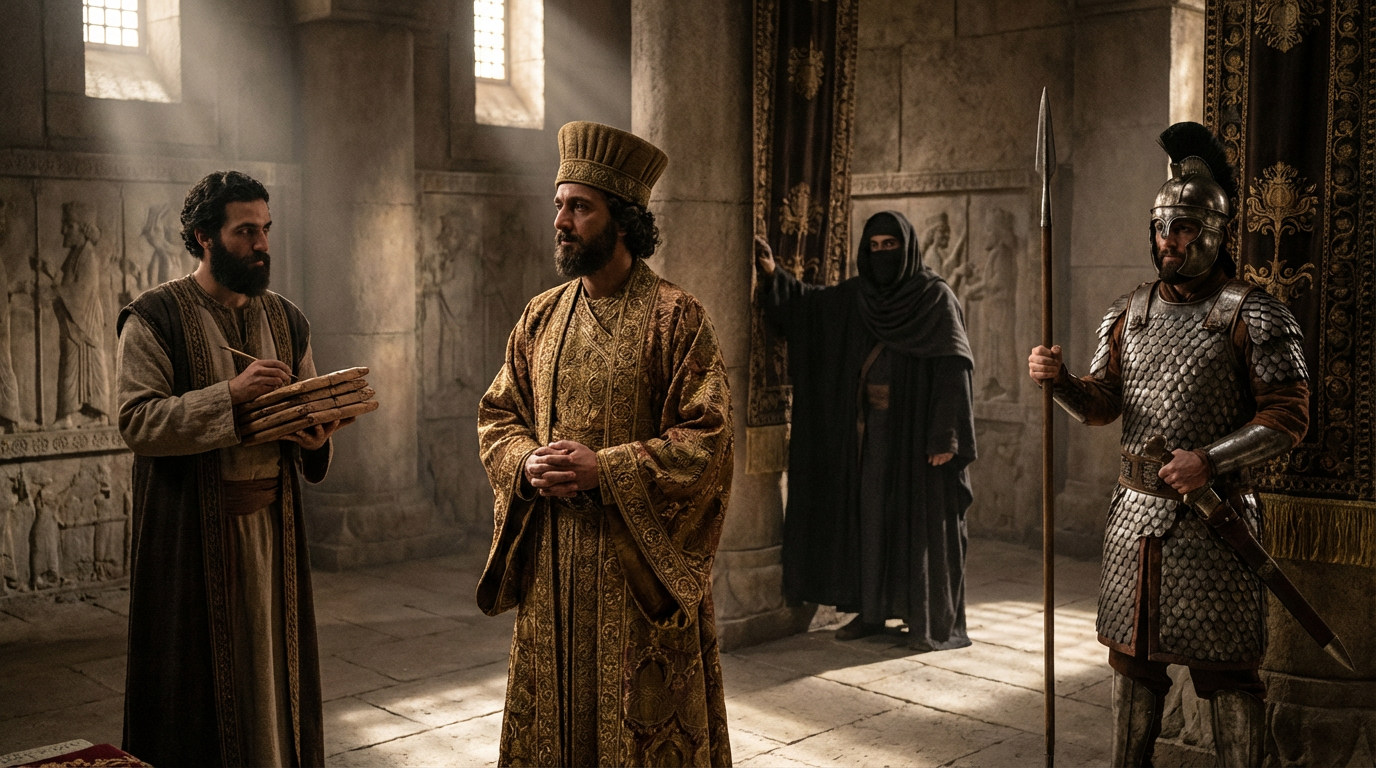
In 522 BCE, Darius the Great inherited an empire stretching from India to Greece. It was the largest the world had ever seen, a sprawling, chaotic tapestry of conquered peoples, diverse religions, and simmering rebellions.
Darius was a genius of administration. He understood a fatal flaw in one-man rule: a single pair of eyes can’t see everything. An empire this vast couldn’t be micromanaged from a golden throne in Susa.
His solution was the satrapy system—a network of provincial governors, or “satraps,” who were granted immense power to rule their territories. But this was not a system of blind trust. Darius, a master of human nature, built in a revolutionary series of checks and balances to keep his governors in line.
For every satrap, there were two other officials who answered only to the king:
- The Royal Secretary: A bureaucrat who monitored the satrap’s finances and administrative decisions, sending independent reports back to the capital.
- The Military Commander: A general who controlled the army in the province, ensuring the satrap could not use military force to stage a coup.
But the ultimate check was Darius’s most brilliant and terrifying innovation: a network of roving inspectors known as the “Eyes and Ears of the King.”
These agents, the Spasaka, were the king’s personal spies. They traveled the empire unannounced, with the authority to investigate anyone and anything. They could audit finances, inspect military readiness, and listen to the complaints of the common people. They had more power than the satraps themselves and could even command armies to depose a corrupt governor.
The Greek philosopher Aristotle, writing centuries later, was still in awe of the system’s efficiency:
“The king himself…might see everything and hear everything.”
This was the genius of Darius’s rule. He empowered his officials with independence, trusting their local expertise. But he held them accountable through a web of overlapping oversight. It was a system built on a delicate balance of trust and paranoia, independence and accountability.
It worked. The Persian Empire flourished for over a century under this system, a stable and prosperous global power.
The Rot Sets In: When Loyalty Replaces Competence

But empires, like all human institutions, are fragile. After Darius, a succession of weaker, more arrogant kings inherited the throne. They saw Darius’s system of checks and balances not as a strength, but as an obstacle to their absolute power.
They began to dismantle it, piece by piece.
They stopped appointing satraps based on merit and instead chose them for personal loyalty. The Royal Secretaries and Military Commanders became yes-men, afraid to contradict the governor. The “Eyes and Ears of the King” went blind, telling the monarch only what he wanted to hear.
Independence was replaced by fear. Competence was replaced by cronyism.
The result was catastrophic. Stripped of effective oversight, satraps became either petty tyrants, enriching themselves at the expense of the people, or incompetent puppets, unable to manage their provinces.
By the time Alexander the Great invaded in 334 BCE, he wasn’t facing the mighty, well-oiled machine of Darius. He was facing a hollowed-out empire, eaten away from the inside by the very corruption its system was designed to prevent. The satraps, long since stripped of their independent authority and prestige, either surrendered or were easily defeated.
The Persian Empire, once the world’s superpower, collapsed not because of a single military defeat, but because its leaders had systematically destroyed the independent institutions that made it strong.
The Supreme Court and the Ghost of Persia

Today, in Washington D.C., the same historical drama is playing out. The independent agencies of the United States—the FTC, the Federal Reserve, the National Labor Relations Board—were created on the same principle as Darius’s satrapy system.
They were designed to be run by experts, shielded from the political winds, and accountable to the law, not to the personal whims of a president. They are the modern “Eyes and Ears” of the American republic, the institutional checks that prevent the concentration of absolute power.
President Trump’s argument before the Supreme Court is the same argument made by the weak, failing emperors of Persia: that independence is inefficiency, that disagreement is disloyalty.
He is asking for the power to blind the eyes of the state, to silence any voice that contradicts his own. He is asking to replace a system of checks and balances with a system of personal loyalty.
History screams a warning at us from across 2,500 years. The path to tyranny is paved with the destruction of independent institutions. It begins when a ruler decides that loyalty is more important than truth, and that power should be absolute.
The nine justices of the Supreme Court now hold the fate of the American system in their hands. Will they heed the wisdom of Darius the Great, who understood that true strength lies in distributed power and independent oversight? Or will they follow the path of his failed successors, who traded the stability of their empire for the fleeting satisfaction of absolute control?
The ghost of Persia is watching. And it knows how this story ends.


