The Modern Mystery
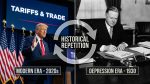
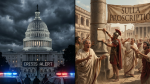
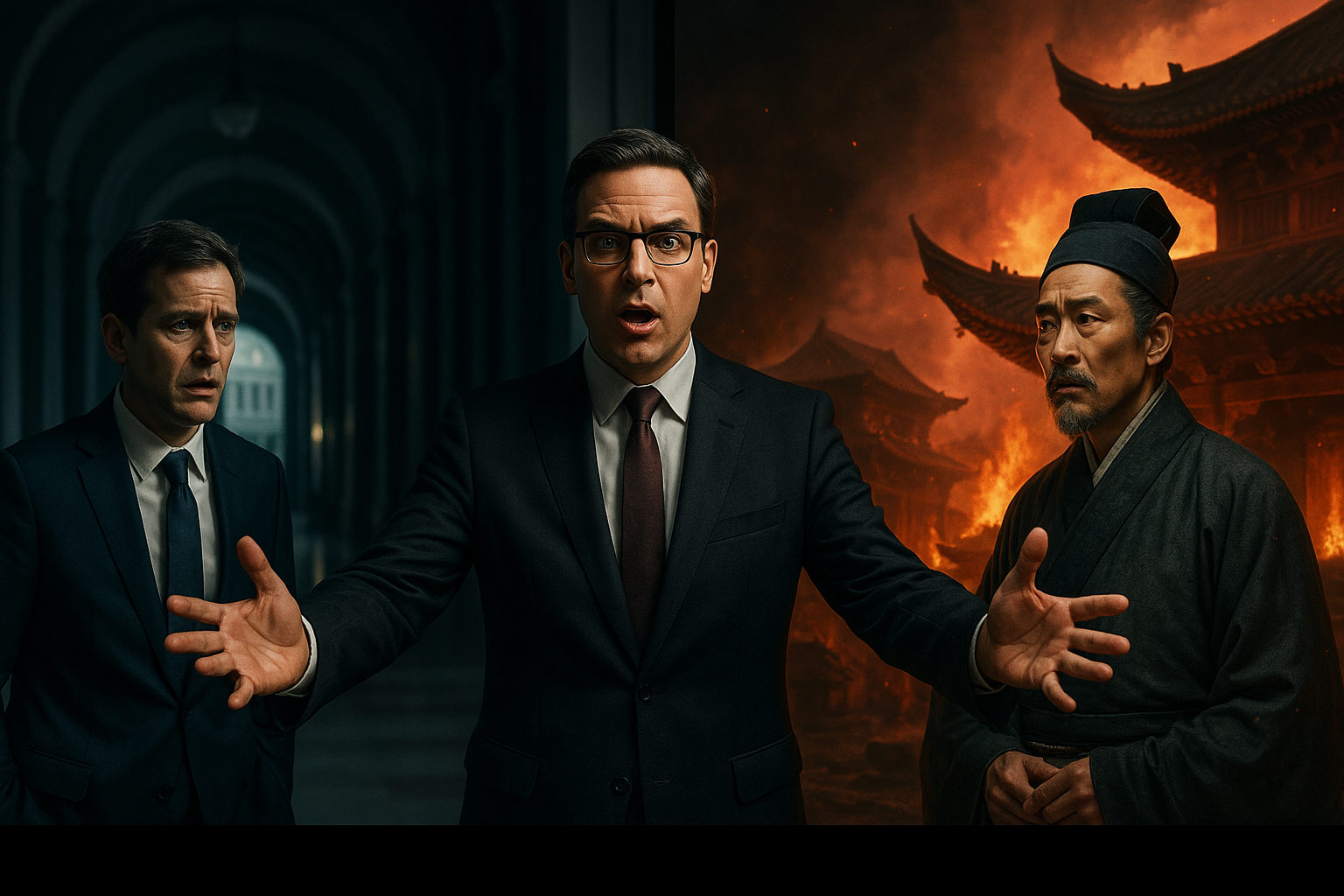
It’s Day 40 of the great American standoff. A chilling quiet has fallen over Washington D.C., a silence that echoes in the empty halls of government and the anxious homes of 800,000 federal workers. The gears of the nation have ground to a halt, not from a foreign threat or a natural disaster, but from a bitter war of words between factions who have forgotten how to yield.
Then, the warning shot. A top White House economic advisor, his face grim, appears on the Sunday morning shows. If this drags on, he says, the fourth-quarter GDP—the very heartbeat of the American economy—could turn negative. A self-inflicted recession, born from political paralysis.
For most Americans, it’s a headline. For those watching the skies, it’s a looming travel nightmare. A shortage of air traffic controllers threatens to turn the Thanksgiving holiday, a time of family and feasting, into a nationwide snarl of canceled flights and stranded passengers. The system is fraying at the edges, and the center cannot hold.
We watch, we worry, and we wonder: Has this ever happened before? Has a great power ever simply… stopped working? The answer, whispered from the dust of 1,800 years, is a terrifying yes. And what happened next is a lesson we can no longer afford to ignore.
The Time Portal
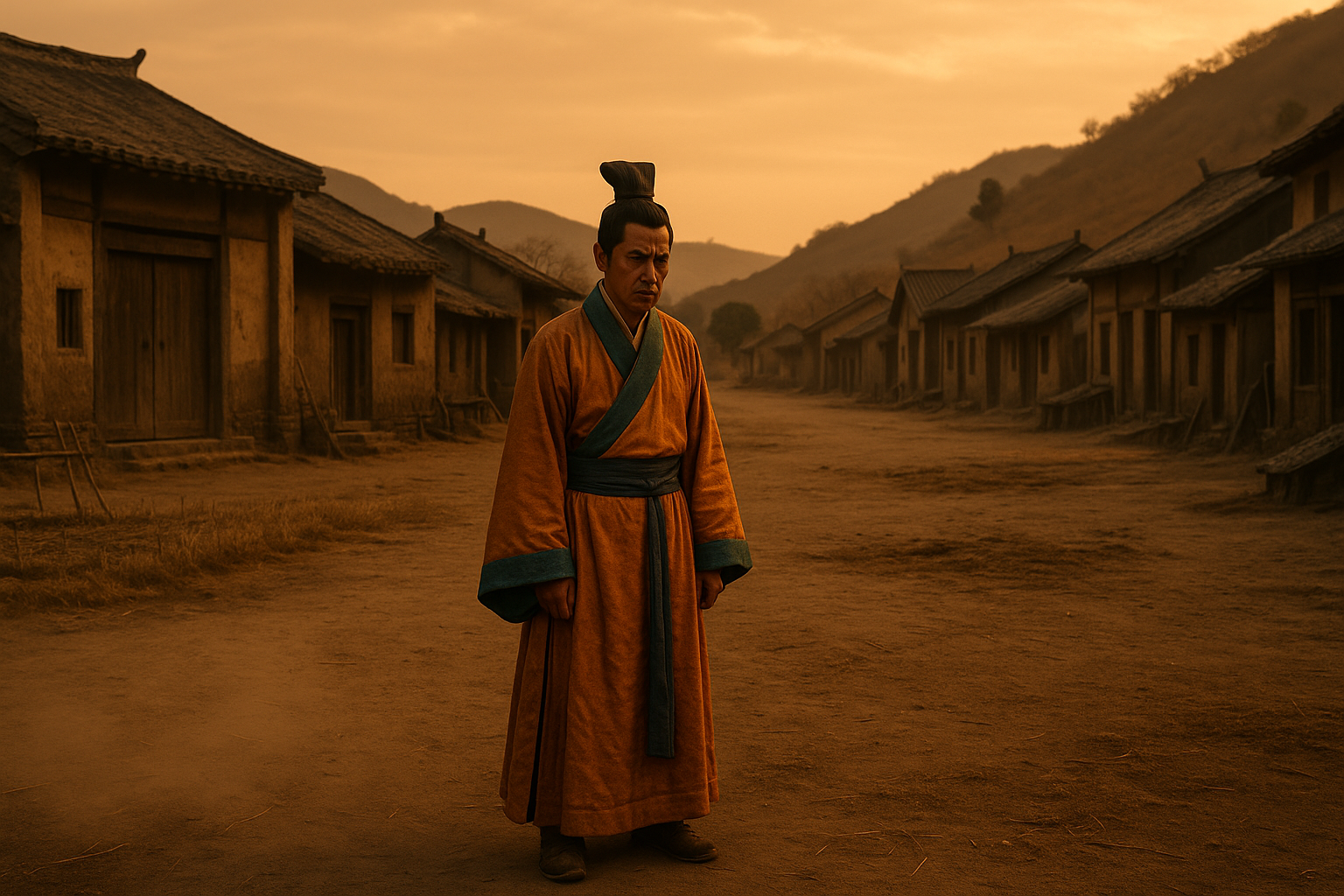
Let’s travel back to 189 CE. We are in the heart of the Han Dynasty, a Chinese empire that has stood for four centuries, a beacon of civilization, technology, and power. But here, in a dusty provincial village, the first cracks in the imperial facade are showing.
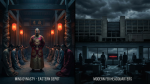
A lone tax collector, his silk robes a stark contrast to the mud-brick homes, approaches the village. He carries the authority of the Emperor, the Son of Heaven. But he is met with an eerie silence. The fields are empty. The homes are shuttered. The villagers, alerted by a sophisticated early-warning system of runners and signals, have vanished into the surrounding hills.
Frustrated, the collector returns to the magnificent capital of Luoyang, his satchels empty. He is not alone. Across the empire, the story is the same. The peasants, crushed by shrinking farms and growing families, have become masters of tax evasion. It is not a protest; it is survival.
Meanwhile, in the gilded halls of the palace, the scholar-officials, the educated elite who run the bureaucracy, have used their influence to exempt themselves from the tax rolls entirely. The imperial treasury, once overflowing with the wealth of a continent, is now “chronically short on money.” The armies guarding the vast frontiers go unpaid. The canals and roads fall into disrepair. The government is broke.
Then, the final blow. The old Emperor Ling dies, leaving his 13-year-old son, Liu Bian, on the Dragon Throne. The court immediately erupts into a vicious power struggle between the corrupt palace eunuchs and the self-righteous scholar-officials. They are not fighting for the future of the empire. They are fighting for their own survival, for power, for revenge. The government of the most powerful nation on Earth is paralyzed, not by an external enemy, but by its own hand.
The Parallel Revelation
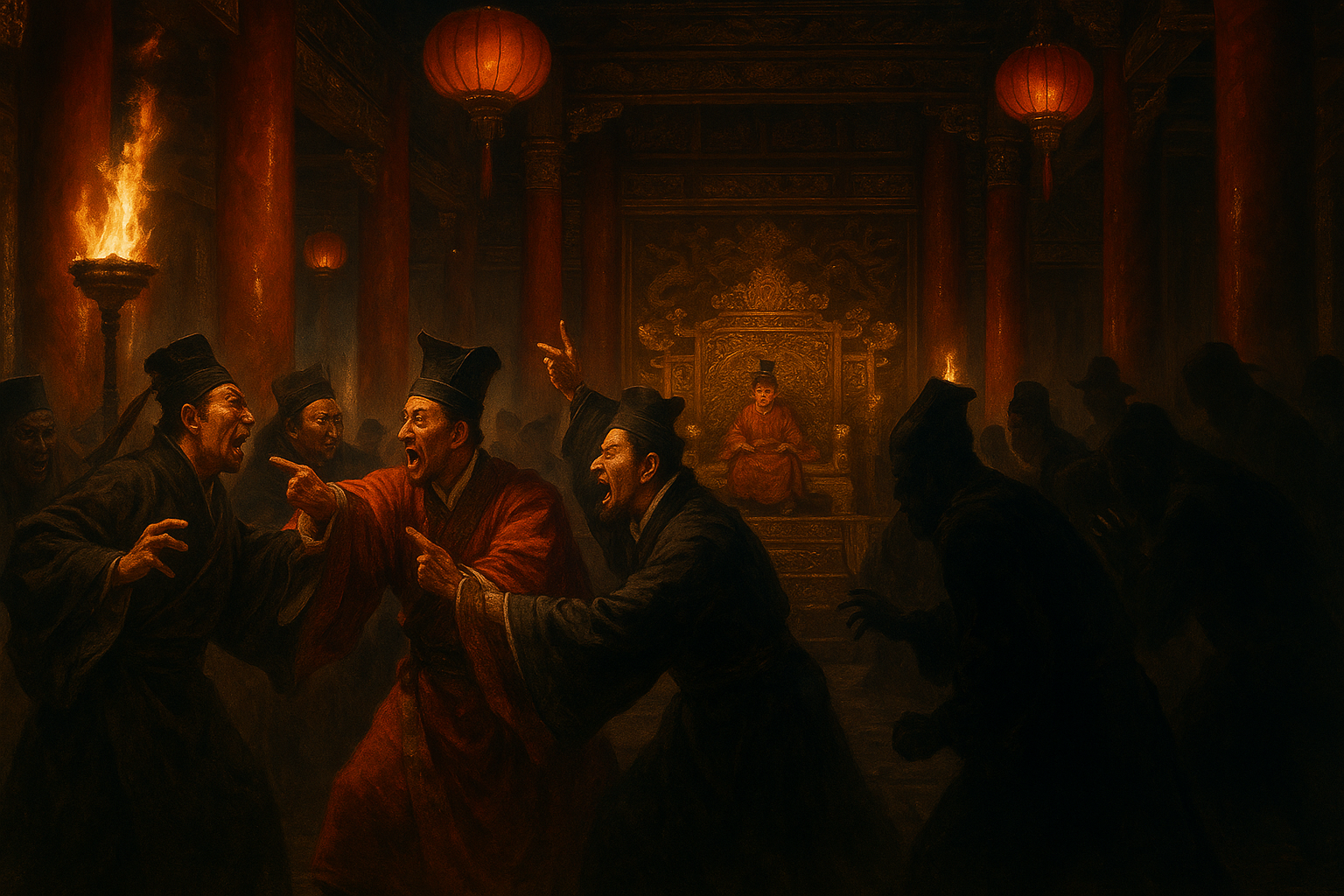
Here, across the gulf of eighteen centuries, the parallel is so precise it’s chilling. A government unable to perform its most basic function: to fund itself. A political system so poisoned by factionalism that compromise is seen as treason. A nation adrift, while its leaders engage in a self-serving power game.
In Han China, the breaking point came with a single, disastrous decision. The leader of the scholar-official faction, the General-in-Chief He Jin, decided to break the deadlock by summoning a battle-hardened warlord, Dong Zhuo, to the capital with his army. The plan was to intimidate the eunuchs into submission.
It was like trying to put out a fire with gasoline. The eunuchs discovered the plot and, in a desperate act of self-preservation, lured He Jin into the palace and murdered him. The capital exploded. He Jin’s allies, led by the ambitious Yuan Shao, stormed the palace, slaughtering every eunuch they could find.
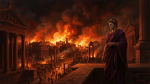
Into this bloody chaos rode Dong Zhuo. He found a city in flames and a government in tatters. He found the young boy-emperor and his little brother, terrified and alone, and he saw his opportunity. He seized control of the capital, kidnapped the emperor, and declared himself the supreme power in the land. When the coalition of other warlords rose against him, he burned the magnificent capital of Luoyang to the ground, forcing the entire imperial court to flee west to his stronghold in Chang’an. The Han Dynasty, as a functioning state, was finished. China fractured into warring kingdoms, and an age of unimaginable suffering began.
The Pattern Recognition
Why does this pattern repeat? Why do great powers, separated by millennia and oceans, fall into the same trap? The answer lies in a timeless truth about human nature and the nature of power.
When a government loses the ability to perform its core functions—to collect revenue, to provide for the common defense, to ensure domestic tranquility—it creates a power vacuum. When political factions come to believe that their own victory is more important than the stability of the system itself, they will tear that system apart to win.
In both 189 CE China and 2025 America, the machinery of government was deliberately jammed by insiders for political gain. The long-term consequences were an afterthought. The immediate goal was to deny the other side a victory, even if it meant bringing the whole house down. This is the moment when a republic becomes vulnerable, when the institutions that are meant to contain conflict become the instruments of it. External forces—whether a warlord like Dong Zhuo or an economic crisis born of inaction—are always waiting to exploit the weakness created by internal division.
The Ancient Warning
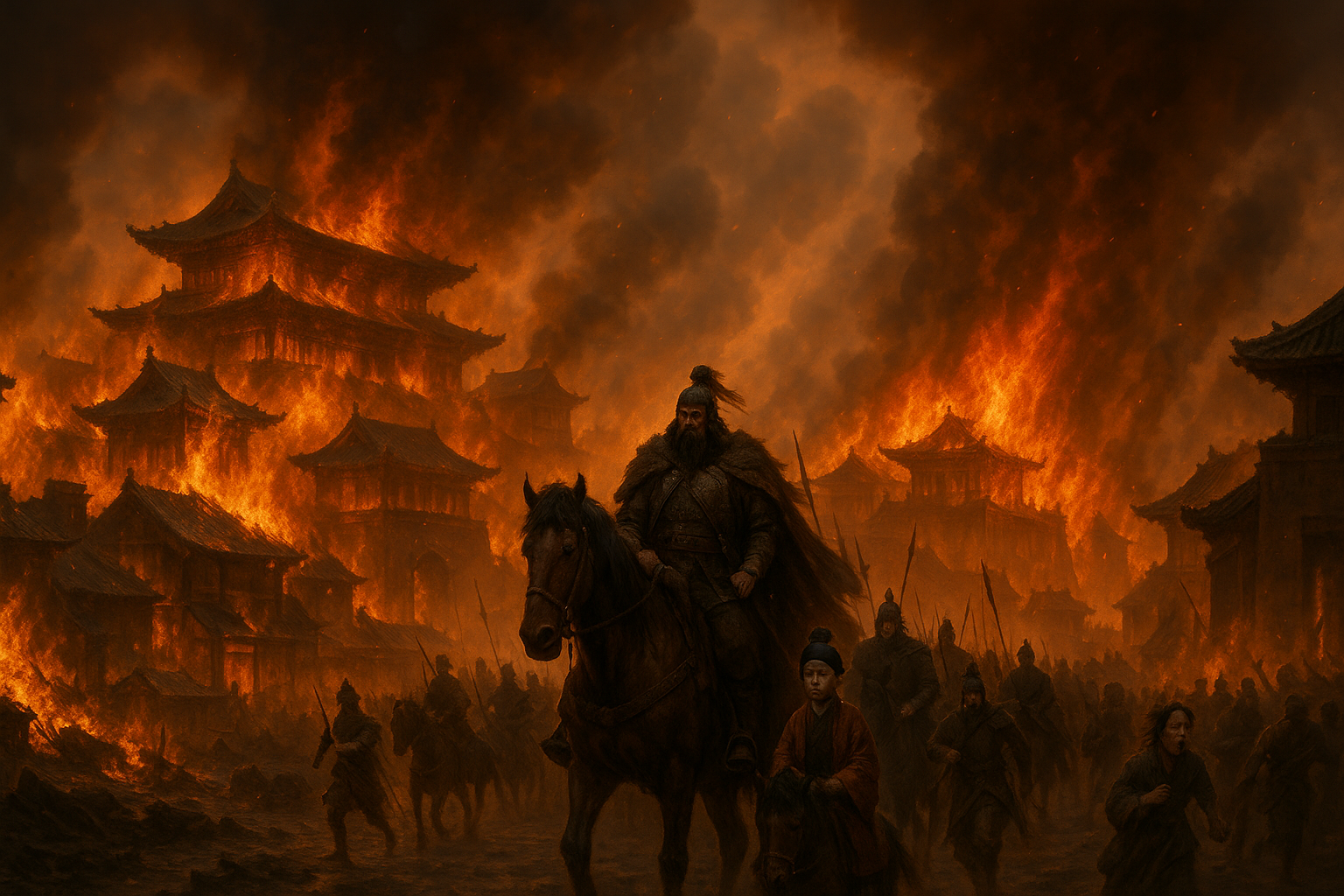
What happened after Dong Zhuo burned Luoyang? Four hundred years of chaos. The period known as the Three Kingdoms was an era of constant, brutal warfare. The population of China plummeted by tens of millions through battle, famine, and disease. Great cities were turned to rubble. The economic and cultural achievements of the Han were lost for generations.
It took centuries for China to be reunified, centuries to rebuild what was destroyed in a few short years of political madness. The ancient warning is this: when a government willingly chooses paralysis, it invites collapse. When the people who are entrusted with power prioritize their own ambitions over the good of the nation, they set the stage for a tragedy of epic proportions. The collapse is not always a sudden, violent event. Sometimes, it begins with a quiet refusal to govern, a slow, grinding halt of the essential machinery of state.
5 Things You Can Do This Week
History is not a spectator sport. It is a warning. The patterns are clear, and the stakes are higher than ever. Here are five practical steps you can take this week to build your own resilience, to create your own pocket of stability in an increasingly unstable world.
- Build Your Personal Food Supply: The government shutdown is a stark reminder that complex supply chains are fragile. Don’t wait for empty shelves. Learn how to build a three-month emergency food supply for your family. Discover the simple, step-by-step guide on Homesteader Depot.
- Create a Second Income Stream: Relying on a single paycheck, especially one tied to a dysfunctional system, is a risky game. It’s time to take control of your financial destiny. Explore proven strategies for building self-reliant income streams at the Self-Reliance Report.
- Master One New Survival Skill: When the system fails, practical skills become more valuable than gold. This week, learn one new thing: how to purify water, how to start a fire without matches, or basic first aid. Survival Stronghold offers free guides for beginners.
- Take Control of Your Health: Our healthcare system is already under strain. A wider crisis would make it inaccessible for many. It’s time to focus on proactive, natural health solutions that don’t rely on a fragile system. Freedom Health Daily is your source for independent health knowledge.
- Strengthen Your Local Community: In a crisis, your most valuable asset is your neighbors. Get to know them. Build a network of mutual support. A strong community is the ultimate insurance policy against systemic collapse.
SPONSOR: The 4ft Farm Blueprint
Worried about the next food shortage? The government has proven it can’t even keep its own doors open, let alone guarantee the food on your table. The 4ft Farm Blueprint is your declaration of independence. This revolutionary system shows you how to turn a tiny 4×4 foot space into a high-yield food-producing powerhouse. No back-breaking work. No complicated setup. Just a steady, reliable source of fresh, healthy food for your family, no matter what happens in Washington.
Click Here to Get Your 4ft Farm Blueprint and Secure Your Food Freedom Today!