

The U.S. national debt just breached $39 trillion.
To service that debt, the Treasury is now paying over $1.2 trillion a year in interest alone. That is more than we spend on national defense. It is more than we spend on Medicare.
We are borrowing money just to pay the interest on the money we already borrowed.
At the same time, the U.S. is burning between $1 billion and $2 billion every single day to fund the ongoing conflict in Iran. Oil prices have surged past $106 a barrel, driving up the cost of everything from groceries to gasoline.
To offset the bleeding, the government has slashed over 260,000 federal jobs, gutting scientific and administrative expertise built over decades.
We are watching a superpower try to cut its way out of a structural collapse.
The assumption in Washington is that the United States is simply too big, too wealthy, and too central to the global economy to fail. They believe our immense wealth will insulate us from the consequences of our endless spending.
But history proves otherwise.
The most terrifying parallel to America’s current crisis isn’t found in Rome or London. It is found in the sprawling plains of 17th-century India.

The Empire That Owned the World
In the late 1600s, the Mughal Empire was the undisputed economic engine of the globe.
Stretching across modern-day India, Pakistan, and Bangladesh, the Mughals ruled over 150 million people. They controlled the most lucrative trade routes on earth, exporting silk, spices, and textiles to every corner of the known world.
At its peak, the Mughal Empire accounted for a staggering 25% of the world’s total GDP.
They were wealthier than all the kingdoms of Europe combined. Their capital cities were marvels of architectural brilliance, funded by a treasury that seemed bottomless.
They believed their wealth made them invincible.
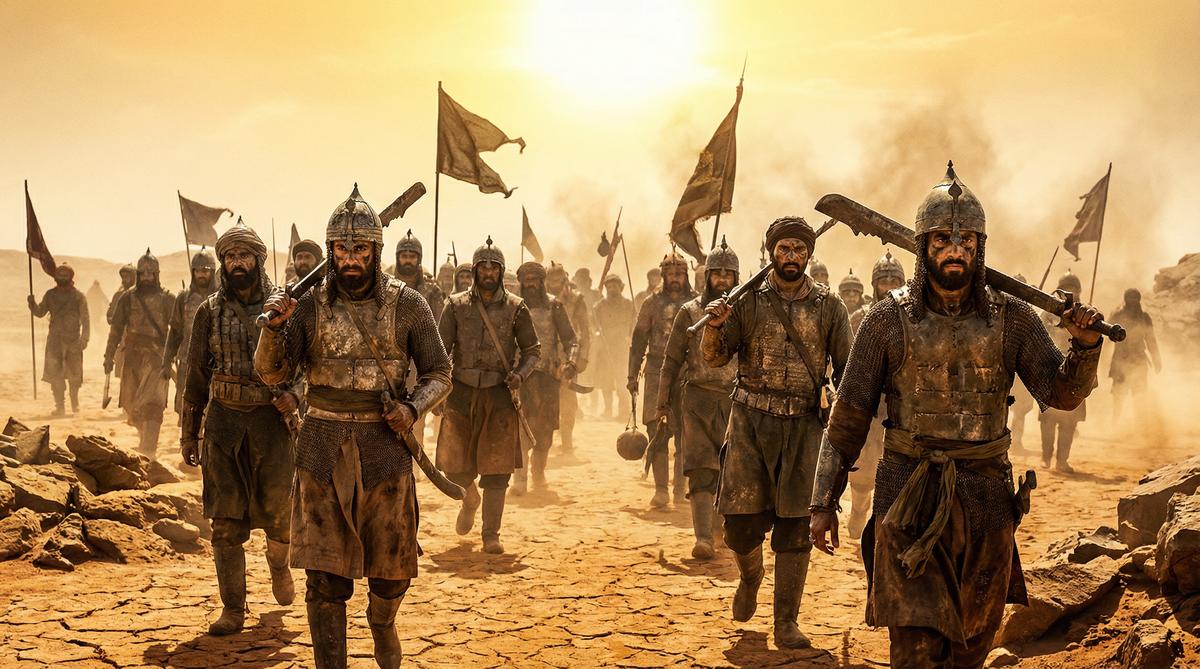
But under the rule of Emperor Aurangzeb, the empire made a fatal miscalculation. Instead of consolidating their wealth and investing in their infrastructure, they embarked on a massive, endless military campaign.
Known as the Deccan Wars, this conflict lasted for 27 grueling years.
Aurangzeb was determined to conquer the southern territories, regardless of the cost. He poured the empire’s vast resources into a war of attrition against the Marathas, a resilient and decentralized enemy that refused to surrender.
The Cost of Endless War
The military won battles, but the economy was dying.
To fund his endless wars, Aurangzeb squeezed his citizens dry. He raised taxes to crushing levels, destroying the agricultural base that had made the empire so prosperous.
“In 27 years of the Deccan Wars, Aurangzeb bled the Mughal treasury white. The empire never recovered from the financial exhaustion.” — Historian William Dalrymple
As the treasury emptied, the empire began to fracture.
Provincial governors, seeing the weakness of the central government, stopped sending tax revenues to the capital. They began acting as independent warlords, prioritizing their own survival over the survival of the empire.
The political class was paralyzed by infighting.
Aurangzeb had also alienated his own people. He imposed strict, orthodox religious laws, persecuting the Hindu, Sikh, and Shia majorities that made up the backbone of his empire.
He chose ideological purity over national unity, fracturing the very coalition that had built the empire.

When Aurangzeb finally died in 1707, his last words were a haunting admission of failure: “I came alone and I go as a stranger. I do not know who I am, nor what I have been doing.”
Within a decade of his death, the wealthiest empire on earth had completely disintegrated. In 1719 alone, four different emperors ascended the throne in a chaotic succession crisis.
They weren’t defeated by a superior military force. They were defeated by their own economic exhaustion and internal division.
The Modern Mirror
Look at the United States today.
We are currently burning billions of dollars a day in the Middle East, fighting a war of attrition that has no clear end in sight. Our national debt has reached a level that is mathematically impossible to repay.
The parallels are not subtle.
Just like the Mughals, we are squeezing our citizens to fund our overextension. The average American household is being crushed by inflation, rising energy costs, and a rapidly devaluing currency.
Goldman Sachs has raised U.S. recession odds to 30%. Moody’s Analytics warns of a 49% chance of an economic downturn in the next 12 months. The U.S. dollar has dropped 10% since the start of Trump’s second term.
We are watching the real-time exhaustion of the American economic engine.
And just like the Mughals, our political class is completely disconnected from the reality facing the citizens they claim to represent. We are fractured by endless culture wars and ideological polarization, destroying the national unity required to survive a crisis.
The BRICS nations are already building alternatives to the U.S. dollar, sensing the weakness of our financial system.
When the treasury is empty, the empire falls.
The Hidden Cost of Complacency
The greatest danger right now is the belief that things will eventually “go back to normal.”
We are conditioned to trust the system. We assume that the grocery store shelves will always be stocked, that the power grid will always stay on, and that our dollars will always hold their value.
But normalcy is an illusion funded by debt.
When the debt bubble finally bursts, the transition will not be slow or polite. It will be sudden, chaotic, and brutal.
The psychological cost of inaction is the realization, too late, that you trusted a system that was mathematically guaranteed to fail.
If you wait for the government to announce the collapse, you have already lost. The time to build your personal infrastructure is right now, while the illusion of normalcy still exists.
Building Your Own Fortress
The people who survived the fall of the Mughal Empire weren’t the elites in the capital. They were the local producers, the farmers, and the self-reliant communities who didn’t depend on the central government for their survival.
You must become your own central bank, your own grocery store, and your own first responder.

Start by securing your physical health and mental resilience. The Seven Holistics approach and the daily intelligence from Freedom Health Daily and Freedom Health Alerts are essential for maintaining peak performance during high-stress transitions.
You cannot protect your family if your own health is failing.
Next, secure your food supply. The 4 Foot Farm Blueprint provides the exact framework for generating massive caloric output from minimal space. Combine this with the hard-skills training at Homesteader Depot to build a truly resilient homestead.
Finally, stay ahead of the macro trends. The American Downfall team will continue to track the historical parallels, while The Ready Report and Self Reliance Report provide the tactical, day-to-day intelligence you need to navigate the coming chaos.
For those looking to understand the deeper economic cycles driving this collapse, The Pattern Ledgers offers the advanced analysis required to protect your wealth.
The empire is bleeding out. Make sure you aren’t bleeding with it.