
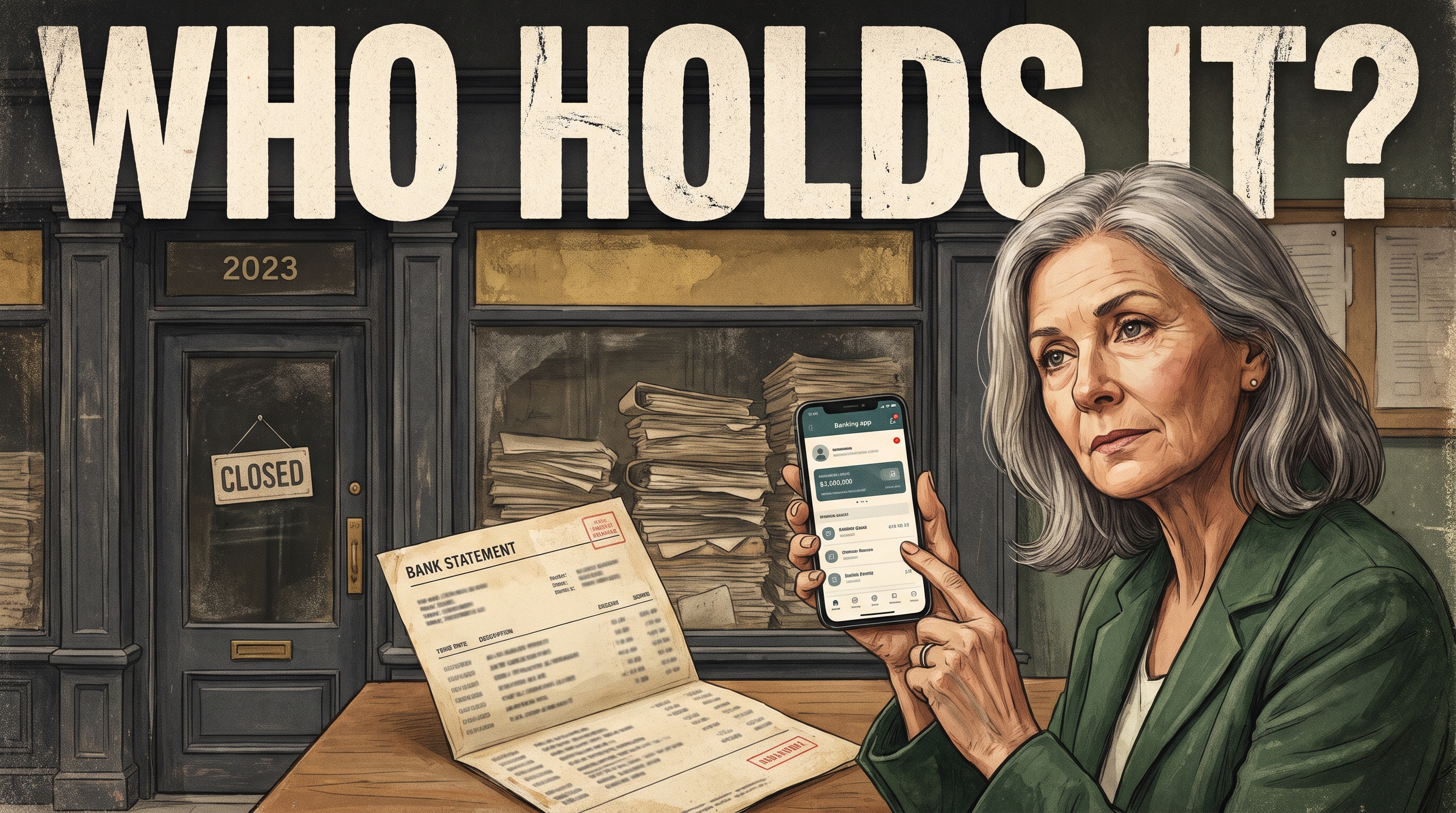
Your Daily Install connects what’s happening now with a useful pattern from the past—and one simple step you can take today to make your household more resilient.
Print the action worksheet below, fill it in, and add it to your Household Resilience Network binder.
What’s happening now?
On October 23, the University of Michigan’s final consumer survey put October sentiment at 48.0—almost unchanged from September. People’s views of their buying power remained weak.
When money already feels tight, vague reassurance does little. One useful move is to check a fact about money you already have: who is actually holding it?
An app can make a balance easy to see. It does not, by itself, tell you whether you are dealing with a bank or another company that uses a bank.
Has this happened before?
In March 2023, Silicon Valley Bank lost more than $40 billion in deposits in one day, the Federal Reserve later reported. A large group of customers moved quickly as worries spread.
The bank failed. Over the weekend, officials had to settle a very practical question for depositors: would their money be available on Monday?
The names on the accounts and the rules behind those accounts mattered more than the look of a banking screen.
What happened next?
On March 12, regulators announced that all of that bank’s depositors would be protected and could access their money on March 13. That was an exceptional action, not a new promise for every product or app.
The pattern is to check the rules before you need them. FDIC guidance says a nonbank app is not itself an FDIC-insured bank. Funds placed at a partner bank may qualify for coverage only when the required conditions are met. Bank-failure insurance does not cover the app company’s own failure.
Before moving retirement money, ask these.
You worked for that nest egg. Before anyone talks you into a gold IRA, get the questions you should ask first.
Tap Here to Request the Free Gold IRA Kit →What can I do?
Use 15 minutes to check one account. Open its official statement or account terms. Find the legal bank name, the kind of account and any deposit-insurance explanation.
Check that bank through the FDIC’s official BankFind tool. Credit unions use a different federal insurer, NCUA. If you use an app, ask where funds are held and how any insurance applies.
Write the bank name and the question still to resolve. Keep account numbers and passwords off this sheet. Do not move money based on a rumor or this article; get the facts from the institution first.
Illustrative household example. Use the worksheet for your own details.
My Account-Backing Check
Date: __________ File under: Money & Records
1. Identify it
App / account label:
Legal bank or credit union name:
☐ Found in official terms or statement
2. Check the record
☐ BankFind checked ☐ NCUA check needed
Date checked:
Deposit-insurance explanation found:
3. Ask one clear question
Where are the funds held?
What conditions apply?
Official contact I will use:
4. Keep the result
☐ Bank identified ☐ Question sent
Next follow-up date:
Today’s win: You know the institution behind one balance—or have one precise question ready for its official support team.
Before you buy more backup gear…

The flashlight works. The rest of the room is still dead. What is the next step beyond another pack of batteries?
A veteran’s battery-backup guide takes the do-it-yourself route. Start with the idea, the parts and the plans.
Tap below for the opening video. See what this build involves before buying another piece of backup gear.
| Tap Here to See the Battery-Backup Idea → |
Stay steady,
Seamus Gerry III
American Downfall
P.S. Have you ever had to hunt for the bank behind an app? Hit reply without sharing account details. Forward this to someone who uses a money app as their main wallet.
P.P.S. One useful next read from the Household Resilience Network: Self-Reliance Install: Reorder Before the Last Scoop.
Want a small food win at home? Tap Here for the Free Small-Space Food Quickstart →