

A special report from Shamus Gerry III
Just hours ago, a chilling headline crossed the wires: “We’re in an Era of Political Violence.”
It wasn’t from some fringe blog. It was from the Wall Street Journal.
They wrote what many of us have been feeling in our bones: our institutions are failing, our culture is fracturing, and the very fabric of our nation feels like it’s tearing at the seams.
This isn’t just about protests or riots anymore. It’s about a deeper, more corrosive decay. A loss of faith in the system itself.
And when that faith dies, history teaches us that something far more dangerous takes its place.
This isn’t a new story. It’s a pattern as old as civilization itself. And to understand what’s happening in America today, we need to travel back in time, not to Rome or Greece, but to a place and a time you’ve likely never heard of.
We need to go to the city of Samarra, in the heart of the Islamic Golden Age, and witness a nine-year period of chaos so bloody, so complete, that it has a name: The Anarchy at Samarra.
The Time Portal: Samarra, 861 CE
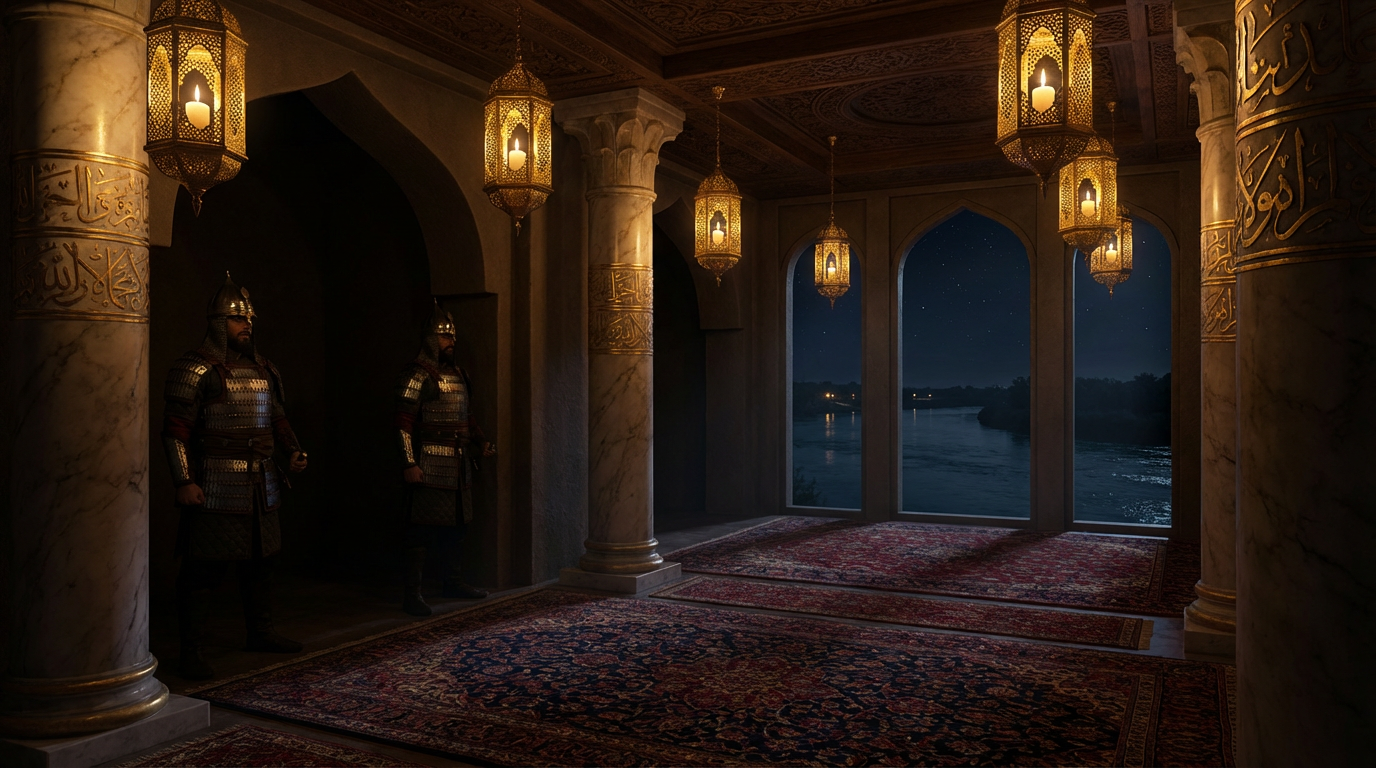
Imagine a city of unimaginable wealth and splendor. A glittering jewel on the banks of the Tigris River. This was Samarra, the capital of the mighty Abbasid Caliphate.
For a century, the Abbasids had ruled over a vast empire stretching from North Africa to Central Asia. They were the patrons of science, art, and philosophy. Their capital, Baghdad, was the largest and richest city in the world.
But in the 9th century, a fatal flaw was introduced into the system. The Caliphs, seeking to protect themselves from the shifting loyalties of Arab and Persian factions, began to rely on a new force: elite Turkish slave soldiers.
These were the most formidable warriors of their time. Fiercely loyal, disciplined, and deadly. They were the Caliph’s personal bodyguards, his Praetorian Guard.
But what happens when the protectors become more powerful than the protected? What happens when the bodyguards realize they are the ones who truly hold the power?
In 861 CE, they found out.

Caliph al-Mutawakkil, a ruler known for his piety and his cruelty in equal measure, made a fatal miscalculation. He had grown too comfortable, too arrogant. He had alienated his own son, and he had pushed his Turkish guards too far.
On a cold December night, as the Caliph drank with his closest companions, a group of Turkish officers burst into the chamber. The Caliph’s own son, al-Muntasir, stood aside and watched as his father was cut down.
It was the first time in the history of the Caliphate that a ruler had been assassinated by his own troops.
It would not be the last.
The Parallel Revelation: A Cascade of Chaos
The murder of al-Mutawakkil was the spark that lit the powder keg. The Turkish guards, having tasted power, were not about to give it up.
What followed was a horrifying nine-year spiral of violence and betrayal.
- Caliph #1: Al-Muntasir (861-862 CE) – The son who had conspired to kill his father lasted only six months. He died of a mysterious illness, likely poisoned by the very Turkish commanders who had put him on the throne.
- Caliph #2: Al-Musta’in (862-866 CE) – A puppet of the Turkish generals, he tried to escape their control by fleeing to Baghdad. The Turkish army simply appointed a new Caliph, besieged Baghdad, and forced his surrender. He was exiled and then, inevitably, executed.
- Caliph #3: Al-Mu’tazz (866-869 CE) – An energetic and determined ruler, he made a valiant effort to restore the authority of the Caliphate. He tried to divide the Turkish factions and reassert civilian control. For his efforts, he was dragged from his palace, beaten, and left to die of thirst in the scorching desert sun.
- Caliph #4: Al-Muhtadi (869-870 CE) – A man of piety and courage, he also tried to stand up to the military. He was captured, tortured, and killed within a year.
Four Caliphs in nine years. Each one a victim of the very forces that were supposed to protect them.
The Anarchy at Samarra was a complete and total breakdown of institutional authority. The Caliphate, once the most powerful and stable empire in the world, had become a plaything of rival military factions. The government ceased to function. The provinces broke away. The empire began to crumble.
The Pattern Recognition: The Poison of Political Violence

What happened in Samarra is a timeless lesson in the fragility of civilization.
It shows us that when political violence becomes a tool for acquiring and maintaining power, it creates a self-perpetuating cycle of destruction.
Once the taboo of assassinating a leader was broken, it became easier and easier to do it again. Each murder set a new, lower standard for political conduct. Each betrayal paved the way for the next.
The Turkish guards were not evil men, at least not at first. They were soldiers, doing their duty. But when they saw that the system was weak, that the leaders were corrupt, and that they held the real power, they took it.
And why wouldn’t they? Human nature doesn’t change. Greed, ambition, and the thirst for power are eternal.
When the institutions that are meant to channel and control these impulses begin to fail, the result is always the same: chaos.
Today, in America, we are seeing the same warning signs.
The normalization of political violence. The erosion of trust in our institutions. The rise of factionalism and tribalism. The sense that the system is rigged and that the only way to win is to break the rules.
We are not yet at the point of assassinating our leaders in the halls of power. But the trajectory is deeply, deeply troubling.
The Ancient Warning: What Comes Next
The Anarchy at Samarra was not just a temporary crisis. It was a mortal wound from which the Abbasid Caliphate never truly recovered.
The nine years of chaos shattered the prestige and authority of the central government. It emboldened secessionist movements in the provinces. It drained the treasury and crippled the economy.
While the Caliphate would limp on for another four centuries, it was a shadow of its former self. The Islamic Golden Age was over.
The lesson is clear: when a civilization turns on itself, when it devours its own leaders and institutions, it loses the ability to project power, to maintain order, and to provide for its people.
It becomes a failed state.
5 Things You Can Do This Week to Prepare
History is not a spectator sport. It is a living, breathing force that is shaping our lives every day. The patterns of the past are a roadmap to the future, and they are telling us that we need to be prepared.
Here are five things you can do this week to build your own personal resilience and self-reliance, inspired by the lessons of history:
- Secure Your Food Supply: The chaos in Samarra led to widespread economic collapse and food shortages. Don’t wait for the shelves to go bare. Learn how to grow your own food, even in a small space. The 4ft Farm Blueprint is the single best guide to creating a high-yield, low-maintenance food source for your family. It’s not just a garden; it’s an insurance policy against a fragile system.
- Build Your Community: When the central government fails, your local community is all you have. Get to know your neighbors. Build relationships. Create a network of mutual support. Check out Homesteader Depot for ideas on how to build a resilient homestead and community.
- Learn a Real Skill: In a crisis, practical skills are worth more than gold. Learn how to purify water, administer first aid, or defend your home. Self Reliance Report is an invaluable resource for learning the skills you need to survive and thrive in any situation.
- Protect Your Health: A health crisis can be just as devastating as a political one. Take control of your own health and wellness. Explore natural and holistic approaches to healing. Seven Holistics offers a wealth of information on how to build a strong and resilient body and mind.
- Stay Informed, Not Indoctrinated: The mainstream media is not your friend. They are part of the system that is failing. Seek out alternative sources of information and learn to think for yourself. Survival Stronghold provides a daily dose of uncensored news and analysis that you won’t find anywhere else.
History is knocking. It’s time to answer the door.


