
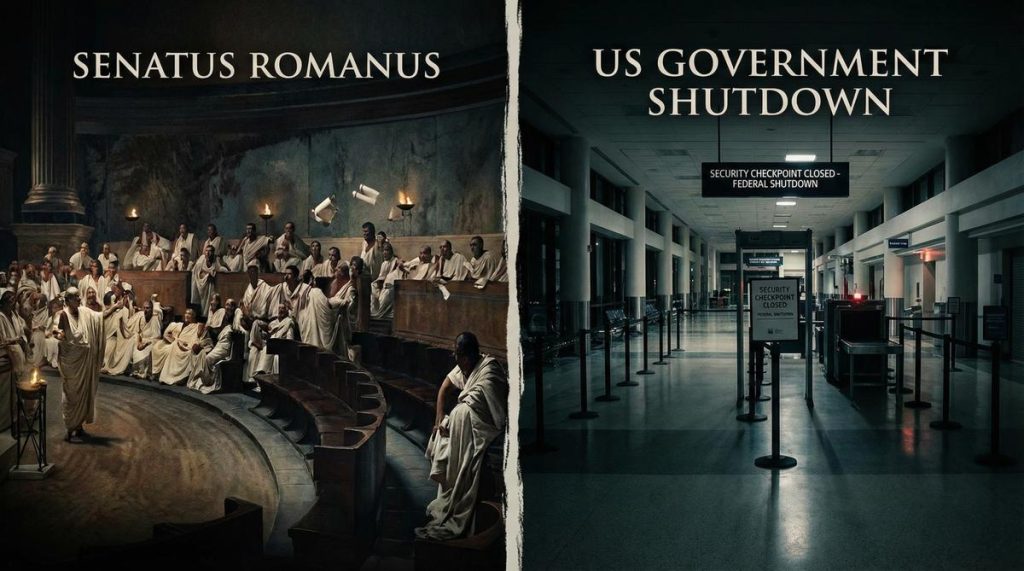
As of this week, the United States government is paralyzed by a shutdown that is rapidly approaching the second-longest in American history.
Over 50,000 TSA agents are working without pay. The Department of Homeland Security is warning that small airports across the country may soon be forced to close entirely.
The gears of the American state are grinding to a halt.
In Washington, lawmakers remain deadlocked in a bitter partisan fight over DHS funding, completely detached from the real-world consequences playing out in airports and border checkpoints. The system is no longer functioning to serve the people. It is functioning only to serve the political factions fighting for control over it.
We have seen this exact form of institutional suicide before. It is not a story of foreign invasion or economic collapse, but of a government that simply forgot how to govern.
It is the story of the Roman Republic.
The Paralysis of an Empire
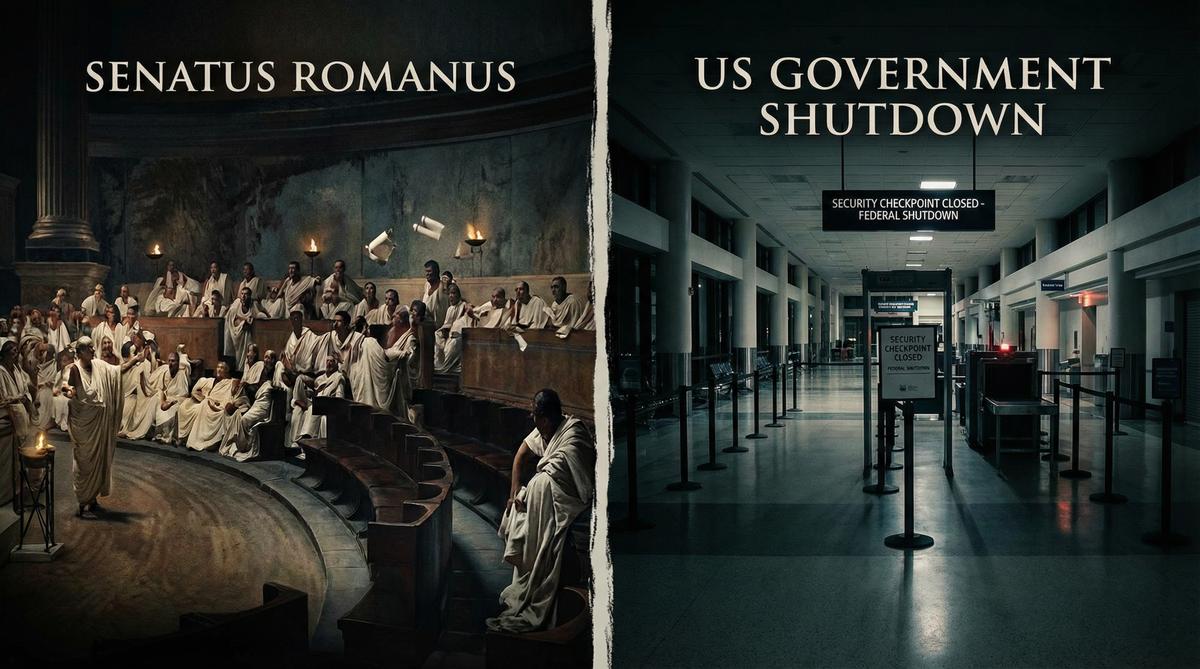
Two thousand years ago, the Roman Republic was the most sophisticated political system the world had ever seen. It was built on a complex web of checks and balances, designed specifically to prevent any one man or faction from gaining too much power.
For centuries, this system worked brilliantly. The Senate debated, the assemblies voted, and the Republic expanded its reach across the Mediterranean.
But then, the unwritten rules began to break down.
In the late 2nd century BC, Roman politics became infected by a toxic factionalism. Politicians stopped viewing their opponents as colleagues with differing views, and started viewing them as existential enemies that had to be destroyed at all costs.
The political process became a weapon of mutual destruction.
Tribunes began using their veto power not to protect the people, but to completely paralyze the government. They blocked every piece of legislation, shut down the courts, and refused to allow elections to proceed until their specific demands were met.
“The Republic was torn apart not by foreign armies, but by its own leaders, who chose to burn the system to the ground rather than share power within it.”
The Roman government experienced its own version of a shutdown. Essential services were halted, the military went unpaid, and the streets of Rome descended into chaos as political gangs fought for control.
The Cost of Gridlock
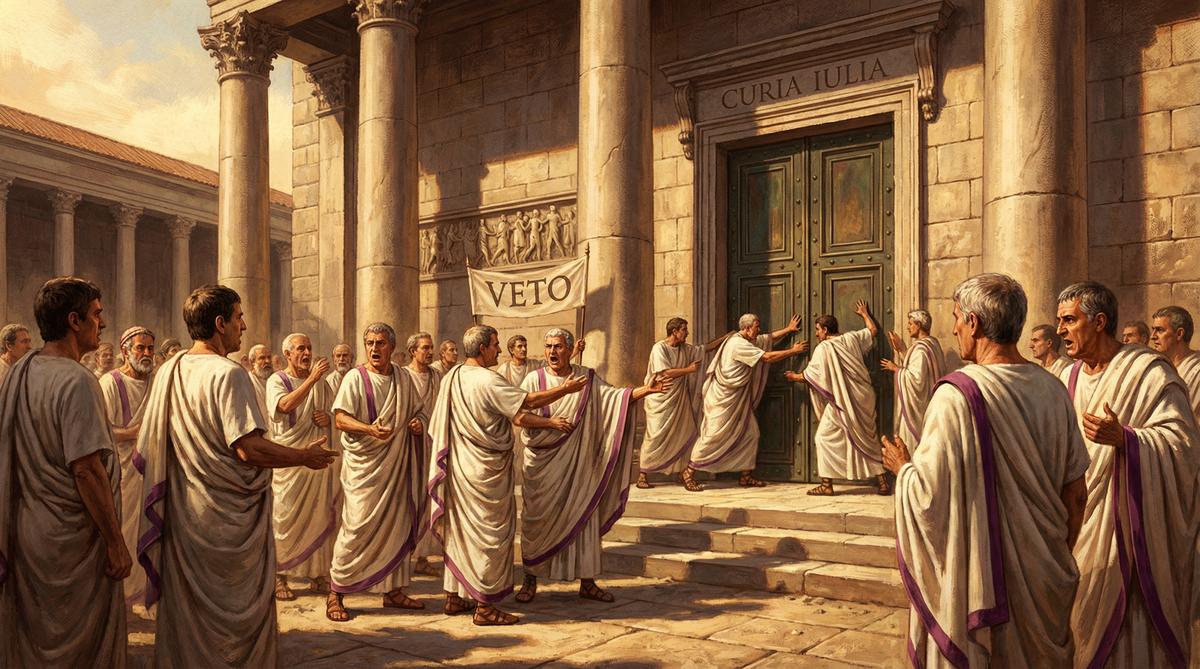
The Roman people watched in horror as their once-great institutions became entirely dysfunctional. The Senate, once revered as the guiding light of the Republic, became a theater of absurd political performance and endless gridlock.
The system was no longer capable of solving problems. It was only capable of creating them.
Because the government was paralyzed, the real power shifted away from the institutions and into the hands of ambitious individuals who promised to cut through the red tape. Men like Julius Caesar realized that the people were so exhausted by the political dysfunction that they would willingly trade their Republic for a dictator who could simply get things done.
The Republic didn’t fall because it was conquered. It fell because it stopped working.
Today, we are watching the exact same institutional breakdown play out in real-time. The current government shutdown is not an anomaly. It is the logical conclusion of a political system that has prioritized factional warfare over basic governance.
When TSA agents go unpaid and airports are threatened with closure, it is a glaring signal that the American political machine is breaking down at its core.
The American Mirror
The parallels are not metaphorical. They are structural.
The Roman Republic’s tribunes weaponized the veto to paralyze governance. Today, Senate procedural rules are used in exactly the same way — not to protect the people, but to extract political concessions while essential services collapse.
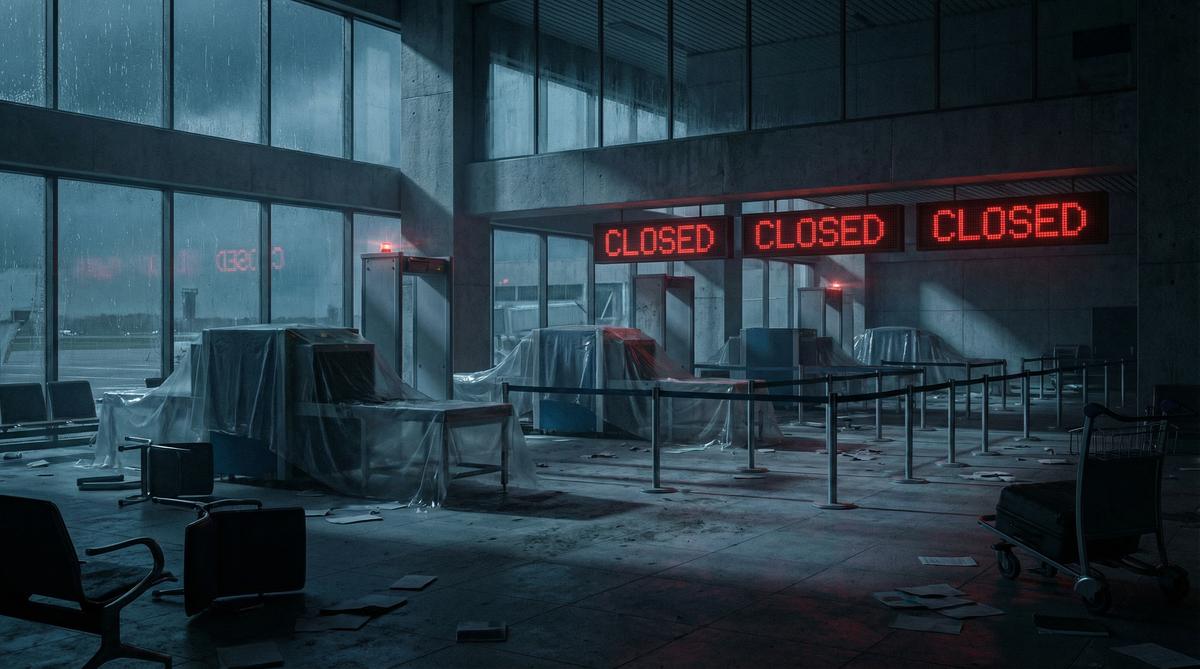
The DHS shutdown has now lasted 32 days. 120,000 federal employees are working without pay. Spring break travelers are facing hours-long security lines. Small regional airports face permanent closure.
And in Washington, the debate continues.
The Roman people eventually grew so tired of the dysfunction that they welcomed Caesar with open arms. Not because they wanted a dictator, but because they were desperate for a government that could simply function. History does not remember this as a triumph. It remembers it as the death of a Republic.
The question is not whether our institutions are failing. The question is what we are going to do about it.
The Path to Resilience
It is easy to look at the paralysis in Washington and feel a profound sense of despair. To see the institutions we rely on crumbling under the weight of political gridlock.
But history teaches another, more powerful lesson.
When the great, centralized systems fail, they create a vacuum. And into that vacuum rushes the opportunity for something new. The survivors of the Roman Republic’s collapse weren’t the ones who simply waited for the Senate to fix things. They were the ones who rebuilt, who focused on their local communities, who strengthened their own skills, and who created resilient networks of mutual support.
This is not a call to hide from the world as the political system fractures. It is a call to build a better one, starting in your own backyard.
The Roman farmers who tended their land through the chaos of the late Republic were the ones who fed their families when the grain dole stopped. The craftsmen who built local trade networks were the ones who prospered when the central economy seized up. They didn’t wait for the Senate to save them. They saved themselves.
That same choice is available to you right now.
The Blueprint for Hope
Building a resilient future starts with a single, powerful step: taking control of your own life and reducing your dependence on a dysfunctional system.
The 4ft Farm Blueprint is not just about survival. It’s about sovereignty. It’s the first chapter in your family’s story of independence — a story where you are the builder, not the victim of someone else’s political theater.
While the political factions fight over the scraps of a paralyzed government, the earth remains. The ability to grow your own food, to provide for your family, to build a community of like-minded individuals — these are the things that endure. These are the skills that will see you through the coming storm.
Learn more about how you can build your own personal ark of resilience:
- 4ft Farm Blueprint — The complete guide to food self-sufficiency.
- Homesteader Depot — Tools and supplies for the modern homesteader.
- Self Reliance Report — News and analysis for the prepared citizen.
- Survival Stronghold — In-depth guides to surviving any crisis.
- Seven Holistics — Health and wellness for a resilient life.
- The Ready Report — Stay informed, stay prepared.