
The clock is ticking on the most dangerous deadline of the decade.
Today, April 7, 2026, marks the expiration of President Trump’s ultimatum to Iran: reopen the Strait of Hormuz, or face the obliteration of the country’s power plants and bridges.
The global economy is holding its breath.
Roughly 20% of the world’s daily oil supply remains trapped behind a geopolitical wall. The economic shockwaves are already tearing through the system.
Crude oil has surged past $100 a barrel. U.S. jet fuel prices have skyrocketed. Across Europe and Asia, governments are implementing emergency fuel rationing.
Meanwhile, the U.S. is burning $1 billion a day on military operations in the Middle East, while staring down a $39 trillion national debt and a new 15% global blanket tariff.
The American consumer is being squeezed from every direction.
We are watching a superpower overextend its military to control a vital waterway, only to trigger an economic crisis at home.
It feels like a modern disaster. But it is an ancient pattern.
The Empire That Conquered the Seas (And Lost Its Soul)
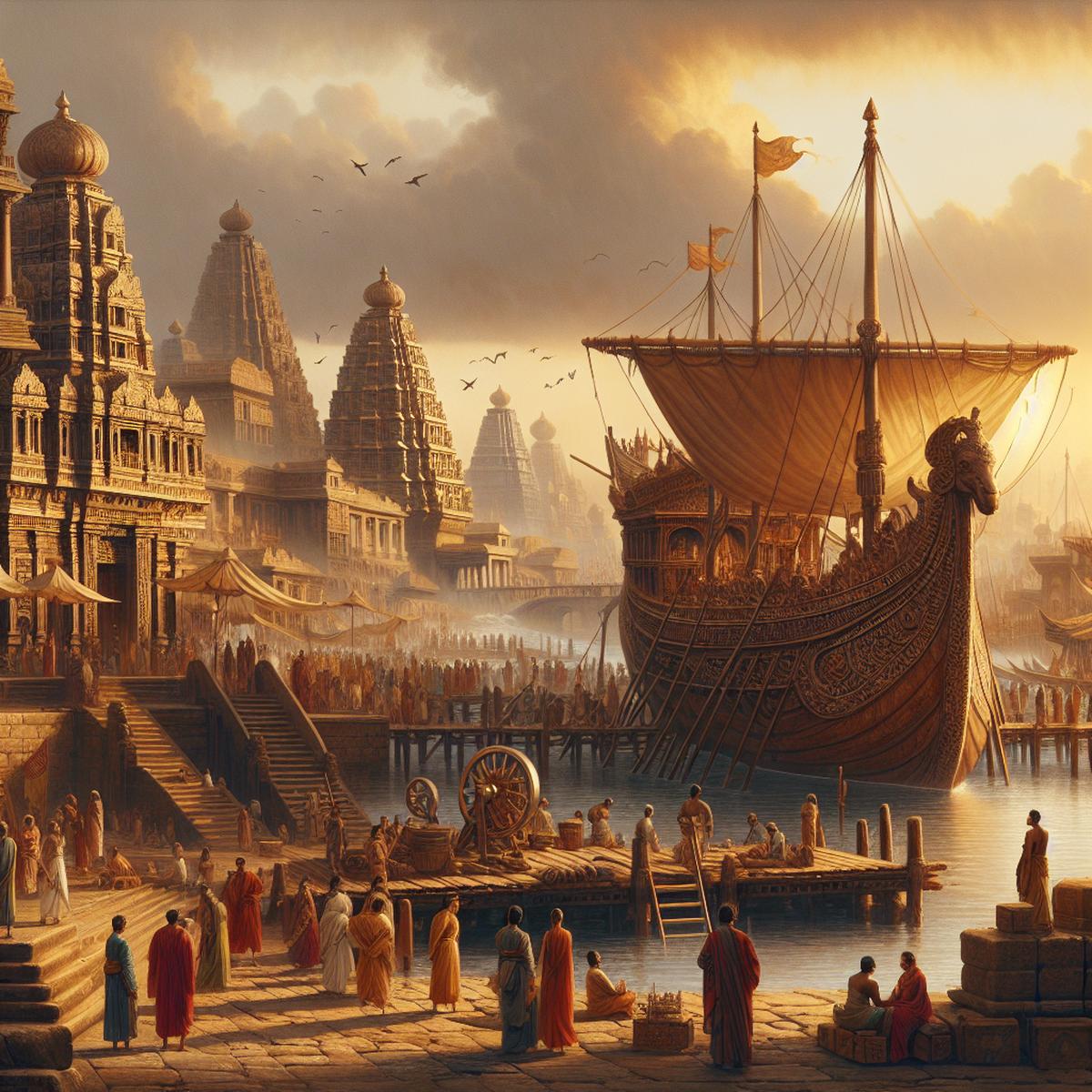
In the 11th century, the Chola Empire was the undisputed master of South Asia.
Originating in the fertile Kaveri River valley of modern-day Tamil Nadu, the Cholas built a maritime empire that stretched across the Bay of Bengal. They were the first Indian dynasty to project naval power overseas — a feat that made Rome and the Tang Dynasty take notice.
Under Emperor Rajendra Chola I, the empire was an economic juggernaut. By controlling the vital maritime arteries of the Indian Ocean, the Cholas dominated global trade, moving spices, textiles, and precious metals between China, Southeast Asia, and the Middle East.
At its peak, the Chola Empire’s navy had launched raids on 14 major port cities across Southeast Asia — from Palembang to Kedah — making it the most powerful maritime force in the Indian Ocean world. (Wikipedia: Chola dynasty)
But then, the Cholas made a fatal miscalculation.
The Cost of Imperial Overreach
In 1025 AD, Rajendra Chola launched a massive naval invasion of the Srivijaya Empire in modern-day Indonesia and Malaysia.
The goal was simple: secure the lucrative trade routes and punish a rival power threatening Chola commercial interests. The military campaign was a stunning success. The Chola navy captured the Srivijayan king, plundered 14 major port cities, and established a dominant presence in Southeast Asia.
But the economic cost was catastrophic.
The Chola military, once a lean and effective force, became bloated and ruinously expensive. The empire was forced to maintain a massive standing navy and army to project power thousands of miles from home.
To fund these endless overseas campaigns, the Chola emperors squeezed their citizens dry. Taxes were raised to crushing levels. The agricultural base — the true source of the empire’s wealth — was neglected in favor of military spending.
As the economy faltered, internal revolts erupted. The Pandyas, a rival dynasty that the Cholas had subjugated centuries earlier, began to rise again. Succession disputes turned the imperial court into a nest of intrigue and betrayal.
When the Pandyas finally struck in the 13th century, they didn’t defeat a strong empire.
They simply kicked in the door of a rotting structure.
The Chola Empire — which had controlled the world’s wealth and its most vital waterways for over 300 years — collapsed under the weight of its own overextension. By 1279, the dynasty ceased to exist entirely.
The Modern Parallel: America’s Chola Moment
America is currently walking the exact same path as the Chola Empire.
We are projecting military power across the globe — specifically in the Persian Gulf — while our domestic economy crumbles under the weight of debt and inflation. The $1 billion a day we are spending on the U.S.-Iran war is our version of Rajendra Chola’s disastrous Srivijaya campaign.
We are bleeding our treasury dry to control a chokepoint, while the homeland suffers.
The closure of the Strait of Hormuz is not just a geopolitical crisis; it is an economic reckoning. The surging oil prices, the 15% global tariffs, and the warnings from retail giants like Walmart and Home Depot are the modern equivalent of the crushing taxes that broke the Chola citizens.
The U.S. national debt has crossed $39 trillion. Interest payments alone now exceed $1 trillion per year. Recession odds have climbed to 40%. The S&P 500 is down 4% in 2026 — its worst start since the pandemic. (JPMorgan, Goldman Sachs, 2026)
When an empire overextends its military and destroys its currency, the end result is always the same: economic collapse and internal fracture.
The global supply chain is breaking. The era of cheap energy and endless consumer goods is ending.
The Turn: The Path to Resilience
It is easy to look at the fragility of these global systems and feel a sense of despair. To see yourself as a pawn in a game of empires.
But history teaches another, more powerful lesson.
When the great, centralized systems fail, they create a vacuum. And into that vacuum rushes the opportunity for something new.
The survivors of the Chola collapse weren’t the ones who simply hid. They were the ones who rebuilt — who focused on their local communities, who strengthened their own skills, and who created resilient networks of trade and mutual support.
The Tamil merchant guilds that outlasted the Chola Empire didn’t survive because they were powerful. They survived because they were self-reliant, locally rooted, and adaptable.
This is not a call to hide from the world. It is a call to build a better one, starting in your own backyard.
The Action: The Blueprint for Hope

Building a resilient future starts with a single, powerful step: taking control of your own food supply.
The 4ft Farm Blueprint is not just about survival; it’s about sovereignty. It’s the first chapter in your family’s story of independence — a story where you are the builder, not the victim.
While Washington bleeds the treasury fighting wars 7,000 miles away, you should be building. Every raised bed you plant is a direct hedge against the oil shock and food price inflation that follows military overextension.
If you want to build true household sovereignty — food, energy, health, and finance — independent of the overextended imperial machine, explore these resources:
- Homesteader Depot: The skills and tools you need to build your own sovereign household economy — just like the Tamil merchant guilds that outlasted the Chola collapse.
- Survival Stronghold: Build your perimeter and resources now, before the supply chain fragility deepens further.
- Self Reliance Report: Adapt and thrive when the centralized system prioritizes its own survival over yours.
- Seven Holistics: Protect your nervous system and build the physical resilience to weather any economic storm.
- The Ready Report: The timeline is documented. The pattern is 1,000 years old. Here is what to do before stage 3.
The Chola Empire fell because its leaders chose imperial glory over domestic resilience. They chose the chokepoint over the community.
You don’t have to make the same choice.