
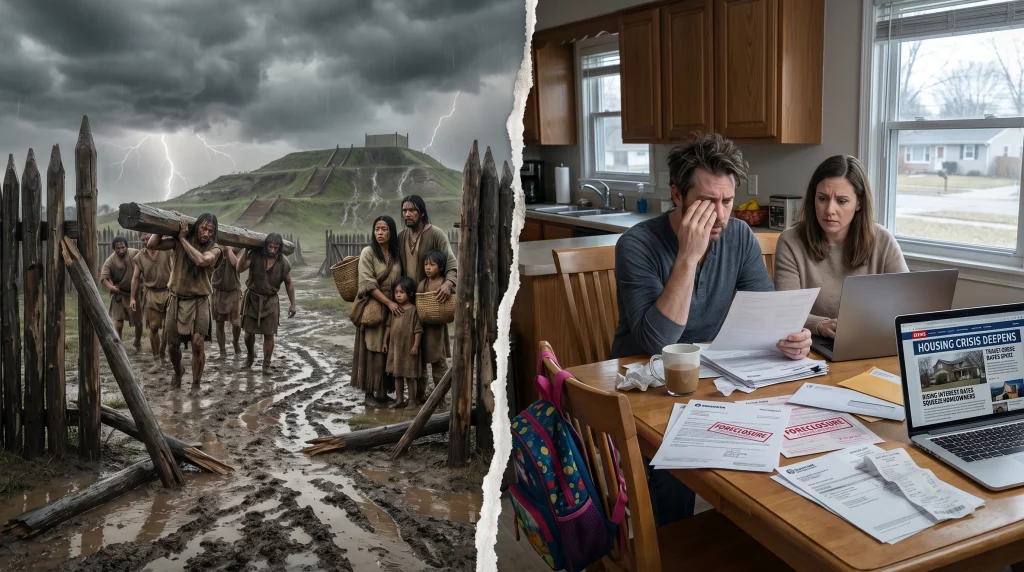
For years, the American dream was sold as a simple equation: work hard, buy a home, build a life.
That equation is breaking in plain sight.
The Associated Press reported this week that White House economists now estimate the United States is short 10 million homes.[1]
At the same time, home prices have risen 82% since 2000, while incomes are up only 12%.[1]
Then came the second number.
HousingWire, citing ATTOM’s first-quarter data, reported 118,727 properties with foreclosure filings in Q1 2026, up 26% from a year ago.[2]
Foreclosure starts rose to 82,631. Bank repossessions climbed 45% year over year.[2]
That is not just a bad housing cycle.
It is a warning that one of the most important promises in American life is turning into a strain machine.
When shelter stops feeling secure, everything downstream gets shakier.
A family can survive a lot.
It can survive a bad quarter. A rough job market. An ugly inflation report.
But when the place that is supposed to anchor the household becomes a source of chronic instability, the damage spreads fast.
You stop thinking in years.
You start thinking in payments.
You stop planning upgrades.
You start calculating what can be delayed, downgraded, or quietly abandoned.
That is where America is drifting.
Not toward a cinematic overnight collapse.
Toward something slower and more corrosive: a society that still talks about ownership, stability, and middle-class life while making shelter harder to secure and easier to lose.
History has seen that pattern before.
When Cahokia Still Looked Unstoppable
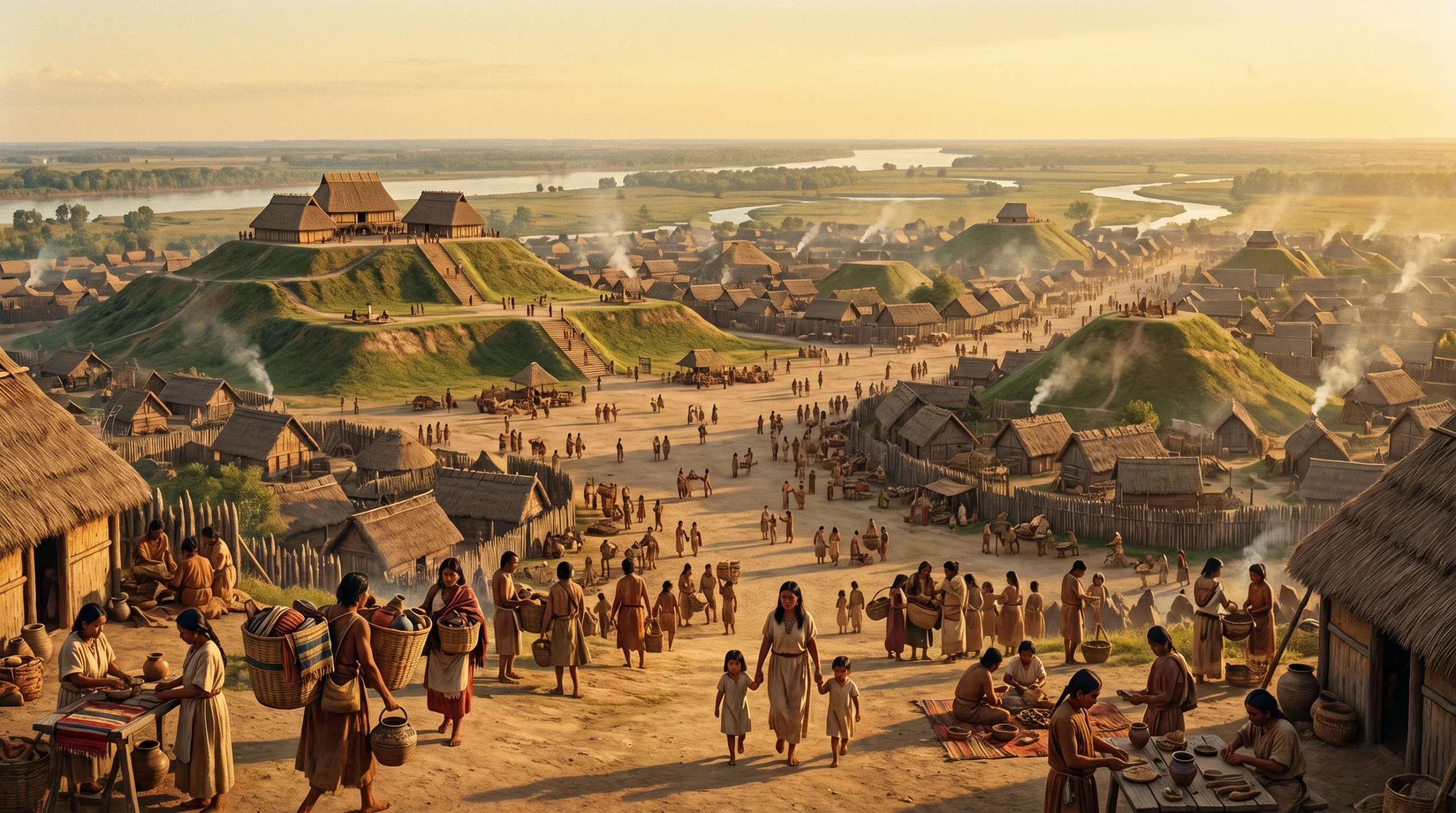
Long before modern skyscrapers, mortgages, or zoning boards, there was Cahokia.
At its height in the 12th century, Cahokia was the largest metropolitan center in North America north of Mexico.[3]
It rose in what is now southern Illinois.
It held thousands of people. It drew in labor, trade, ceremony, and political power from the surrounding countryside.[3][4]
This was not a primitive village.
It was a serious center of civilization.
Researchers describe a city-scale complex with monumental earthworks, more than 100 mounds, vast public space, and a political order impressive enough to absorb large numbers of people from surrounding settlements into a single, visible core.[3]
Cahokia was the largest metropolitan area and most complex political system in North America north of Mexico, and its growth pulled much of the surrounding rural population toward the center.[3]
That is the part worth sitting with.
Cahokia did not look weak when the danger began.
It looked organized. Ambitious. Important.
Its rulers could point to construction, ceremony, scale, and visible achievement.
The center felt real because the monuments were real.
The public works were real.
The energy pouring into the city was real.
And that is how brittle systems often hide their weakness.
They show you the center.
They do not show you the strain required to keep feeding it.
The Monuments Kept Rising. So Did the Burden.
One of the easiest mistakes people make about collapse is imagining that it begins with obvious ruin.
Usually it does not.
Usually it begins with concentration.
More labor pulled into the center.
More prestige projects.
More political energy spent maintaining a visible order that looks permanent from the outside.
Cahokia’s central precinct was built to impress.
Monks Mound alone ranks among the largest prehistoric structures in North America. The city also built plazas, palisades, ceremonial alignments, and large public spaces that required enormous, repeated labor.[3]
The famous palisade around the central precinct was not built once and forgotten.
It had to be rebuilt multiple times, with roughly 20,000 logs going into each construction cycle according to the research cited in the Frontiers study.[3]
That means the city was not just consuming labor.
It was consuming upkeep.
And upkeep is where many systems begin to bleed.
Because every grand structure creates future obligations.
Every centralized solution requires a support population.
Every prestige display depends on ordinary households somewhere in the background continuing to produce enough margin to keep the center supplied.
That is where the modern parallel becomes uncomfortable.
America has spent decades treating housing not simply as shelter, but as a financial engine, a retirement plan, a speculative asset, a tax base, and a political symbol.
It is asked to do everything at once.
Protect family wealth.
Prop up local government balance sheets.
Reward existing owners.
Support consumer confidence.
Signal prosperity.
But a house can only do all of those jobs for so long before it stops doing its most basic one well.
Providing stable shelter.
When one institution is forced to carry too many promises, it eventually starts dropping some of them.
That is what the current numbers suggest.
A shortage of 10 million homes means the system has not kept pace with what families actually need.[1]
An 82% rise in home prices against only 12% income growth means the visible asset story has badly outpaced the household story.[1]
A 26% jump in foreclosure filings means the strain is no longer theoretical.[2]
Some families are already running out of road.
The Real Crisis Is Not Just Cost. It Is Misallocation.
Most housing coverage treats the issue as a price problem.
And of course price matters.
But the deeper pattern is misallocation.
A civilization gets into trouble when it becomes excellent at building status and poor at protecting foundations.
Cahokia poured huge organizational capacity into its ceremonial and political center.[3]
That made the city look magnificent.
It also made the system more dependent on continued coordination, continued labor extraction, and continued environmental luck.
Later research linked Cahokia’s decline to a combination of floods, droughts, resource scarcity, and depopulation pressures.[4]
In other words, the center was only as durable as the support system beneath it.
Once the underlying margin thinned, scale became a burden instead of a shield.
America’s housing model is drifting toward the same kind of inversion.
The public language still says the goal is family stability.
But much of the lived experience says the system is rewarding scarcity, delay, and financial extraction instead.
Rates rise, and the monthly payment becomes the wall.
Inventory stays constrained, and young families keep renting longer.
Builders face cost burdens, regulatory drag, and financing pressure.
Owners are told rising values mean they are winning even when taxes, insurance, repairs, and debt service are eating the gain.
And families on the edge learn the hardest lesson of all: paper wealth is not the same thing as breathing room.
ATTOM’s Q1 2026 data showed 118,727 properties with foreclosure filings, including 82,631 foreclosure starts and 14,020 lender repossessions.[2]
That is not a niche statistic.
That is a signal that shelter itself is becoming less dependable.
What Happens When the Center Stops Protecting the Household
The most useful part of the Cahokia parallel is not that one city declined.
Cities have always risen and fallen.
The useful part is the sequence.
First comes concentration.
Then comes prestige.
Then comes maintenance burden.
Then comes environmental or economic stress.
Then comes the discovery that the visible center was stronger in appearance than in slack.
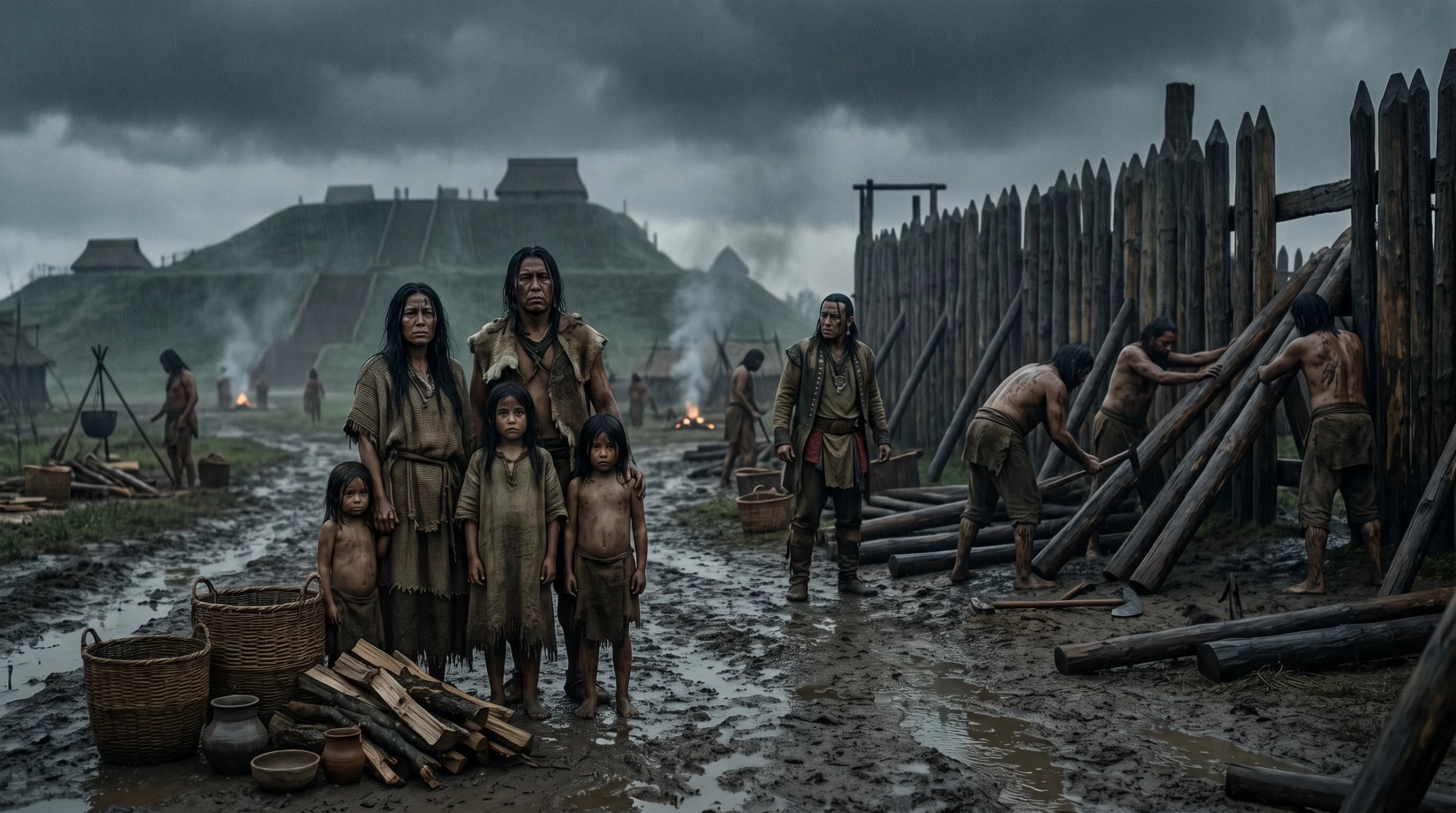
Cahokia did not fail because one thing went wrong one Tuesday afternoon.
It faced accumulated pressures. The population that had once fed the center dispersed. Public works became harder to sustain. The system lost the household-level support that had made complexity possible in the first place.[3][4]
That sequence rhymes with modern America more than many people want to admit.
The nation still has huge wealth.
It still has brand power.
It still has neighborhoods where the old promise feels intact.
But broad middle-class shelter security is getting thinner.
And when shelter thins, the rest of civic life thins with it.
Marriage gets delayed.
Children get delayed.
Mobility falls.
Communities get older, angrier, and more transient.
Young adults inherit less confidence and more monthly obligations.
Politics gets nastier because households under pressure become easier to radicalize and harder to reassure.
The housing issue is not separate from national decline.
It is one of the clearest ways decline becomes personal.
Civilizations do not lose legitimacy only in wars and markets.
They lose it in kitchens.
They lose it when a couple earning decent money still cannot picture a stable future.
They lose it when ordinary competence no longer buys ordinary security.
That is why a housing shortage is more dangerous than it sounds.
It tells people the system may still be rich, but it is no longer organized around their continuity.
The Turn: The Path to Resilience
It is easy to look at numbers like these and slide straight into despair.
To assume that if homes are scarce, prices are high, and foreclosures are rising, then the individual household has no meaningful move left.
But history teaches a better lesson.
When large systems become brittle, the winning move is not to become more emotionally attached to the brittle system.
It is to start building real margin outside its failure points.
That was the deeper lesson after Cahokia’s central order thinned.
People did not simply vanish into the air. Later Native communities reorganized in more flexible, smaller-scale ways tied to farming, hunting, and movement adjusted to reality rather than prestige.[4]
That is the hope hidden inside hard history.
Human beings can rebuild on saner terms.
Families can create flexibility before the next payment shock, tax increase, insurance spike, or market downturn lands.
You may not be able to solve national housing policy this year.
But you can reduce how much of your future depends on the most fragile parts of the system.
You can lower food dependency.
You can increase productive use of whatever space you do control.
You can build practical skills that turn a yard, patio, side lot, or even a small corner of home into output instead of pure cost.
You can strengthen family economics by producing some of what you consume.
You can build relationships with people who still understand tools, trade, repair, food, and local trust.
That is not retreat. It is sovereignty.
And it matters precisely because shelter is getting more expensive and less forgiving.
If a house is going to consume more of the household budget, then the household must become more capable inside and around that house.
That is how you push back against a system that has turned basic stability into a premium product.
The Action: Build Margin Before the Next Payment Shock
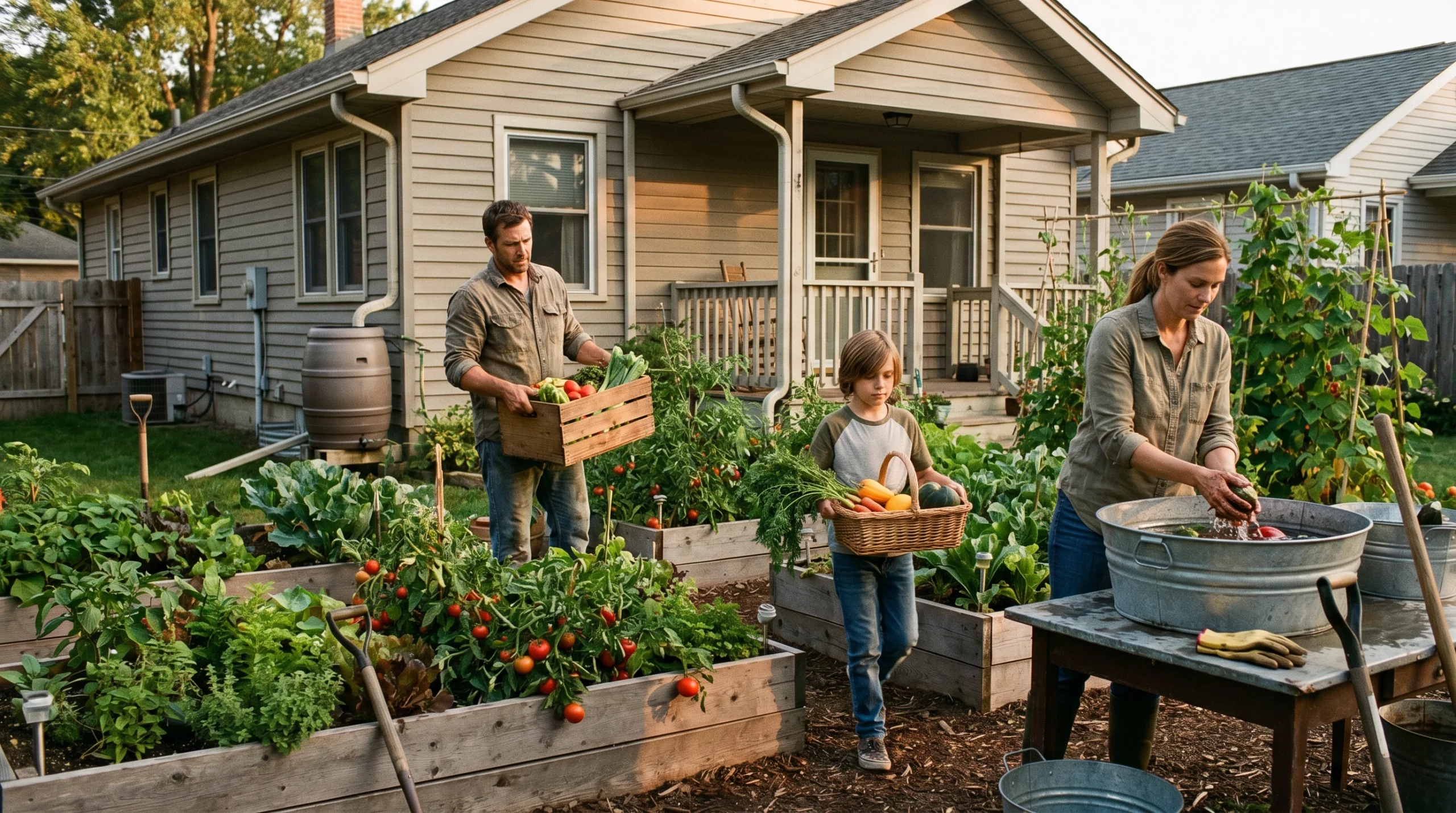
The most rational response to a housing system under strain is not panic.
It is construction.
Not speculative construction.
Household construction.
If shelter is going to stay expensive, then the family that learns to turn limited space into food, utility, and resilience will have an advantage that spreadsheets cannot fully capture. That is why the 4ft Farm Blueprint matters right now. It gives ordinary families a practical system for producing real food in small spaces, which is one of the fastest ways to create breathing room when the cost of everything else keeps rising.
If you want to make your property more useful instead of merely more expensive, Homesteader Depot helps you think like a builder again. Tools, systems, repairs, storage, and self-sufficiency all matter more when the outside market is becoming harsher.
If your concern is what to do when financial pressure starts spilling into household instability, Survival Stronghold is where preparedness becomes practical. Cash, supplies, redundancy, and calm planning all get more valuable when foreclosure pressure and affordability stress start spreading through the broader economy.
If you want a sharper strategic read on the pattern itself, Self Reliance Report and The Ready Report help you think beyond headlines and into systems, incentives, and timelines.
And if the stress of all this is already hitting your sleep, metabolism, and nervous system, Seven Holistics is part of the same answer. A resilient future is not built only with money and tools. It is built with a body and mind strong enough to carry responsibility.
Cahokia’s warning is not that every great center disappears overnight.
It is that visible scale can distract people from invisible fragility.
America still has scale.
What more and more families are losing is slack.
That is why now is the time to build.
Not because the sky is falling tomorrow.
Because when a civilization starts making shelter harder to keep, the smartest households stop waiting for permission and begin creating stability on purpose.
Sources
- AP News: The US is short 10 million houses. A new White House report lays out a blueprint to fix that
- HousingWire: US foreclosure filings rise 26% in Q1 2026, ATTOM says
- Frontiers in Sustainable Cities: Cahokia: Urbanization, Metabolism, and Collapse
- Berkeley News: New study debunks myth of Cahokia’s Native American lost civilization