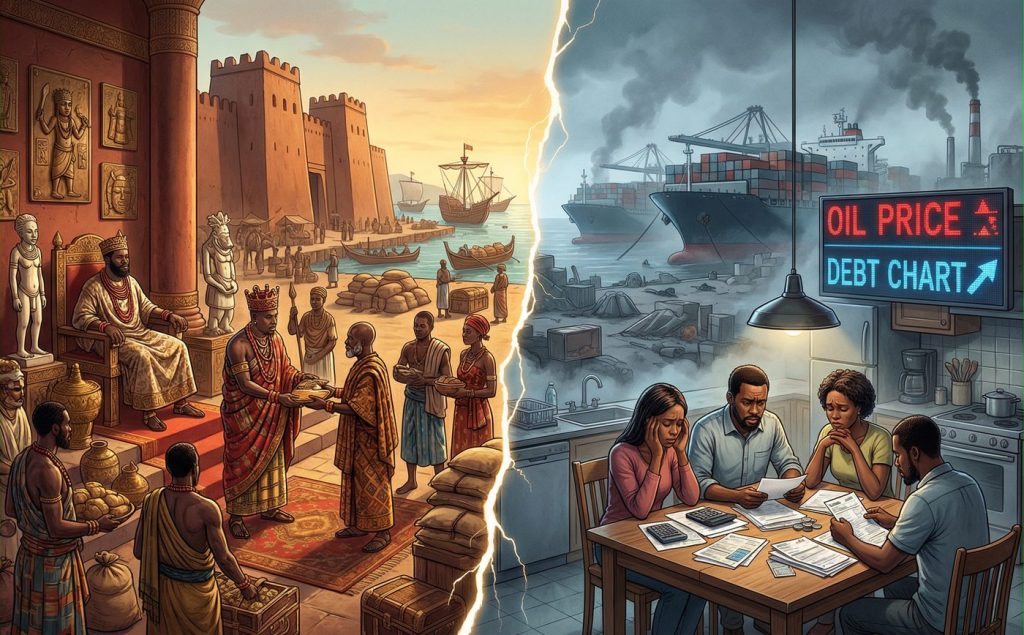
The 3.1% Warning Hidden Inside a Trade Kingdom’s Family Civil War
Three days ago, Brookings warned that what looked like a year of economic healing has become a year of peril.
One day later, the IMF made the danger more concrete. Before the latest Middle East escalation, the institution had lifted its 2026 global growth outlook to 3.4%. Now, even under its relatively optimistic reference case, it sees global growth dropping to 3.1% this year, with headline inflation rising to 4.4%. In its adverse scenario, growth falls to 2.5% and inflation jumps to 5.4%.
That is what a fragile system looks like in real time.
It does not collapse because one headline appears.
It collapses because the margin for error was already gone.
America entered this shock with nearly $39 trillion in national debt, rising interest costs, and an economy that still depends on consumers, cheap imports, and confidence in a global order Washington increasingly struggles to control. Brookings warned that the war now points toward higher deficit spending, higher federal debt, and significantly higher Treasury yields.
The danger is not just oil.
The danger is discovering that an empire can still look wealthy right up to the moment the system around it begins to reroute.
History has seen that pattern before.
The Kingdom That Controlled the Gate
For centuries, the Kingdom of Benin was one of the great powers of West Africa.
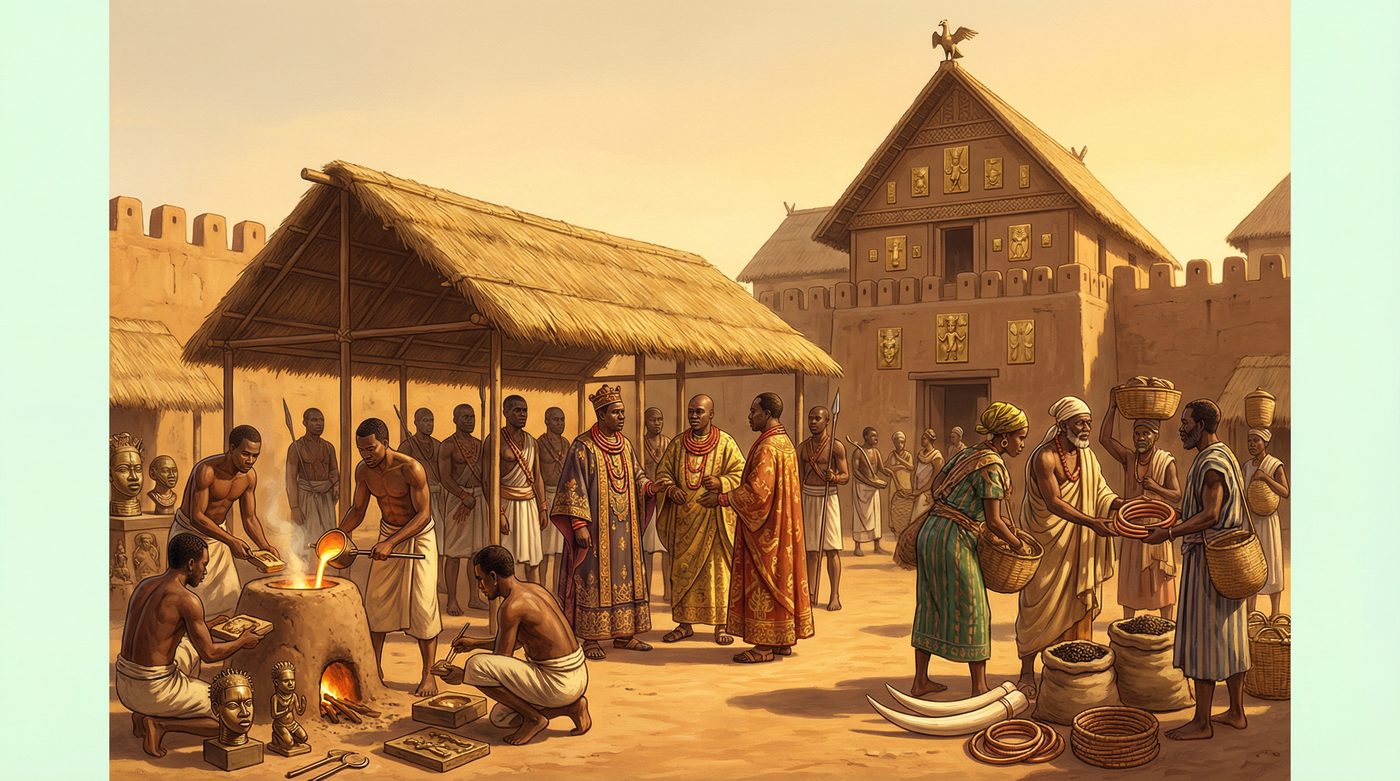
From roughly the 1200s through the 1800s, Benin built a sophisticated state in what is now southern Nigeria. Its capital was famous for its scale, its royal court, and its immense earthworks. Its artisans produced some of the most extraordinary brass and ivory work in the world. Its rulers controlled trade with the discipline of a modern customs regime.
When the Portuguese arrived in the 15th century, they found a kingdom that understood leverage.
Benin did not simply participate in trade. It curated it.
European traders wanted pepper, ivory, metals, and eventually access to human cargo through the wider Atlantic slave system. Benin’s rulers understood that proximity to foreign demand could be converted into state power. Brass and copper flowed in. Wealth accumulated at the center. The royal court tightened control over which goods moved, who could trade, and who profited.
The Oba did not allow commerce to operate as a free-for-all.
He treated it as a strategic asset.
That control helped make Benin rich. It also made Benin vulnerable.
Because when a kingdom centralizes the profits of trade, it also centralizes the political fight over who gets to command that machine.
The Moment the Wealth Machine Turned Inward
For a long time, the arrangement worked.
Trade funded power. Power protected trade. Prestige reinforced legitimacy. The palace grew stronger because the commercial system fed it.
But strong systems often hide a fatal weakness: they train elites to believe the machine will keep paying them forever.
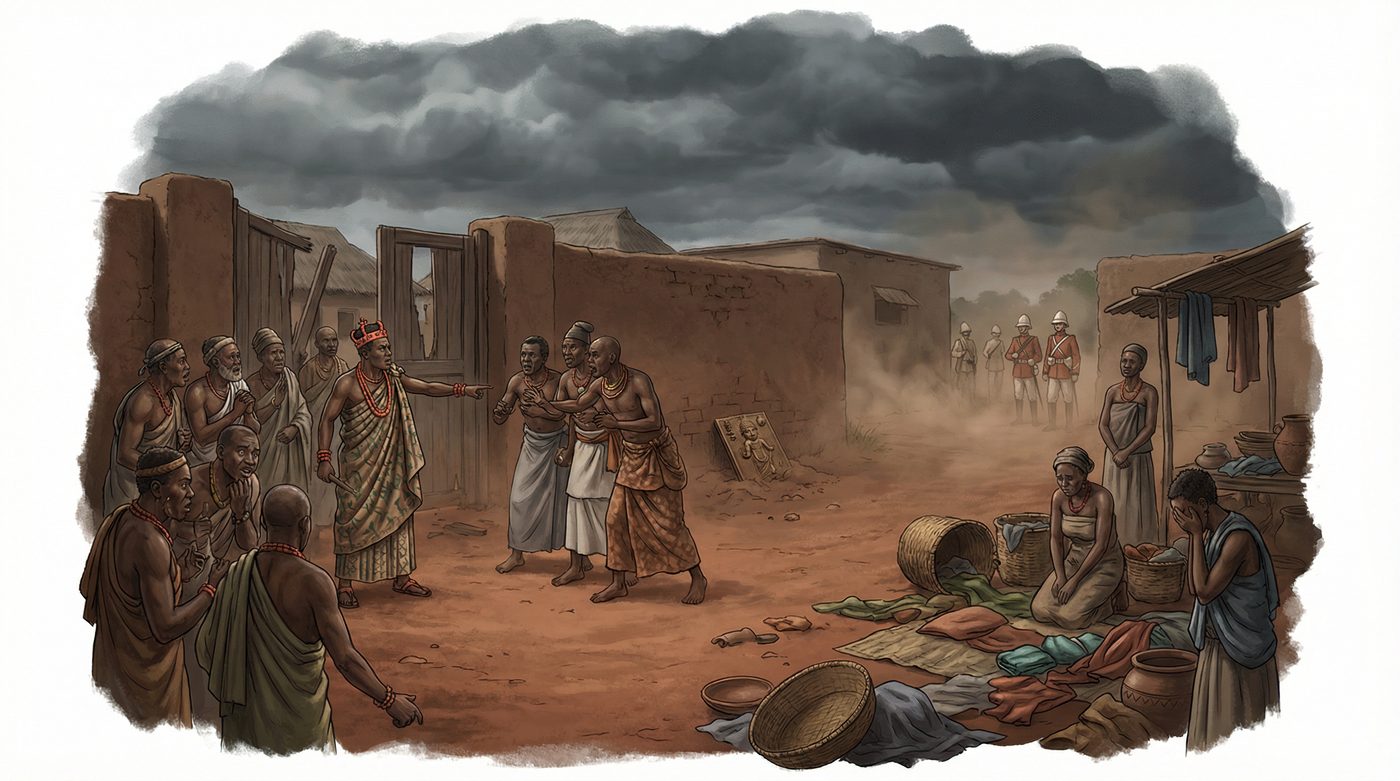
By the 1800s, Benin began to lose the internal cohesion that had made its trade model viable. Royal family factions fought over succession and control of the throne. Civil wars and internal power struggles weakened the kingdom’s administration and damaged its economy. The center that had once coordinated the flow of wealth began consuming its own energy in domestic conflict.
That is the pattern people miss.
External pressure becomes fatal only after internal fracture makes the state soft.
In Benin’s weakened condition, foreign interference became far more dangerous. British commercial and imperial pressure intensified as European powers moved aggressively to control West African trade routes, territory, and extraction. A kingdom that had once dictated terms found itself struggling to resist a new external order forming around it.
By 1897, the British invaded Benin City, burned it, broke the kingdom’s governing power, and folded the territory into colonial rule.
Benin was not poor when the end began.
It was exposed.
It still had prestige. It still had art. It still had memory. But it no longer had the internal discipline required to defend the economic system that made all of that possible.
That is how decline often works.
The treasure remains visible long after resilience is gone.
America Is Learning the Same Lesson the Hard Way
The United States is not Benin.
But the mechanism is uncomfortably similar.
America’s real power was never just aircraft carriers or speeches about democracy. It was its position inside the world’s operating system. It sat at the center of trade finance, reserve currency demand, maritime security, and consumer markets large enough to pull global production into orbit.
That system made Washington look permanently indispensable.
Now the cracks are multiplying at the same time.
War raises the cost of energy. Higher energy prices revive inflation risk. Inflation risk keeps rates higher. Higher rates increase interest costs on a debt load already approaching absurdity. Political factions cannot agree on a durable economic direction. Trade policy lurches between coercion, retaliation, and legal uncertainty. The rest of the world, as the IMF noted, is adapting to an increasingly multipolar environment in which trade is rerouted through new partners and new regional agreements.
That is the part that should alarm you.
When systems become unreliable, the market does not wait for them to recover.
It routes around them.
That is what happened to Benin after internal fracture weakened its control over commercial power. And it is what can happen to the United States if fiscal stress, political warfare, and strategic overreach continue to erode confidence in the American-led order.
A superpower does not need to be formally conquered to become less central.
It only needs to become too expensive, too divided, and too unpredictable.
Once that happens, the world starts building alternatives.
Why This Pattern Matters More Than a Single War
It is easy to look at the latest headlines and assume the danger is the conflict itself.
But war is often just the revealer.
The deeper problem is that America increasingly resembles a system with scale but not slack. There is still enormous wealth. There is still military reach. There is still brand power in the dollar and the Treasury market. But there is less room for error than the headlines imply.
Benin’s warning is not that foreign rivals are strong.
It is that domestic fracture makes foreign pressure decisive.
A country can survive outside pressure for a long time if its internal order is disciplined, productive, and coherent. But if the ruling class treats the national system like a prize to be captured rather than an inheritance to be maintained, then every external shock becomes more dangerous.
That is where America is drifting now.
We fight over the throne while the trade architecture, the debt math, and the cost structure all worsen at once.
The result is not immediate collapse.
The result is slower, more humiliating decline: more dependence, more volatility, more extraction from ordinary households, and fewer reliable guarantees from the institutions that once looked permanent.
The Turn: The Path to Resilience
It is easy to read patterns like this and feel trapped.
To look at debt, war, inflation, and institutional decay and conclude that the individual is just a spectator waiting for the next blow.
But history teaches something more useful than panic.
When centralized systems become brittle, the people best positioned for the future are not the ones who cling hardest to the old machine.
They are the ones who start building outside its failure points.
The survivors of a decaying order are the households and local networks that reduce dependency before the next shock hits. They build practical sovereignty. They produce more than they consume. They store knowledge, not just goods. They create margin where the larger system has none.
That is the real lesson in Benin’s fall.
When the center loses coherence, prestige cannot save it.
Only durable capacity matters.
This is not a call to withdraw from the world in fear.
It is a call to stop outsourcing every basic necessity to institutions whose balance sheets, incentives, and competence are all getting worse at the same time.
You do not need to predict the exact day the next break comes.
You only need to understand the direction of travel and start building accordingly.
The Action: Build What the System Can No Longer Guarantee

The most rational response to a brittle empire is not despair.
It is construction.
If food inflation, supply disruptions, and debt-driven instability keep intensifying, then the most valuable move you can make is to build a household that can produce, adapt, and endure. That is exactly why the 4ft Farm Blueprint matters right now. It turns abstract anxiety into a practical system for producing food in a small space, which is where real sovereignty begins.
If your goal is to become less dependent on failing institutions, then capability matters more than commentary. Homesteader Depot helps you build the skills, tools, and judgment required to make your household more resilient when centralized systems grow less reliable.
If inflation, shortages, and stress are going to define the next stage of the cycle, then your health cannot remain another outsourced dependency. Seven Holistics is part of that same builder’s mindset: strengthen the system closest to you so you are not left negotiating with a failing one later.
And if you want to understand the timeline, the pressure points, and the strategic logic behind what is happening, The Ready Report helps you think clearly while others are still reacting emotionally.
Empires crack slowly.
Then suddenly.
The people who come through those transitions best are rarely the ones who trusted the old center the longest.
They are the ones who started building early.
That is the real opportunity now: not to mourn the system, but to outgrow your dependence on it.