The exits are quietly closing on Wall Street.
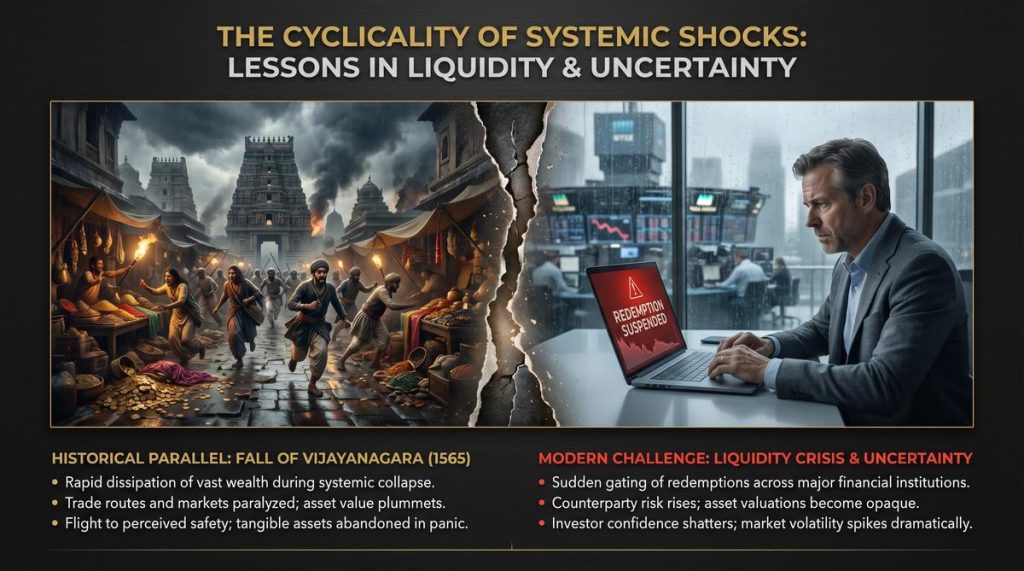
Over the past few weeks, major financial institutions—including BlackRock, Morgan Stanley, and Blue Owl—have begun halting or restricting redemptions on their private credit funds. [1] [2]
Investors are discovering a terrifying reality: they cannot get their money out.
This is how a liquidity crisis begins.
Private credit is the shadow banking system that now controls roughly $3.5 trillion in assets. [3] It grew in the dark, outside the strict regulations of traditional banking, offering high yields to investors desperate for returns.
But private credit is fundamentally illiquid. When panic sets in and everyone rushes for the door, the cash simply isn’t there.
We are watching the early tremors of a systemic freeze.
And history warns us exactly what happens when a massive, unregulated credit network suddenly stops moving.
The Empire Built on Paper Promises
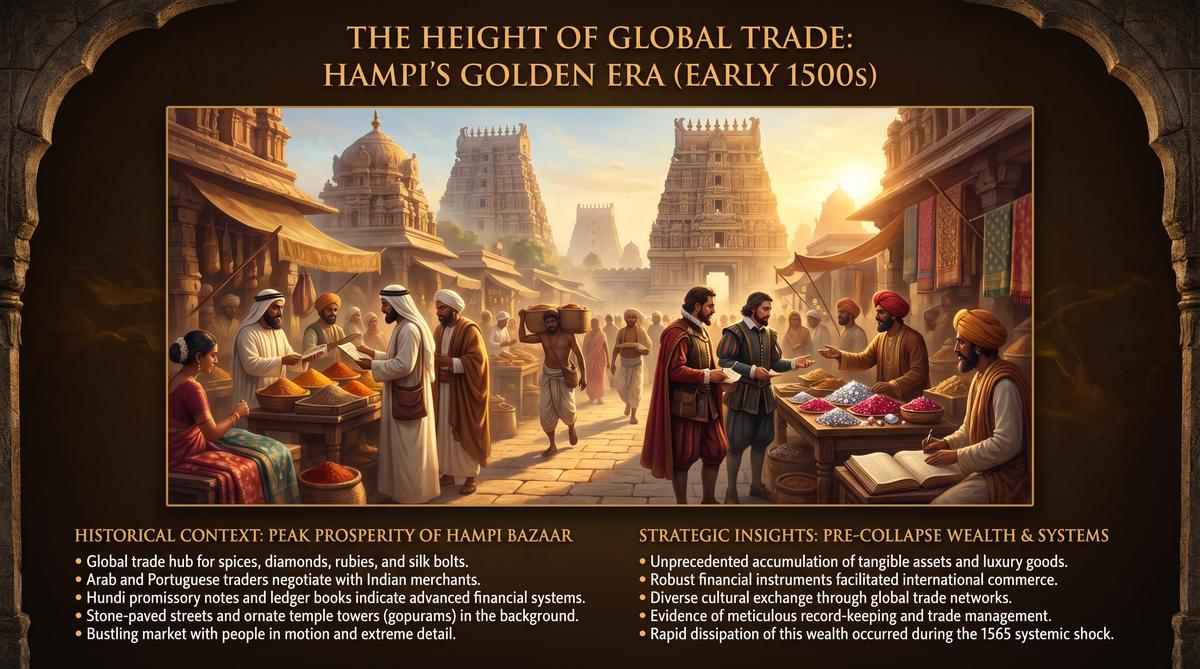
In the 1500s, the Vijayanagara Empire in southern India was arguably the wealthiest society on earth.
Its capital, Hampi, was the world’s second-largest medieval city, trailing only Beijing. [4] Portuguese horse trader Domingo Paes visited in 1520 and described markets overflowing with diamonds, rubies, and mountains of spices. [5]
But Vijayanagara’s true power wasn’t just gold. It was credit.
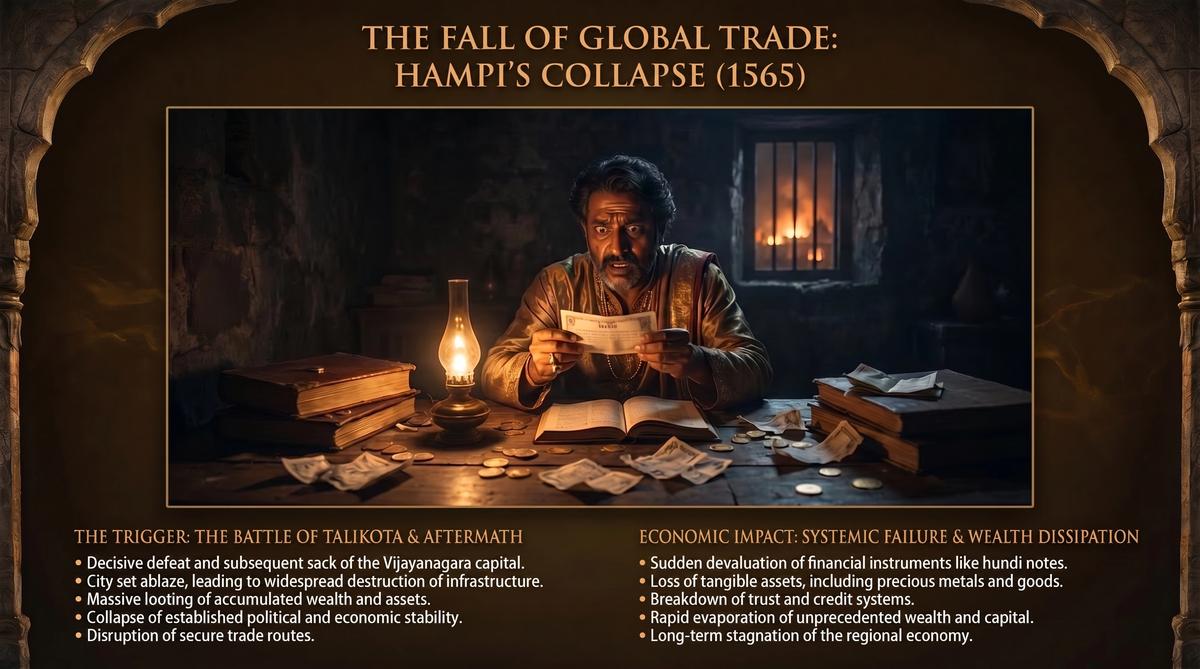
The empire ran on a sophisticated indigenous financial instrument called the hundi—a system of promissory notes and bills of exchange. [6]
Merchants didn’t need to carry heavy chests of gold across dangerous trade routes. They carried paper.
The hundi system allowed massive amounts of capital to flow seamlessly across the subcontinent and the Indian Ocean. It was the medieval equivalent of today’s shadow banking system—built entirely on trust, reputation, and the assumption of endless liquidity.
As long as the music played, everyone got rich.
When the Exits Closed
But the system had a fatal flaw: it was highly leveraged and deeply interconnected.
When the Portuguese arrived and began violently disrupting the Arabian Sea spice and horse trade, the underlying cash flows of the Vijayanagara merchants were threatened. [7]
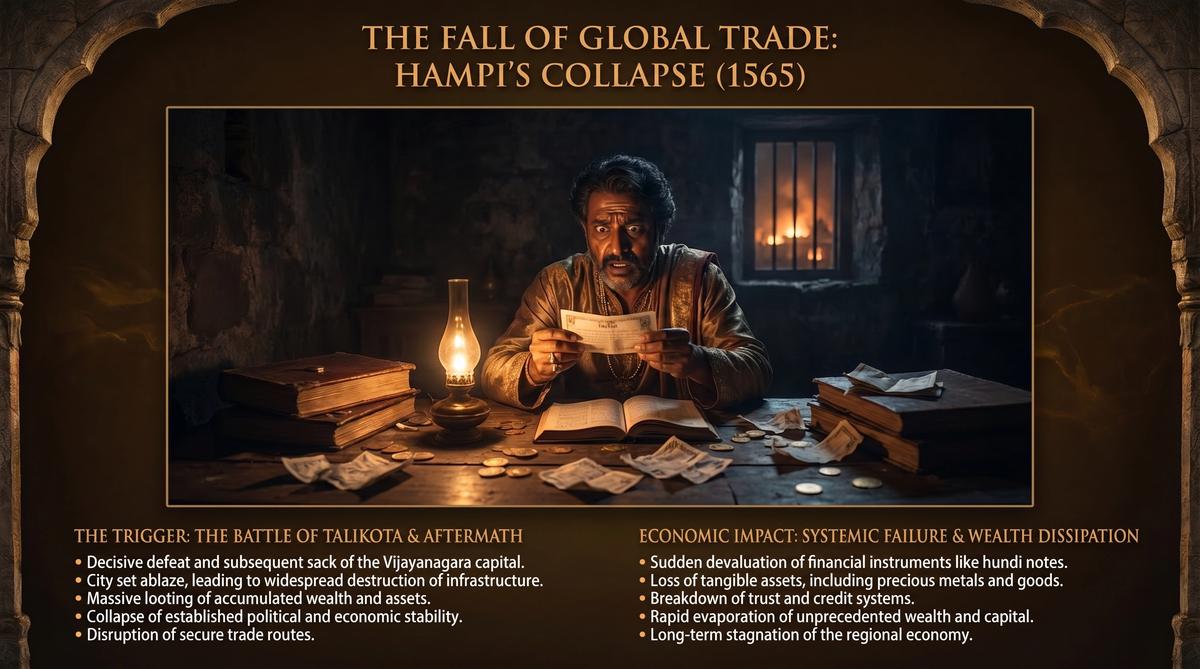
Then came the catastrophic Battle of Talikota in 1565. [8]
The empire suffered a sudden military defeat. But the true collapse wasn’t just on the battlefield; it was in the ledgers.
Panic swept through the merchant class. Everyone tried to cash in their hundis at once.
But the physical gold wasn’t there to cover the paper promises. The credit network froze instantly.
Without liquidity, the world’s richest city couldn’t pay its mercenaries, couldn’t buy food, and couldn’t defend its walls.
Within months, Hampi was sacked, looted, and abandoned. [9] The paper wealth evaporated into the jungle air.
The Modern Liquidity Trap
Today, America is facing its own hundi crisis.
The $3.5 trillion private credit market is built on the exact same premise: that illiquid loans to highly leveraged companies can somehow be treated as liquid assets by the investors holding them. [10]
But the math is breaking.
With interest rates remaining elevated and a wall of $620 billion in debt coming due by 2027, the underlying companies are struggling to pay. [11]
When investors ask for their money back, the funds have to say no. They impose “redemption gates.”
They lock the doors.
Just like the merchants of Vijayanagara, modern investors are realizing that paper wealth is an illusion when the system freezes.
The Turn: The Path to Resilience
It is easy to look at the fragility of these global financial systems and feel a sense of despair. To see your retirement accounts as nothing more than digital promises waiting to evaporate.
But history teaches another, more powerful lesson.
When the great, centralized systems fail, they create a vacuum. And into that vacuum rushes the opportunity for something new.
The survivors of the Vijayanagara collapse weren’t the ones holding the most paper credit. They were the ones who held tangible assets, who knew how to produce real value, and who had strong local networks.
This is not a call to hide from the world. It is a call to build a better one, starting in your own backyard.
True wealth isn’t a number on a screen that a fund manager can freeze. True wealth is sovereignty.
The Action: The Blueprint for Hope
Building a resilient future starts with a single, powerful step: taking control of your own resources.
The 4ft Farm Blueprint is not just about survival; it’s about sovereignty. It’s the first chapter in your family’s story of independence, a story where you are the builder, not the victim.
By learning to produce your own food, you insulate yourself from the shocks of a fragile system.
For deeper strategies on protecting your family’s physical and financial security, explore the Survival Stronghold and the Self Reliance Report.
If you want to master the skills of independent living, the Homesteader Depot provides the tools you need. And for maintaining your health outside the fragile medical supply chain, turn to Seven Holistics.
The exits on Wall Street may be closing. But the door to your own independence is wide open.
Step through it.