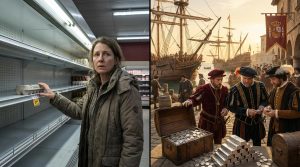
The Hook: A Shortage Can Begin Long Before Shelves Look Empty
Three days ago, the UN warned that disruptions around the Strait of Hormuz are threatening the fuel and fertilizer flows that keep the global food machine running.
That sounds far away.
It is not far away at all.
FAO officials now say 30–35% of crude oil, 20% of natural gas, and 20–30% of fertilizers are not moving through the system as expected. They also warned that the real danger is delayed, not immediate: inventories can hide the stress for a while, but missed input windows can lower yields and drive up prices later in the year.
The shelf lies before the system does.
That is the part most people miss.
A civilization does not wait for the final visible failure before it starts getting weaker. The real decline begins when the hidden replenishment systems stop doing their job, even if the public still sees stocked markets, familiar routines, and official reassurances.
That is why America should pay attention now.
Not when the grocery aisle looks ugly.
Now, while it still looks normal.
The Empire in the Thin Air
High in the Andes, near Lake Titicaca, the civilization of Tiwanaku built one of the most remarkable agricultural systems in the ancient world.
This was not an easy place to live.
The altitude was brutal. Nights were cold. Weather was unstable. Farming there required more than labor. It required engineering, coordination, and the ability to manage water with precision.
Tiwanaku solved that problem with raised fields, irrigation channels, and a highly organized farming system that turned a hostile environment into a productive one. Their fields trapped heat, managed frost, and made use of scarce moisture. For a time, the system worked so well that Tiwanaku became one of the great powers of the Andes.
It attracted migrants. It built monuments. It fed a large urban population. It projected the image of order.
From the outside, it looked durable.
That is how powerful systems usually look.
They do not advertise their dependency structure.
They display the results of that structure and call it permanence.
Tiwanaku’s agricultural system was sophisticated enough to support a population of at least 10,000 people in a harsh high-altitude environment, even as later environmental stress began reducing output.[1]
The Part That Started Failing First
The story of Tiwanaku is not a cartoon about one dry season destroying a kingdom overnight.
It is more interesting than that.
Accessible research suggests prolonged arid stress reduced local water productivity and forced consolidation in Tiwanaku’s raised-field and irrigation system.[1] A newer chronology also argues the final site-level collapse was a cascading breakdown of community practices and social networks around AD 1010–1050, not just a simple one-factor weather event.[2]
That matters because it gives us the real lesson.
Great systems usually break in layers.
First, the margins get thinner. Then output falls. Then coordination gets harder. Then the public story and the material reality stop matching. Only after that does the visible collapse arrive.
Tiwanaku could still feed people for a time.
It could still look like Tiwanaku.
But a system can remain recognizable long after it stops being safe.
That is the danger zone every empire misreads.
When the replenishment cycle weakens, a society starts spending hidden reserves.
It spends water tables, trust, slack, infrastructure, social cohesion, and time.
Once enough of those reserves are gone, the final break can look sudden to outsiders even though the real failure began years earlier.
America Has the Same Blind Spot
The United States does not depend on one raised-field system in the Andes.
It depends on a modern version of the same idea: invisible coordination.
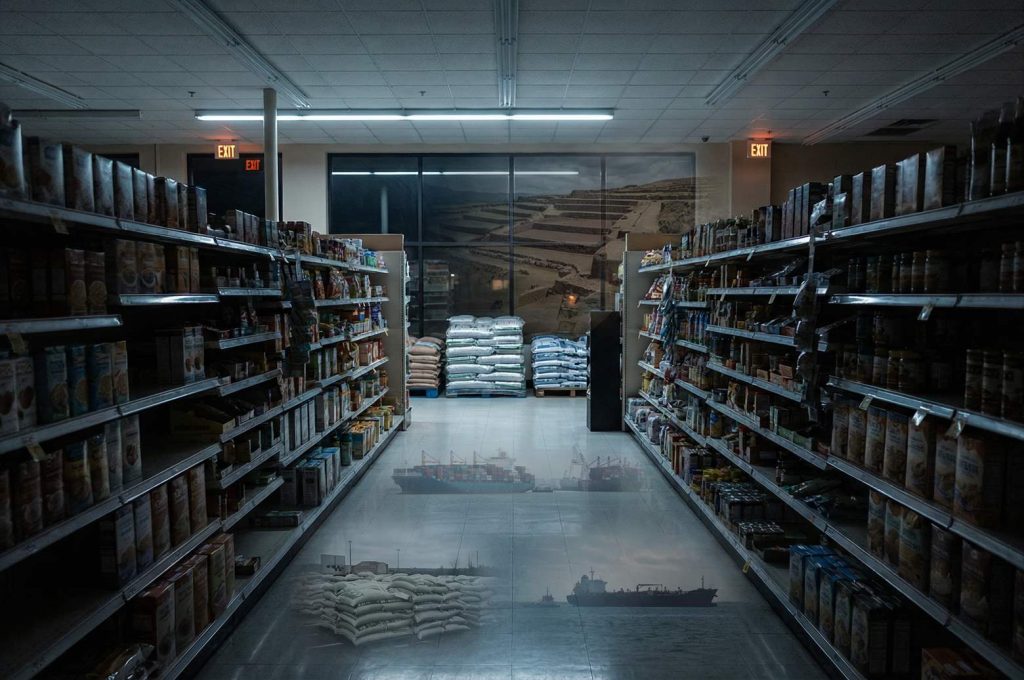
Americans walk into climate-controlled stores and see abundance. They assume the abundance is sitting there because the nation is strong. In reality, that abundance sits on top of fuel flows, fertilizer flows, shipping insurance, credit markets, diesel logistics, foreign inputs, and a financial system that has to keep absorbing ever more debt.
That machine still works.
But it is working under more strain than the average household understands.
The IMF’s latest reference case now sees global growth at 3.1% this year with headline inflation at 4.4%. In its adverse scenario, growth falls to 2.5% and inflation rises to 5.4%. In its severe scenario, growth drops to 2.0% and inflation climbs above 6%.[3]
Those are not numbers from a fringe survival blog.
Those are numbers from the people who manage panic for a living.
The IMF also warned that public finances were already weak before this shock. The global fiscal deficit stayed at 5% of GDP in 2025, gross public debt rose to 94% of GDP, and interest spending climbed from 2% to nearly 3% of GDP in just four years.[4]
In plain English, that means the system is less able to absorb another hit.
It also means every disruption now lands on top of higher debt, tighter margins, and less room for error.
Why the Buffer Is the Real Story
One of the most revealing lines in the FAO warning was not about immediate starvation.
It was about timing.
Officials said the world still has decent stocks and recent harvests that make the system look resilient in the short term. But if fertilizer and energy inputs do not arrive when farmers need them, yields can fall later and food prices can rise into the next season.[5]
That is exactly how buffered systems become brittle systems.
The buffer creates the illusion of safety.
It buys time, but it also buys denial.
When a household still sees full shelves, it feels foolish preparing. When a government still sees reasonable store inventory, it feels safe managing headlines instead of root causes. When investors still see functioning markets, they mistake temporary order for structural strength.
Tiwanaku teaches the opposite lesson.
A society can look organized while its productive base is thinning underneath it.
America is now running a similar gamble with food inputs, energy routing, debt financing, and political bandwidth.
This Is Bigger Than Food
Food is the easiest part of the problem for families to understand.
It is not the only part.
The same hidden-fragility pattern now touches the whole American operating system. Energy shocks push up transport and input costs. Higher prices make it harder for central banks to loosen. Higher rates punish debt-heavy governments and households. Rising interest bills crowd out future flexibility. And political leaders, already locked in permanent conflict, become less capable of making disciplined choices before the next wave hits.
That is why the modern parallel is not “an ancient farming story.”
It is a story about replenishment failure.
If your food system depends on inputs that are delayed, your resilience is weaker than it looks. If your government depends on private investors to keep absorbing bigger debt issuance, your fiscal sovereignty is weaker than it looks. If your household depends on just-in-time retail and low prices, your personal margin is weaker than it looks.
Normality can survive for a while after resilience has already started dying.
That is the warning.
The Turn: The Path to Resilience
It is easy to read this pattern and feel trapped.
That would be the wrong conclusion.
History does not just show how systems fail. It shows where ordinary people recover their power. They recover it when they stop outsourcing every critical function to distant institutions and start rebuilding local capacity, household margin, and community competence.
The people who come through unstable periods best are rarely the ones with the strongest opinions.
They are the ones with the strongest systems.
That means food on hand. Skills that reduce dependency. Relationships with local producers. Backup plans for basic household needs. A budget that assumes price volatility instead of pretending it will disappear.
It also means training yourself to read fragility correctly.
Do not ask whether today looks normal.
Ask whether the replenishment cycle beneath today’s normal still looks trustworthy.
That is the better question.
And it is the question Tiwanaku forces us to ask.
The Action: Build Before the Delay Reaches Your Street
If you want a single rule for moments like this, make it simple: build before the shortage becomes visible.
That starts with food.
A household that can grow even part of its own calories is not just saving money. It is building sovereignty. That is why the 4 Foot Farm Blueprint matters right now. It gives families a practical system for producing food at home instead of betting everything on a strained national machine.
If you want to harden the rest of your household, pair that with deeper preparedness thinking from Survival Stronghold and the macro fragility coverage at Self Reliance Report. If inflation and supply stress are already hitting your routines, Homesteader Depot offers practical skill-building and tool-oriented self-reliance ideas, while Freedom Health Daily helps families think through the health side of economic volatility.
You do not need to predict the exact next disruption.
You need to reduce how much damage it can do to your household.
That is the lesson the experts always learn too late.
Tiwanaku did not become vulnerable the day the public could see the danger clearly.
It became vulnerable when the system underneath the appearance of order started losing its depth.
America is sending the same signal now.
The shelves are still full.
That is why the warning matters.
Sources
[1] University of Pittsburgh Climate and Global Change Center, “Pitt researchers find new links between drought and South American civilization dynamics,” summarizing Arnold et al. research on Tiwanaku climate stress.
[2] Marsh et al., “The center cannot hold: A Bayesian chronology for the collapse of Tiwanaku,” PLOS One (2024), arguing for a rapid cascading breakdown around AD 1010–1050.
[3] IMF Blog, “War Darkens Global Economic Outlook and Reshapes Policy Priorities,” April 14, 2026.
[4] IMF Blog, “War Shock Requires Disciplined Fiscal Reaction,” April 15, 2026.
[5] UN News / FAO, “Clock is ticking: Hormuz disruption raises fears of global food crisis,” April 13, 2026.