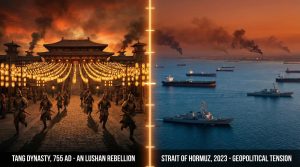

The United States is now two weeks into a war with Iran that has no clear objective and no end in sight. The Strait of Hormuz is a parking lot of burning tankers, oil is at $95 a barrel, and another 2,200 Marines are being sent to the Middle East even as the Pentagon admits it must cut 200 NATO positions.
Six American crewmen fell from the sky over Iraq just two days ago. The war has already cost over $11 billion in its first week alone.
It feels unprecedented.
But it is not.
Eight hundred years ago, the most dominant military force the world had ever seen conquered a continent. Then, it collapsed — not because it was defeated by an outside enemy, but because it declared war on itself.
This is the story of the Mongol Empire. And it is a chilling prophecy for America.
The Unstoppable Force
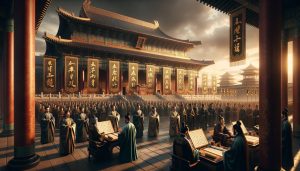
From 1206 to 1227, Genghis Khan built the largest contiguous land empire in history. His armies were a force of nature — a storm of horses and arrows that swept from the Pacific Ocean to the heart of Europe.
They were masters of siege warfare, psychological operations, and battlefield tactics. No walled city could stop them. No army could stand against them. When unified, the Mongols never lost a major battle.
They were the undisputed hyper-power of their age.
At its peak, the Mongol Empire was a globalized system of trade and security. The Silk Road was safer than it had ever been. Merchants traveled from China to Persia without fear. The empire’s strength was its unity of command, its speed, and its absolute willingness to project force anywhere on earth.
Sound familiar?

The War Against the Mirror
Genghis Khan died in 1227, and the cracks began to show almost immediately. His empire was too vast, his sons and grandsons too ambitious. The succession crises began.
After the death of Möngke Khan in 1259, the empire shattered. It broke into four warring khanates, each vying for supremacy.
The Golden Horde in Russia. The Ilkhanate in Persia. The Chagatai Khanate in Central Asia. The Yuan Dynasty in China. All Mongol. All enemies of each other.
While the khanates fought each other, the empire’s expansion ground to a halt. They tried to invade Japan twice — and failed both times, their fleets destroyed by typhoons the Japanese called kamikaze, the “divine wind.” They were defeated in Egypt at the Battle of Ain Jalut in 1260 — the first time a Mongol army had ever been stopped. They were repelled from Vietnam three times. They failed in Java.
The empire that had conquered everything suddenly couldn’t hold anything.
The Mongols were not defeated by a superior enemy. They were defeated by overextension — by trying to fight everywhere at once while the center rotted from within.

The American Mirror
Today, the United States finds itself in a position that would have been recognizable to any Mongol general from the 13th century.
The nation is fighting a war in Iran with no clear exit strategy. It is simultaneously managing a proxy conflict in Ukraine, a fracturing NATO alliance, and a domestic political divide so deep that 250 organizations have signed a letter demanding Congress halt war funding. Russia is reportedly sharing intelligence about the locations of American military bases with Iran. China may be providing economic and technological support to the enemy.
The US has struck over 15,000 targets in Iran in 14 days. It has spent $11.3 billion in the first six days alone. Oil is at $95 a barrel — $30 higher than when the war started. Wells Fargo warns that $130 oil means recession.
The Mongols tried to conquer Japan, Egypt, Vietnam, and Java — all while holding a continent together. They failed on every frontier because they were already failing at the center.
America is cutting 200 NATO positions while deploying 2,200 more Marines to the Middle East. It is borrowing $7.2 billion every single day just to keep the lights on, and now it is adding the cost of a new war to that tab.
This is not strength. This is the last charge of an overextended empire.
The Turn: The Path to Resilience
It is easy to look at this pattern and feel a sense of despair. To see the echoes of a fallen empire in our own headlines and believe that collapse is inevitable.
But history teaches another, more powerful lesson.
When the great, centralized systems fail, they create a vacuum. And into that vacuum rushes the opportunity for something new.
The survivors of the Mongol collapse weren’t the ones who waited for the next Khan to save them. They were the ones who rebuilt — who focused on their local communities, who strengthened their own skills, and who created resilient networks of trade and mutual support.
The Mongols could conquer cities. They could burn libraries. They could reroute trade routes. But there was one thing they could not conquer: the peasant who grew his own food, built his own shelter, and needed nothing from the empire.
Self-reliance is the only strategy that has ever worked when empires overextend and collapse.
This is not a call to hide from the world. It is a call to build a better one, starting in your own backyard.
The Action: The Blueprint for Hope
When an empire is at war with itself, the only winning move is not to play. The path to true security is not found in the pronouncements of presidents or the movements of aircraft carriers. It is found in your own two hands.
Build Food Sovereignty. The Mongols could conquer cities, but they couldn’t conquer the peasant who grew his own food. The 4ft Farm Blueprint is not just about survival; it’s about sovereignty. It’s the first chapter in your family’s story of independence — a story where you are the builder, not the victim.
Master Real Skills. The skills that outlast empires are not taught in universities. They are the practical skills of making, fixing, and providing. Survival Stronghold is a library of the knowledge that matters when the system fails — the same knowledge that allowed communities to rebuild after the Mongol collapse.
Acquire Real Assets. Real wealth is the land under your feet and the tools in your hands — not a number in a bank account that can be inflated away overnight. Homesteader Depot provides the tools for a life of genuine independence, not a life dependent on fragile supply chains that a single war can sever.
Protect Your Health. Your body is your most sovereign asset — the one thing that can never be debased or confiscated. When the financial system fails, your health is your wealth. Seven Holistics provides the knowledge to protect it, because a resilient body is the foundation of a resilient life.
The Self Reliance Report is the playbook for a world where you can’t trust the experts. The Ready Report gives you the specific, actionable steps to take right now. And The Pattern Ledgers documents the 800-year-old history of this very moment — because those who understand the pattern are the ones who survive it.
The American empire, like the Mongol empire before it, may be fighting a war it cannot win. But you don’t have to be a casualty.
Build something that lasts.