The World Stops Moving
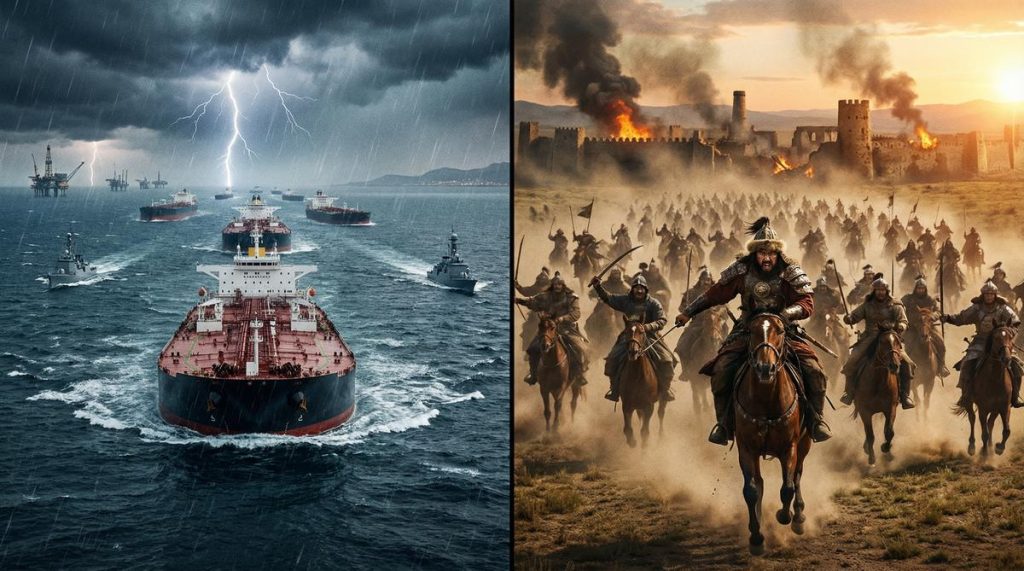
A single, narrow channel of water, no wider than 21 miles at its most constricted point, holds the global economy hostage. The Strait of Hormuz, the artery through which one-fifth of the world’s oil flows, is now a flashpoint in a rapidly escalating conflict. As American and Israeli forces engage with Iran, the world holds its breath. The closure of this chokepoint, whether by military blockade or the chilling effect of risk, would not be a minor disruption; it would be a catastrophic seizure of the world’s economic heart.
But this is not a new story.
History is littered with the ghosts of empires that learned too late that their power was built on the free movement of goods. When the arteries of trade are severed, the body of the empire withers and dies. For a chillingly precise parallel, we look not to the sea, but to the sprawling, dusty trade routes of the 13th century.
When the Silk Road Died
For centuries, the Silk Road was the terrestrial equivalent of the Strait of Hormuz — a vibrant network of trade that connected East and West. It was more than a route for silk; it was a conduit for ideas, technologies, and wealth that fueled civilizations from China to Europe. The great cities of Central Asia — Samarkand, Bukhara, Khwarazm — were jewels of commerce and culture, thriving on the constant flow of caravans.
Then came the Mongols.
The invasion led by Genghis Khan and his successors in the early 1200s was not a simple conquest; it was an annihilation of the world’s most critical trade network. The Mongols’ military strategy was one of absolute terror and destruction. They didn’t just conquer cities; they razed them to the ground, slaughtered their inhabitants, and destroyed the intricate systems of irrigation and administration that made life and trade possible.
The once prosperous region of Khwārezm suffered for centuries from the effects of the Mongol invasion. The destruction of its cities and the massacre of its people brought a sudden and catastrophic end to its economic and cultural life.
The effect was immediate and devastating. The Silk Road, as a reliable and high-volume trade route, effectively ceased to exist. Caravans stopped moving. Merchants, fearing for their lives, no longer made the journey. The economic engine of Central Asia sputtered and died, plunging a once-thriving region into a dark age from which it would not recover for centuries.
The world, for all intents and purposes, had stopped moving.
The Lesson from the Steppes
The Mongol obliteration of the Silk Road and the modern threat to the Strait of Hormuz are separated by 800 years, but they teach the same brutal lesson: the fragility of chokepoints. An empire that becomes dependent on a single point of failure — be it a sea lane or a desert trade route — is an empire one crisis away from collapse.
The American economy, and indeed the global economy, is critically dependent on the free flow of oil through the Strait of Hormuz. A prolonged closure would trigger a cascade of failures: soaring energy prices, rampant inflation, collapsing supply chains, and a stock market crash that would make 2008 look like a minor correction. The intricate, just-in-time delivery systems that stock our shelves and fuel our industries would grind to a halt.
We have built a magnificent globalized world, but we have built it on a knife’s edge.
The Mongols did not need to occupy every corner of the world to bring it to its knees. They simply had to destroy the connections. Today, the same outcome can be achieved not by a horde of horsemen, but by a few well-placed missiles or the strategic declaration of a blockade.
The Turn: The Path to Resilience
It is easy to look at the fragility of these global systems and feel a sense of despair. To see yourself as a pawn in a game of empires.
But history teaches another, more powerful lesson. When the great, centralized systems fail, they create a vacuum. And into that vacuum rushes the opportunity for something new. The survivors of the Silk Road’s collapse weren’t the ones who simply hid. They were the ones who rebuilt, who focused on their local communities, who strengthened their own skills, and who created resilient networks of trade and mutual support.
This is not a call to hide from the world. It is a call to **build a better one**, starting in your own backyard.
The Action: The Blueprint for Hope
You cannot stop a war in the Middle East. You cannot personally guarantee the safety of oil tankers in the Persian Gulf. But you are not helpless. The lesson of history is that when the great systems of empire fail, prosperity and legacy belong to those who build their own, smaller, more resilient worlds.
Building a resilient future starts with a single, powerful step: taking control of your own food supply. The **4ft Farm Blueprint** is not just about survival; it’s about sovereignty. It’s the first chapter in your family’s story of independence, a story where you are the builder, not the victim.
Click here to learn more and start building your own blueprint for resilience.
Also see: SurvivalStronghold.com | SelfRelianceReport.com | 4FootFarmBlueprint.com | SevenHolistics.com | HomesteaderDepot.com | TheReadyReport.com