
A special report from Shamus Gerry III
The Rot Within
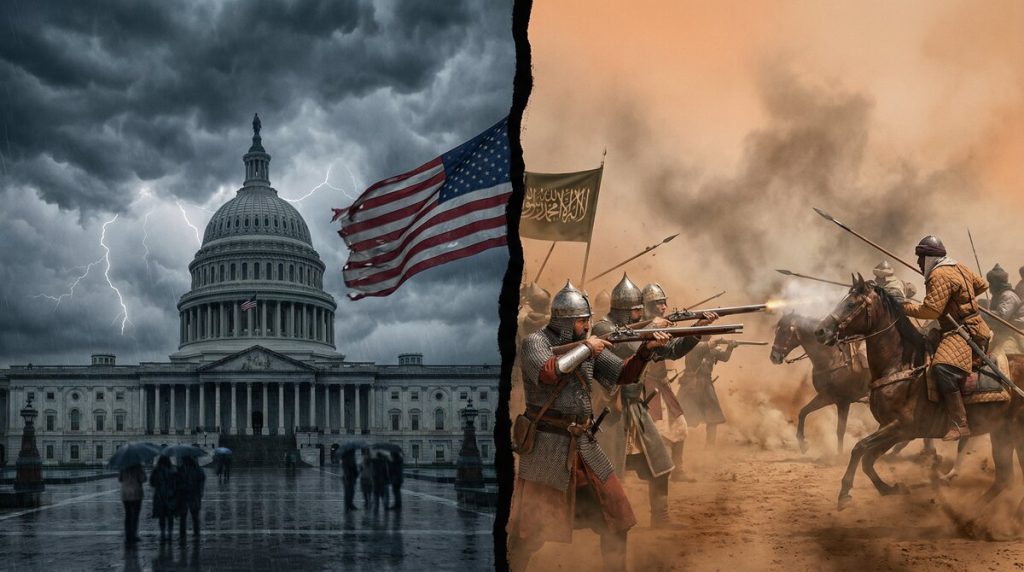
In the halls of power, a creeping paralysis has taken hold. The gears of the American government, once a symbol of decisive action, now grind to a halt, choked by the rust of partisan fury. Bills that would once have been debated and passed with bipartisan consensus now wither and die in committee, victims of a political class that has forgotten how to govern. We are witnessing a government at war with itself, a nation divided not by a foreign enemy, but by its own reflection.
This spectacle of legislative gridlock feels intensely modern, a unique sickness of our times. But the disease of a state consuming itself from within is an ancient one. Five hundred years ago, in the heart of West Africa, the mighty Songhai Empire, a beacon of wealth, learning, and power, faced its own crisis of internal division. Its leaders, consumed by ambition and blinded by factionalism, tore the empire apart from the inside, leaving it a hollow shell, ripe for conquest. This is the story of the Songhai Empire’s fall, and it is a chilling prophecy of what happens when a nation’s greatest enemy is itself.
The Golden Age of Songhai
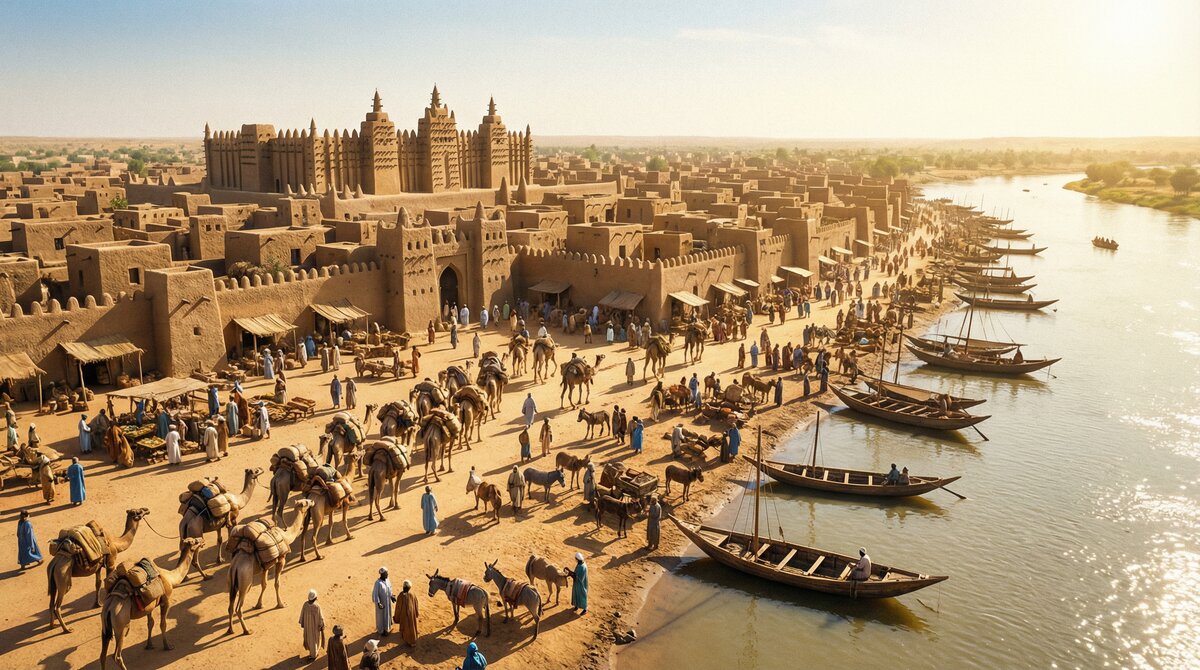
At its zenith in the early 16th century, the Songhai Empire was a titan of its age. Stretching over a thousand miles along the fertile bend of the Niger River, it was larger than Western Europe. Its capital, Gao, and the legendary city of Timbuktu were world-renowned centers of commerce and Islamic scholarship. Gold, salt, and slaves flowed through its trade routes, enriching an empire that was as intellectually vibrant as it was commercially powerful.
The architect of this golden age was Askia Muhammad the Great, a brilliant general and statesman who seized power in 1493. He centralized the administration, standardized weights and measures, and created a professional army. He was a devout Muslim who replaced traditional Songhai beliefs with a strict adherence to Islamic law, a move that solidified his authority and integrated the empire more deeply into the wider Muslim world. Under his rule, Songhai was not just a powerful state; it was a cohesive and well-ordered civilization. The University of Sankore in Timbuktu attracted scholars from across the Islamic world, and the empire’s legal and bureaucratic systems were the envy of its neighbors.
But the very strength of Askia’s rule contained the seeds of its destruction. His centralization of power created a system where the emperor’s authority was absolute, but it also made the question of succession a matter of life and death. There was no clear, agreed-upon mechanism for the transfer of power. The throne was not simply inherited; it was seized.
The Seeds of Destruction
When Askia Muhammad, old, blind, and frail, was overthrown by his own son, Askia Musa, in 1528, it unleashed a half-century of bloody dynastic struggles that would bleed the empire dry. Musa was a tyrant who purged his father’s loyalists and ruled through fear. He was, in turn, overthrown and killed by his brothers in 1531. What followed was a grim carousel of power: between 1528 and 1591, the Songhai Empire saw no fewer than nine different rulers, most of whom gained and lost the throne through violence.
Brother turned against brother, and son against father, in a relentless series of coups and assassinations. The empire was convulsed by civil war as rival claimants to the throne carved out their own fiefdoms. Provincial governors, once loyal servants of the central government, began to act as independent warlords, withholding taxes and raising their own armies. The professional army, once the guarantor of stability, became a king-making (and king-breaking) institution, its loyalty for sale to the highest bidder.
The administrative machinery that Askia had so carefully constructed ground to a halt. Tax revenues plummeted, the trade routes became unsafe, and the empire’s vast territories began to break away. The great cities of Timbuktu and Djenne, once jewels of the empire, became prizes to be fought over rather than centers of learning and commerce. The Songhai Empire had not been invaded. It had not been struck by plague or famine. It was simply eating itself alive.
The Battle of Tondibi: When the Wolves Arrived
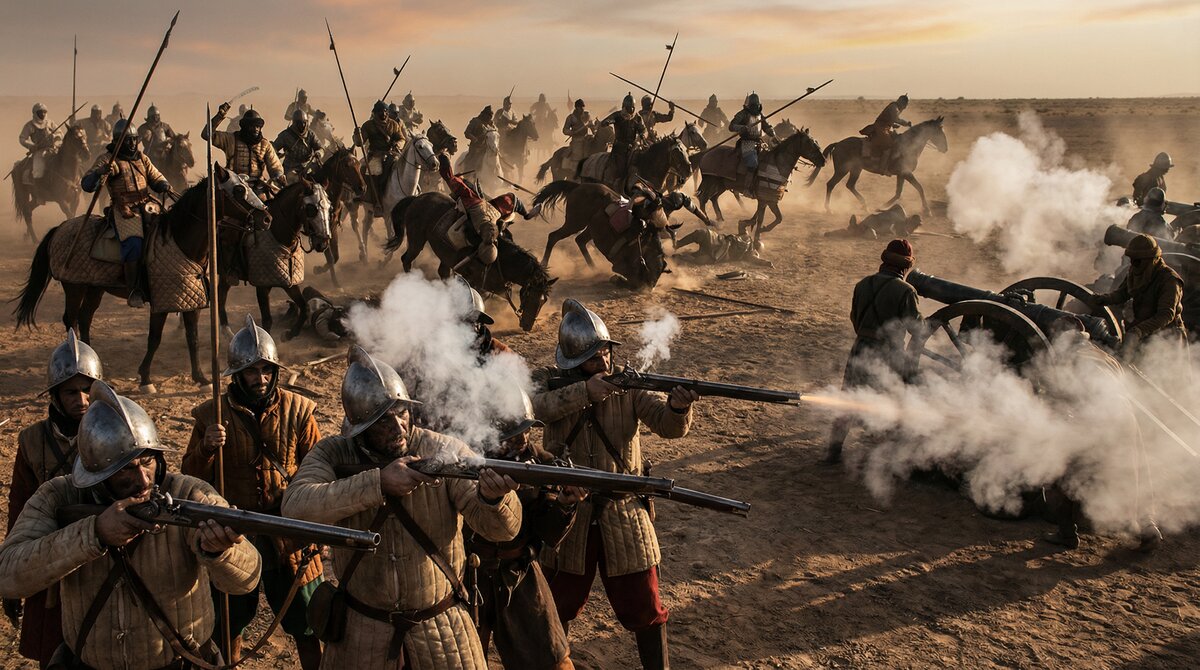
The final, fatal blow came not from within, but from across the vast expanse of the Sahara Desert. Sultan Ahmad al-Mansur of Morocco, eyeing the legendary gold wealth of Songhai, saw an opportunity in the empire’s self-inflicted weakness. In 1590, he dispatched a small but disciplined army of roughly 4,000 men, led by the Spanish-born eunuch Judar Pasha. The force was composed largely of European renegades and Moroccan musketeers. Critically, they were armed with arquebuses — a firearm technology that was entirely unknown in sub-Saharan West Africa.
The march across the Sahara was itself an epic of endurance. Hundreds of men and thousands of camels perished in the crossing. But the survivors who arrived on the banks of the Niger in March 1591 were a hardened, disciplined force with a devastating technological advantage.
At the Battle of Tondibi, on March 13, 1591, the Moroccan force met the Songhai army of Askia Ishaq II. The Songhai army, though numbering perhaps 30,000 or more, was a disorganized, disloyal rabble, a shadow of its former self. The Songhai reportedly drove a herd of cattle before their army, hoping to use the stampede to disrupt the Moroccan lines. It was a desperate, almost pathetic tactic. The noise and smoke of the Moroccan firearms terrified the cattle, which turned and stampeded back through the Songhai ranks, sowing chaos. The disciplined volleys of the arquebusiers then cut through the Songhai lines with merciless efficiency.
The Songhai Empire, which had dominated West Africa for over a century, was shattered in a single afternoon. Gao and Timbuktu fell without significant resistance. The greatest empire in African history had been brought to its knees not by a superior civilization, but by 4,000 men who simply walked through the door that the Songhai themselves had left wide open.
The Lesson for America
The fall of the Songhai Empire is not a story about military technology. It is a story about the fatal consequences of political paralysis. The Songhai were not defeated because they lacked resources, manpower, or strategic depth. They were defeated because their government had ceased to function. Decades of succession crises, factional infighting, and administrative gridlock had hollowed out the state from within, leaving it a magnificent but empty shell.
The parallels to modern America are not subtle. They are screaming. A political class consumed by partisan warfare. A government that lurches from crisis to crisis, unable to perform its most basic functions. Essential legislation that dies not because it lacks merit, but because compromise has become a dirty word. A nation so consumed by its internal squabbles that it is blind to the external threats gathering on the horizon.
The Eurasia Group, in its 2026 global risk assessment, identified the United States itself as the single greatest risk to the global economy — not China, not Russia, but America’s own political dysfunction. Like the Songhai Empire in its final decades, we have become our own worst enemy.
The lesson of Tondibi is brutally simple: internal division is a luxury no nation can afford. The wolves are always watching. And when the center cannot hold, they do not need to be strong. They only need to show up.
The Path to Self-Reliance
History teaches us that when great powers begin to rot from within, the time for dependency is over. The systems we have come to rely on — for our safety, our prosperity, and our future — are more fragile than we dare imagine. The time to prepare is not after the battle is lost. It is now.
This is not a call to despair, but a call to action. It is a call to embrace the principles of self-reliance that have always been the true bedrock of American strength. It is a call to build our own independent and resilient households and communities, to secure our own food, water, and energy, and to take control of our own destinies.
For those ready to take the first and most important step, the 4ft Farm Blueprint offers a proven, step-by-step path to food security and independence. In just a few square feet, you can begin growing enough fresh food to feed your family, regardless of what happens in Washington. But this is just the beginning. Explore the resources below to continue your journey towards true self-reliance:
- SurvivalStronghold.com — Your guide to preparing for any crisis, from natural disasters to economic collapse.
- SelfRelianceReport.com — News and analysis for the independent-minded American.
- HomesteaderDepot.com — The tools and knowledge for building a self-sufficient life.
- SevenHolistics.com — Health and wellness for a resilient future.
Do not wait for the system to save you. The lesson of the Songhai is clear: when the center cannot hold, you must become your own center. The time to act is now.