A special report from Shamus Gerry III
A government, at its core, is a protection racket. It takes your money in exchange for services and security. But what happens when the racket goes broke?
What happens when the enforcers can no longer be paid, and the people being shaken down refuse to pay?
The system collapses.
This is the fiscal death spiral America is now entering. The numbers are no longer just numbers; they are a countdown clock to a national heart attack.
Last week, the Congressional Budget Office released its latest projection: under current policies, the U.S. national debt will hit $53.1 trillion by 2035, a staggering 116% of GDP. In this fiscal year alone, we have already added over $1 trillion to the pile.
We are borrowing money just to pay the interest on the money we have already borrowed.
At the exact same moment, President Trump’s primary tool for raising revenue—tariffs—was gutted. The Supreme Court struck down his emergency tariffs, wiping out a stream of income that had already collected over $133 billion.
His response? Defiance. He lashed out at his own justices and immediately imposed a new, legally dubious 15% global tariff.
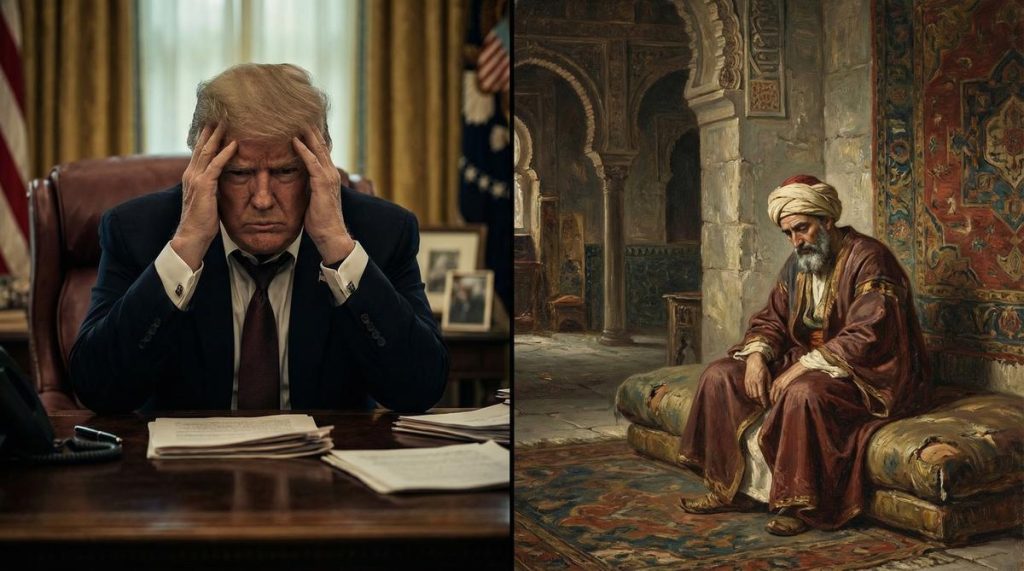
He is a man trying to plug a bursting dam with his fingers, while the reservoir behind it is being fed by a hurricane.
It feels like a uniquely modern crisis, a spreadsheet problem of zeroes and commas.
It is not.
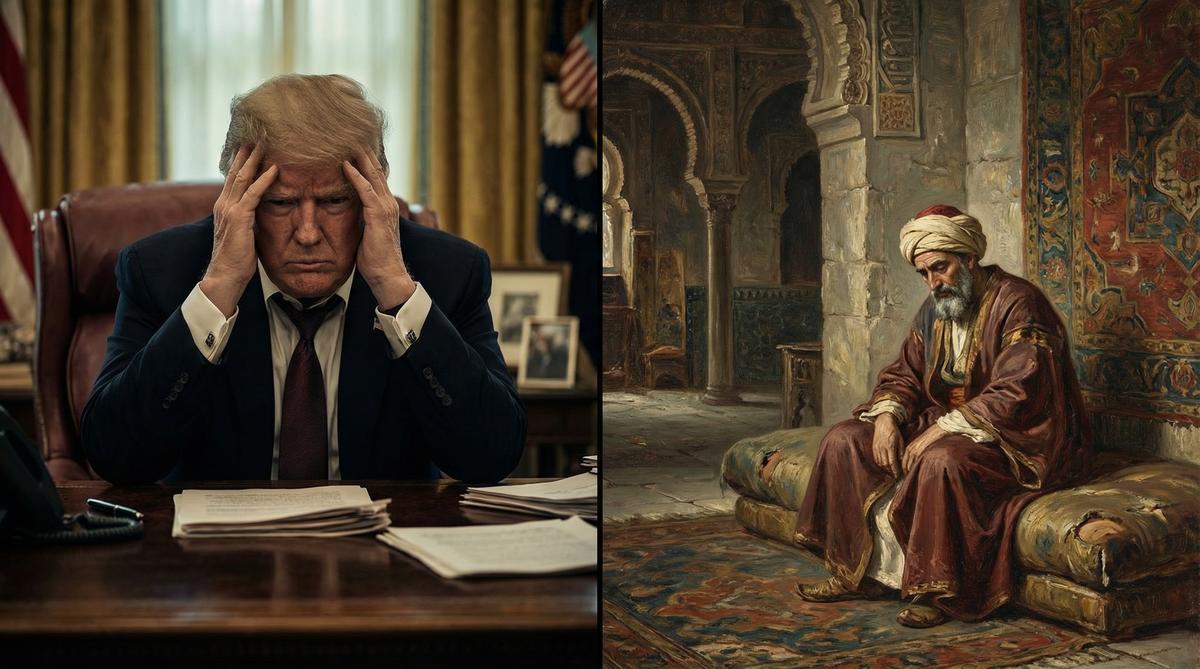
Thirteen hundred years ago, the largest empire on Earth, the Umayyad Caliphate, faced the exact same crisis. They ran out of other people’s money. And the story of their spectacular, violent collapse is a chilling prophecy of what happens when a government’s promises outstrip its ability to pay.
The Damascus Protection Racket
The Umayyad Caliphate (661-750 CE) was the largest empire the world had yet seen, stretching from Spain to the borders of India. But its entire fiscal system was built on a discriminatory premise: Arabs conquered, and everyone else paid.
Non-Arab Muslims, known as the mawali, were treated as second-class citizens. Even after converting to Islam, they were forced to pay the jizya, the heavy poll tax reserved for non-believers.
This created a perverse incentive. The more people who converted to Islam, the less tax revenue the government collected.
The great historian Al-Baladhuri reported that tax revenues from the Sawad, the fertile heartland of Iraq, dropped by as much as sixty percent during the later Umayyad period as the population converted.
Instead of reforming the system, the Umayyads doubled down. They spent lavishly on opulent desert palaces and endless military campaigns, funding it all on the backs of an increasingly resentful population.
The racket was becoming unsustainable.
The Black Banners of Khorasan
The breaking point came in the remote eastern province of Khorasan, a region populated by proud Persian landowners and disenfranchised mawali. It was here that a shadowy revolutionary figure known as Abu Muslim began to organize.
He didn’t just promise a new Caliph. He promised a new deal.
He promised an end to the Arab-first discrimination. He promised fiscal justice.
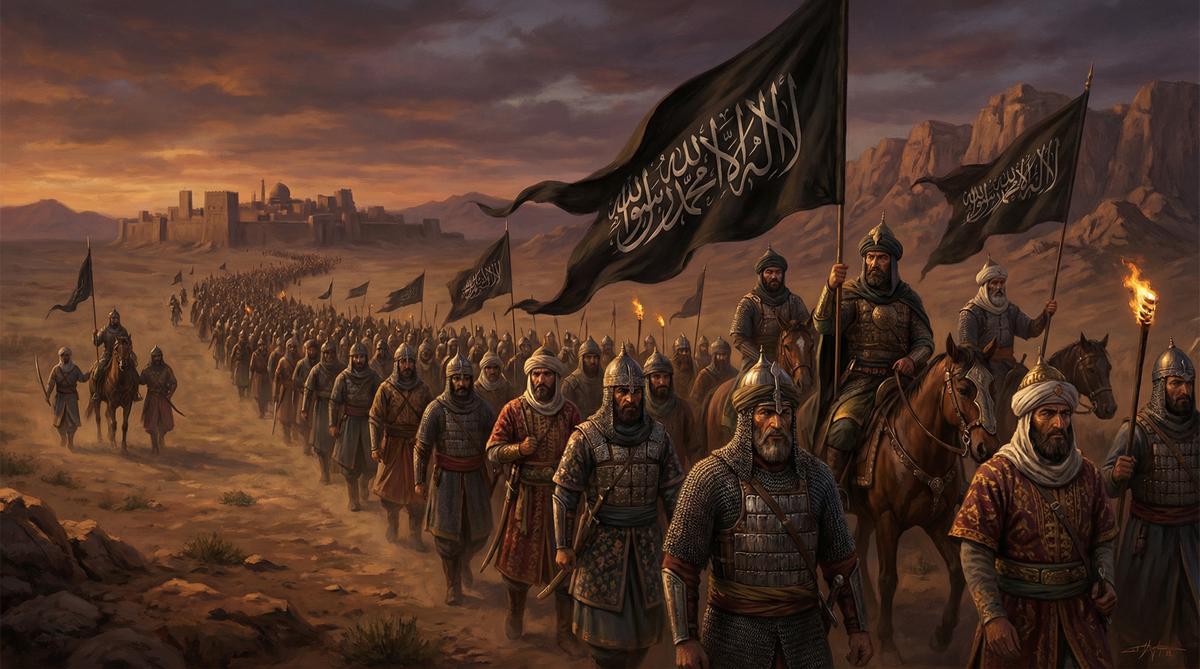
His followers marched under stark black banners, a symbol of mourning for the injustices of the past and a promise of revolutionary change. The movement spread like wildfire, uniting Shia rebels, Persian nationalists, and ordinary people simply fed up with a corrupt, bankrupt government.
Caliph Marwan II, the last Umayyad ruler, was a seasoned military commander. He was known as “the Donkey” for his stubbornness in battle.
But he was leading a hollowed-out empire.
He had armies, but he didn’t have the money to pay them.
When the black banners of the Abbasid revolution reached the banks of the Great Zab River in northern Iraq in January 750, the final act began. Marwan II, at the head of the main Umayyad army, faced Abu Muslim’s rebels.
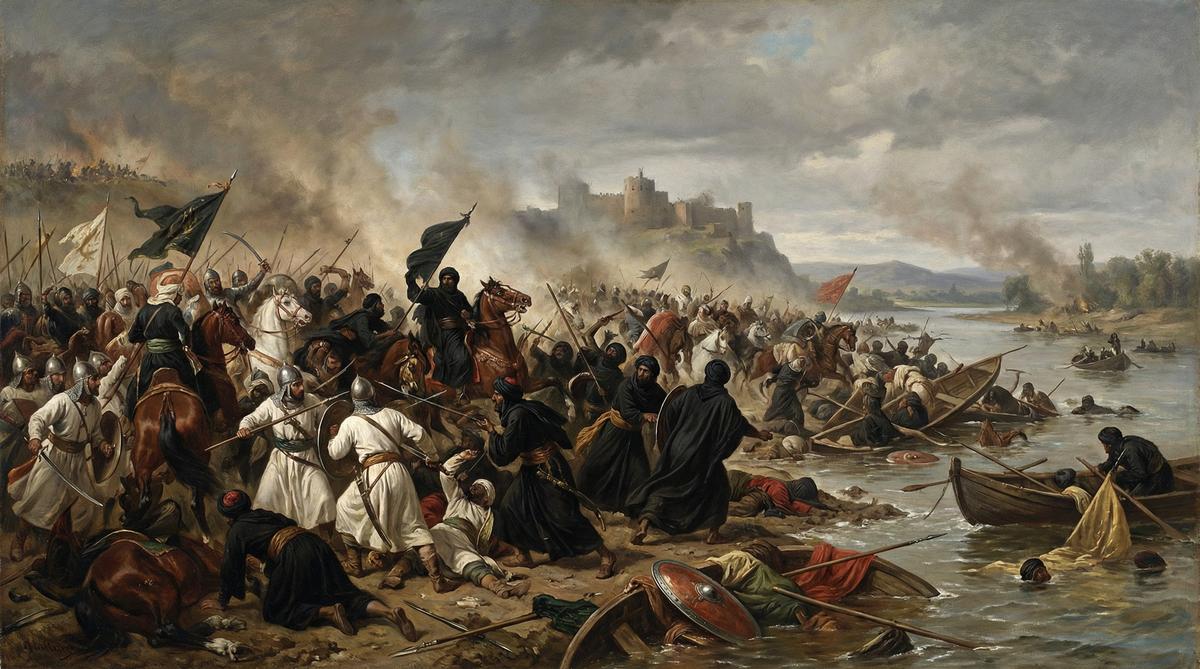
The battle was a slaughter. The Umayyad forces, demoralized and likely unpaid, were routed. Marwan II fled, a king without a kingdom, hunted across his former empire to Egypt, where he was finally killed.
The Umayyad dynasty, which had ruled for 89 years, was extinguished in a single afternoon.
The Abbasids, to ensure there would be no return, invited eighty remaining Umayyad princes to a “reconciliation banquet,” laid carpets over them, and clubbed them to death while they ate.
The protection racket had gone broke. And it had been violently replaced.
The Lesson: Debt is the Executioner
The Umayyads were not defeated by a foreign enemy. They were devoured from within by their own fiscal irresponsibility.
They made promises they couldn’t keep, created a tax system that was both unjust and unsustainable, and responded to the inevitable crisis with defiance instead of reform.
Sound familiar?
America’s national debt is no longer an abstract number. It is a national security threat. It is the dry tinder waiting for a spark.
President Trump’s defiant, ad-hoc tariff policy in the face of a spiraling deficit is the modern equivalent of the Umayyads squeezing the mawali one last time.
He is trying to fund the promises of an empire with a system that is fundamentally broken. The Supreme Court told him no. The CBO is screaming that the math doesn’t work.
And his response is to lash out and double down.
The black banners are not yet on the horizon. But the conditions that raise them are all here.
The Action: Declare Your Financial Independence
When the empire is writing checks it can’t cash, the only rational response is to take your own finances off their balance sheet.
True security is not found in government promises. It is found in self-reliance.
It is the quiet confidence of knowing that your family will eat, your home will be secure, and your future will be determined by your own actions — not by the frantic death throes of a bankrupt state.
This is why we created the 4ft Farm Blueprint. It is more than a guide to growing food; it is a system for reclaiming your sovereignty. It is the practical, step-by-step knowledge you need to build your own personal economy, one that is resilient to the fiscal storms gathering in Washington.
To understand the full scope of the challenges we face and the solutions available, explore our network of resources:
- HomesteaderDepot.com: Tools and knowledge for the self-reliant life.
- SelfRelianceReport.com: In-depth analysis of the threats to our freedom.
- SurvivalStronghold.com: Strategies for protecting your family in a crisis.
- SevenHolistics.com: Health independence from a broken medical system.
The Umayyads learned that fiscal reality is the one enemy you can never defeat. It is a lesson America is about to learn the hard way.
Will you be ready?