
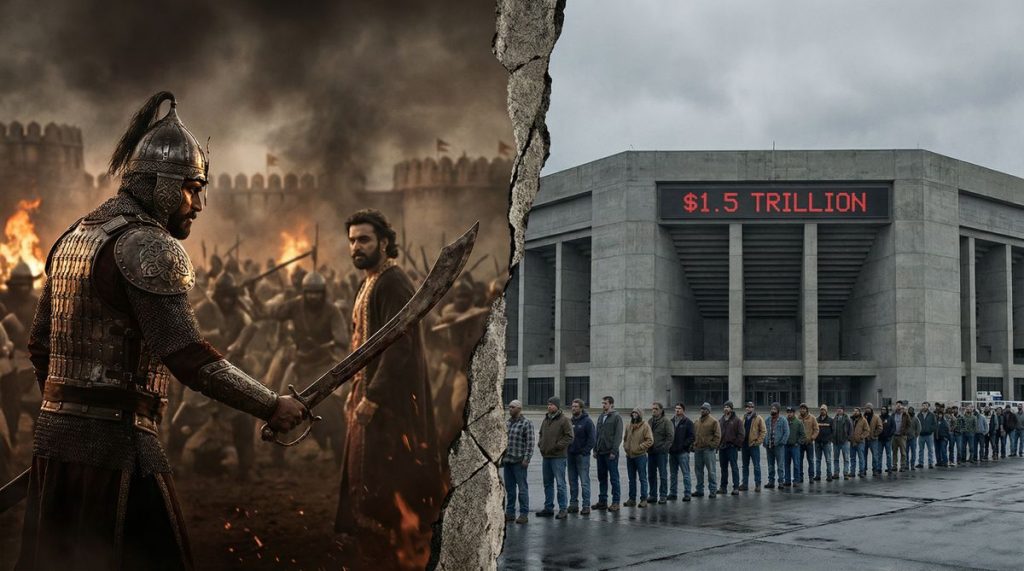
The United States is preparing to spend more money on its military than at any point since World War II.
The White House has just requested a staggering $1.5 trillion defense budget.
That is $4.1 billion every single day.
This historic surge in military spending comes at the exact moment the national debt has crossed $39 trillion. It comes as the Federal Reserve struggles to contain inflation, and as the average American household pays the hidden tax of a multi-front global conflict.
To fund this imperial overextension, domestic programs are facing steep cuts. The financial regulations designed to protect your bank account are being quietly dismantled.
We are watching the financial exhaustion of a superpower in real-time.
The political establishment believes that throwing another trillion dollars at the military will secure the empire. They believe that technological superiority and massive armies can compensate for a hollowed-out domestic economy.
But history tells a very different story.
We have seen this exact pattern before. It is the story of the wealthiest, most technologically advanced empire in Asia — an empire that fielded an army of over a million men, only to be utterly destroyed in a single afternoon.
Not because they were weak. But because they were betrayed from within.
The City of Victory
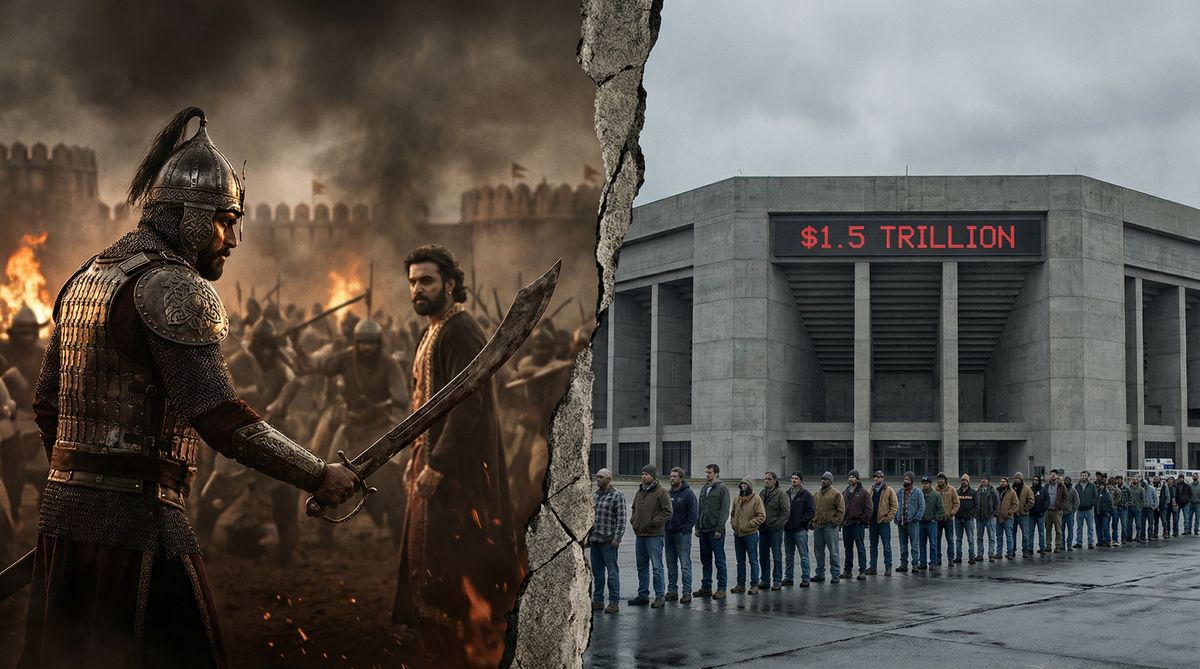
In the early 16th century, the Vijayanagara Empire was the undisputed master of southern India.
Its name literally translated to the “City of Victory.”
Ruling from a capital city that rivaled Rome in its grandeur, the empire controlled the lucrative spice trade, the diamond mines of Kollur, and the major ports of the Arabian Sea. European travelers who visited the capital described a city of unimaginable wealth, where merchants traded diamonds and rubies in the open markets.
They were an economic and military juggernaut.

To protect this vast wealth, the emperors of Vijayanagara built one of the largest standing armies the world had ever seen. At its peak, the military boasted over 100,000 infantry, 20,000 cavalry, and nearly a thousand armored war elephants.
They were the first in the region to deploy long-range artillery, manned by foreign mercenaries.
They believed their wealth and their weapons made them invincible.
But their strength was an illusion built on a fragile foundation. To maintain this massive military machine, the empire overextended itself. They engaged in constant, draining wars with the neighboring Deccan sultanates.
To fund these endless conflicts, the state squeezed its own citizens.
The wealth of the empire was concentrated at the top, while the foundation rotted.
The Battle of Talikota
The breaking point arrived in January 1565.
The neighboring sultanates, tired of Vijayanagara’s constant interference and military aggression, formed an unprecedented alliance. They marched south to confront the empire at the Battle of Talikota.
On paper, it shouldn’t have been a contest.
The Vijayanagara army was vastly larger. They had the wealth, the numbers, and the established power.
But the empire had made a fatal miscalculation.
They had grown so arrogant, so reliant on their massive military budget, that they ignored the rot within their own ranks. The emperor, Rama Raya, had hired thousands of foreign mercenaries and rival generals to staff his army, believing his wealth could buy their loyalty.
As the battle raged, the Vijayanagara forces appeared to be winning. Their sheer numbers were overwhelming the alliance.
And then, the betrayal happened.
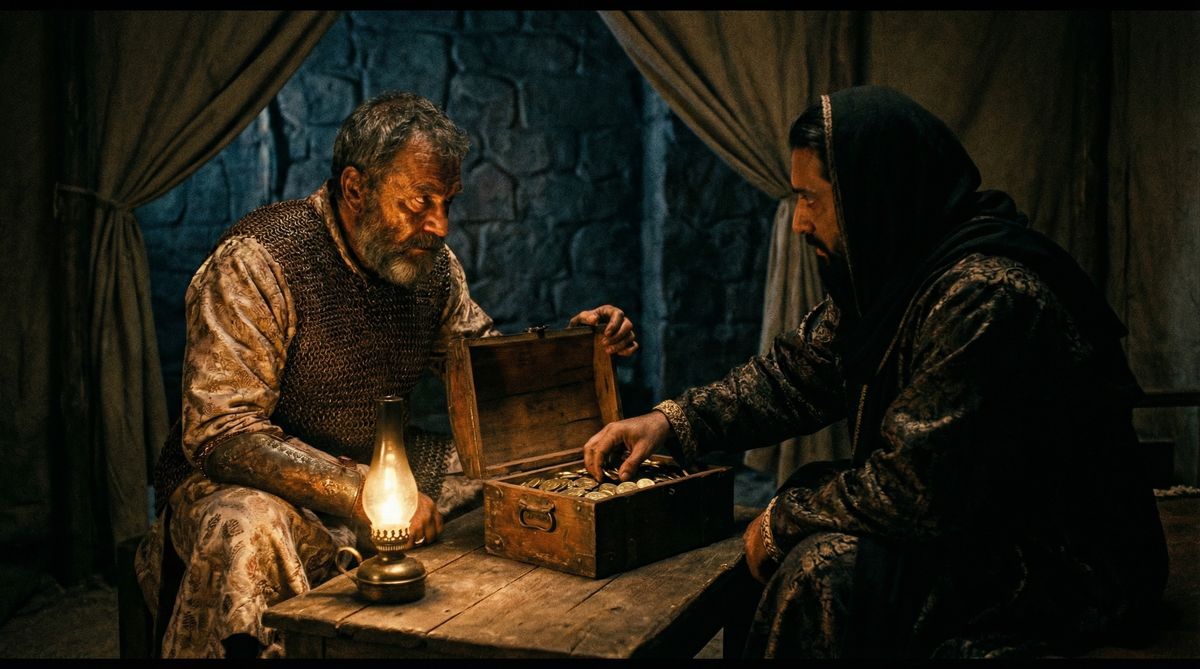
At the decisive moment of the battle, two of Vijayanagara’s top generals — men who had been paid handsomely by the state — suddenly switched sides. They turned their weapons on their own emperor.
The command structure collapsed instantly.
Rama Raya was captured and beheaded on the battlefield. The massive, expensive army dissolved into chaos and fled.
In a matter of hours, the greatest empire in Asia was broken.
The victorious alliance marched on the capital, the “City of Victory.” For five months, they plundered its unimaginable wealth, smashing its temples and burning its markets. The city was reduced to ruins, never to recover.
The empire didn’t fall because it lacked military funding. It fell because its institutions were hollow, and its leaders were betrayed by the very people they paid to protect them.
The Lesson for America
The parallels to modern America are terrifying.
Today, the United States is attempting to solve a crisis of internal rot by throwing $1.5 trillion at the military. We are funding proxy wars, deploying fleets, and expanding our global footprint while the domestic economy crumbles under $39 trillion in debt.
We are building a massive military machine on a foundation of sand.
Just like Vijayanagara, our leaders believe that financial leverage and technological superiority can mask the deep fractures in our society. They believe they can buy loyalty and security.
But look at the institutions designed to protect us.
Financial regulations are being rolled back, exposing regional banks to catastrophic risk. The political class is deeply fractured, fighting endless partisan wars while the middle class is hollowed out by inflation.
The betrayal is already happening.
It is not a betrayal on a battlefield. It is the betrayal of the American middle class by an establishment that prioritizes global military dominance over domestic economic stability.
When the crisis comes — whether it is a debt spiral, a banking collapse, or a supply chain failure — the $1.5 trillion military budget will not protect your family.
The state will protect itself first.
The Turn: The Path to Resilience
It is easy to look at this pattern and feel a sense of despair. To see yourself as a pawn in a game of empires.
But history teaches another, more powerful lesson.
When the great, centralized systems fail, they create a vacuum. And into that vacuum rushes the opportunity for something new. The survivors of the Vijayanagara collapse weren’t the ones who simply hid in the ruins.
They were the ones who rebuilt.
They were the ones who focused on their local communities, who strengthened their own skills, and who created resilient networks of trade and mutual support outside the reach of the fallen empire.
This is not a call to hide from the world.
It is a call to build a better one, starting in your own backyard.
When the institutions you rely on prove hollow, the only logical response is to build your own. True security doesn’t come from a $1.5 trillion defense budget. It comes from what you can control, what you can grow, and what you can build with your own hands.

The Action: The Blueprint for Hope
Building a resilient future starts with a single, powerful step: taking control of your own resources.
The 4ft Farm Blueprint is not just about survival; it’s about sovereignty. It’s the first chapter in your family’s story of independence, a story where you are the builder, not the victim.
Every raised bed you plant is a direct hedge against the inflation caused by endless foreign wars. Every skill you learn is an asset that cannot be taxed, inflated away, or betrayed by a hollow institution.
You can build your own oasis of independence.
Start building today.
For more strategies on building true independence, explore our network of resources:
- Survival Stronghold: Secure your perimeter and resources before the crisis hits.
- Self Reliance Report: Learn how to build true sovereignty at the household level.
- Seven Holistics: Build internal resilience against the stress of an overextended system.
- Homesteader Depot: Equip yourself with the tools and skills that don’t depend on the imperial treasury.