A special report from Shamus Gerry III
It is happening with breathtaking speed.
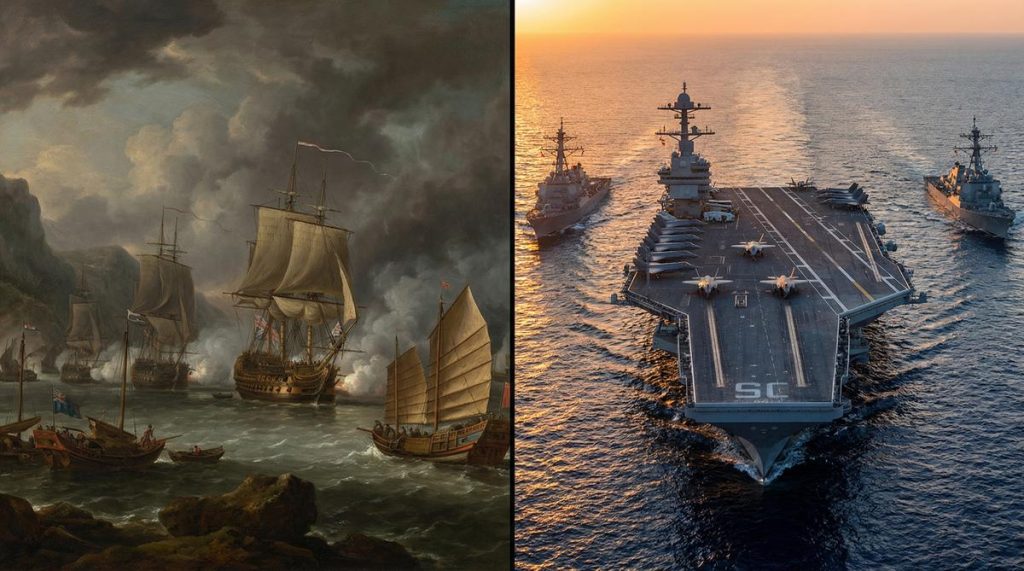
In the last 48 hours, the United States has amassed the largest concentration of military power in the Middle East since the invasion of Iraq. More than 120 advanced fighter jets have been deployed. The USS Abraham Lincoln carrier strike group, already on station, is being joined by the world’s largest warship, the USS Gerald R. Ford.
Two steel cities, bristling with aircraft and missile destroyers, now sit within striking distance of Iran.
President Trump has delivered the ultimatum: Iran has “10 to 15 days” to accept a new deal on its nuclear program. The unspoken threat hangs heavy in the air, thick as the smoke from a burning oil field.
This is gunboat diplomacy in the 21st century.
We are told this is a necessary show of force, a prudent measure to ensure regional stability and prevent nuclear proliferation. A strategic chess move by a global superpower.
But it is not a new move. It is the oldest, most arrogant, and most dangerous play in the imperial handbook.
Nearly 200 years ago, another global superpower, convinced of its own righteousness and the invincibility of its military, sailed a fleet of advanced warships to the coast of a proud, ancient nation to force it to bend to its economic will. That nation was Great Britain. The target was China.
And the conflict that followed—a war fought over drugs and silver—offers a chilling prophecy of the catastrophe America is now courting in the Persian Gulf.
The Empire of Smoke: A Silver Drain and a Poisonous Solution
In the early 19th century, Great Britain ruled the waves, but China ruled the marketplace.
For decades, a tidal wave of Chinese goods—silk, porcelain, and especially tea—flowed into Europe. The British public had an insatiable appetite for it. But the Chinese, under the Qing Dynasty, wanted almost nothing from the West in return, except for one thing: silver.
This created a staggering trade deficit that drained the British treasury. Silver poured out of London and into Canton, the only port the Qing Emperor permitted for foreign trade.
It was an economic hemorrhage that Britain could not sustain.
So, they devised a solution. A product so addictive, so destructive, that it would reverse the flow of silver by force.
Opium.
The British East India Company began to cultivate vast fields of opium poppies in its Indian colonies. They smuggled the drug up the coast to Canton, where corrupt officials and criminal syndicates distributed it throughout China.
The effect was immediate and devastating. Millions became addicts. Society began to fray. And silver, once flowing into China, now flooded out to pay for the British poison.
By the 1830s, the Qing Emperor had seen enough. He appointed a man of unimpeachable integrity, Commissioner Lin Zexu, to end the opium trade for good.
In 1839, Lin blockaded the foreign factories in Canton and demanded they surrender their opium. After a tense standoff, the British merchants handed over more than 20,000 chests of the drug—over 1,400 tons of raw opium.
Lin had it all destroyed, mixing it with lime and salt and flushing it into the sea.
He believed he had won a great moral victory.
In London, it was seen as an act of war.
The Nemesis and the Humiliation: When Technology Crushes Tradition
The British response was swift and brutal.
They didn’t see the destruction of poison; they saw the destruction of property. The call for retribution was overwhelming. In 1840, a modern British expeditionary force arrived off the coast of China.
It was a technological mismatch of horrifying proportions.
The Chinese navy consisted of traditional wooden junks, powered by sail and oar. The British brought the future.
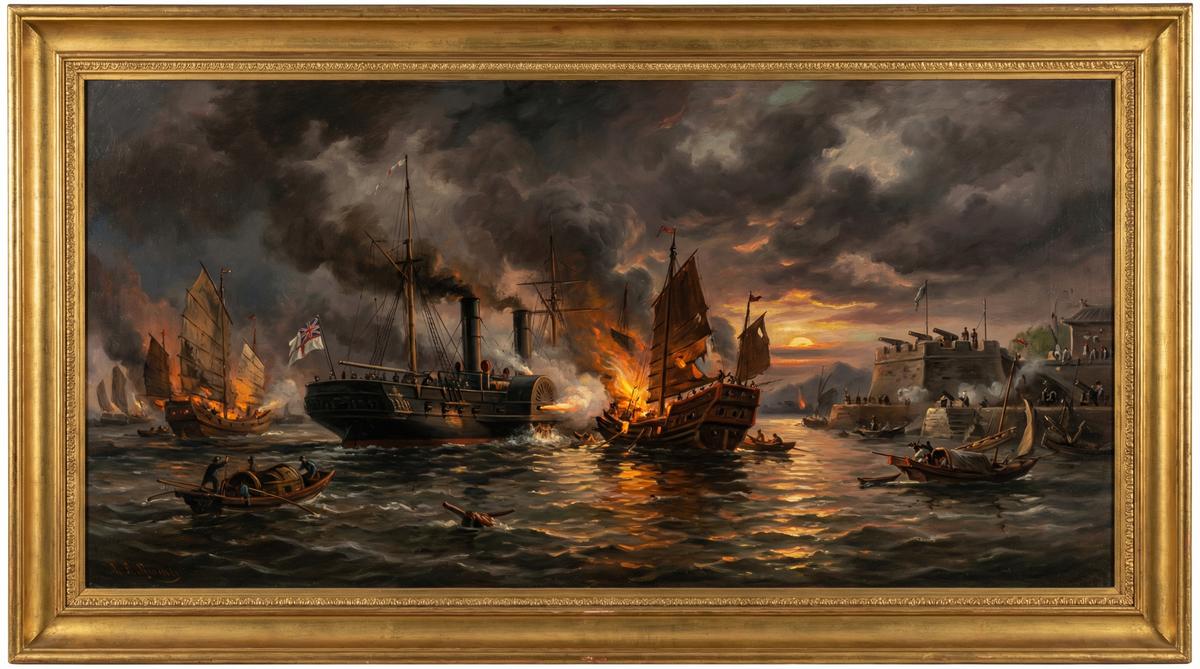
Their fleet included the Nemesis, the first ocean-going ironclad warship. Powered by steam, it could sail against the wind and tide, armed with pivoting cannons and rockets. It was a monster, impervious to Chinese cannonballs.
It could glide upriver and rain fire upon forts and cities with impunity.
The First Opium War was a showcase of military disparity. In one engagement, the Battle of Chuenpi, the British suffered zero casualties while sinking numerous Chinese junks and killing an estimated 500 Chinese soldiers.
The war was a series of foregone conclusions. The British fleet sailed up and down the coast, bombarding ports, seizing cities, and crushing any resistance.
The Qing Dynasty, for all its ancient power and cultural grandeur, was helpless.
In 1842, with British warships anchored in the Yangtze River and threatening the ancient capital of Nanking, the Emperor surrendered.
The resulting Treaty of Nanking was the beginning of China’s “Century of Humiliation.” China was forced to pay massive reparations, cede the island of Hong Kong to Britain, and open five of its ports to foreign trade.
The opium trade, the very cause of the war, continued unabated.
Britain had won. But it had created a wound that would never fully heal, fueling a century of resentment, instability, and revolution.
The Lesson: The Arrogance of the Gunboat
The parallels between Britain’s actions in 1840 and America’s actions today are impossible to ignore.
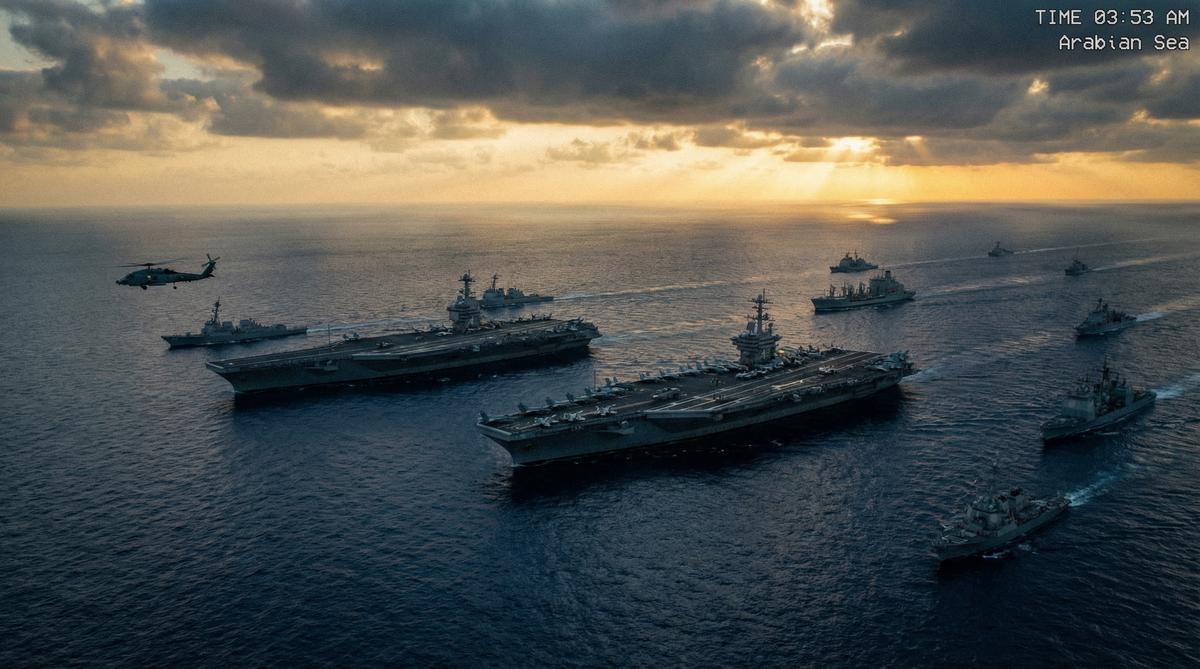
It is the same imperial arrogance, the same belief that overwhelming military force can solve a complex economic and political problem. It is the hubris of a superpower that believes its advanced technology—the ironclad Nemesis then, the F-35 stealth fighter now—makes it invincible and its will unquestionable.
Economic Coercion: Britain used its navy to force open a market for its drugs. The United States is using its navy to force a nation to the negotiating table on its own terms, using the threat of economic annihilation as its primary weapon.
The Illusion of a “Surgical” Strike: The British believed they could teach the Qing a quick, sharp lesson and be done with it. Instead, they destabilized a nation of 400 million people, setting off a chain reaction of rebellions and collapse.
Does anyone in Washington truly believe a strike on Iran—a proud nation of 88 million—would be a clean, contained affair?
The Blowback: The Opium War did not secure Britain’s dominance; it sowed the seeds of its eventual decline. It exposed the brutal reality of colonialism and fueled the rise of Chinese nationalism.
A US attack on Iran would ignite the Middle East, send oil prices to catastrophic highs, and create a new generation of enemies dedicated to America’s downfall.
The ghost fleet is sailing again.
The same logic that led to the humiliation of China is now being deployed in the Persian Gulf. The belief that might makes right, that a show of force can bend history to your will.
History screams that this is a lie.
The Action: Build Your Own Lifeboat
When empires clash, when gunboats appear on the horizon and ultimatums are issued, the lives of ordinary people are the first casualty.
The fallout from these geopolitical games is not contained to the battlefield. It ripples through the global economy, shatters supply chains, and devalues the money in your pocket.
The stability we take for granted is an illusion, dependent on the whims of leaders playing with fire thousands of miles away.
You cannot stop the fleet from sailing. You cannot talk sense into an empire convinced of its own power.
You can only control what is yours. You can only build your own lifeboat.
True security is not found in the pronouncements of presidents or the movements of aircraft carriers. It is found in the soil. It is found in the ability to provide for yourself and your family when the fragile systems we depend on inevitably break.
This is why we have spent years developing the 4ft Farm Blueprint. It is a system designed for absolute self-reliance, a way to produce your own clean, healthy food in a tiny, 4-foot square space, insulated from the chaos of the outside world.
It is the most practical, effective step you can take today to declare your independence from a system teetering on the brink.
When the supply chains snap and the grocery store shelves are empty, the 4ft Farm will be your lifeline.
For those who understand the gravity of this moment, we also urge you to explore the resources our sister sites provide:
- Self Reliance Report — In-depth analysis and guides for surviving the crises that are no longer coming, but are already here.
- Homesteader Depot — The tools and knowledge you need to build a truly independent life.
- Freedom Health Daily — Because your health is your most important asset in times of turmoil.
- The Ready Report — Premium intelligence for those who need to stay two steps ahead.
- Seven Holistics — Natural health solutions for a world that’s anything but natural.
- The Pattern Ledgers — The historical patterns that predict what happens next. Because history doesn’t repeat, but it rhymes.
Do not wait for the crisis to arrive. The warning shots have already been fired.
The ghost fleet is on the move. The time to prepare is now.