The Last Caravan: How a 435-Year-Old African Empire’s Collapse Foretells America’s Coming Economic Shock
The numbers on the screen are bleeding red again. It’s a feeling you know in your bones now, a low hum of anxiety that has become the background radiation of modern life. The Dow is down another 800 points, a cascade of crimson wiping away months of fragile gains. A talking head on the television, his face a mask of feigned gravity, is using words like “unprecedented” and “systemic risk,” words that have lost all meaning through overuse.
You feel it more viscerally at the gas pump, where the numbers on the digital display spin with a dizzying speed, each gallon a little more of your paycheck evaporating into the ether. You feel it at the grocery store, where the bill for the same cart of food is 15% higher than it was last month, forcing quiet, painful decisions in the aisle. And you feel it in the relentless scroll of headlines on your phone — a distant war in the Middle East suddenly not so distant, a trade war of tariffs and counter-tariffs that feels like a game played by elites with your family’s budget, a government that seems to be pouring gasoline on the fire with every contradictory press conference.
This feeling — this low-grade, persistent dread that the complex, invisible systems we rely on for everything are beginning to buckle under their own weight — is the defining feature of our time. We are told it is complex, a result of a thousand interlocking factors, from monetary policy to geopolitical tensions. But what if it’s simple? What if the story of our profound, terrifying fragility has been told before, written not in stock charts, but in the dust of a fallen empire?
For the answer, we don’t look to the trading floors of Wall Street or the marble halls of Washington. We look to the shimmering sands of the Sahara, to a single, catastrophic day in 1591 when the world’s most powerful and sophisticated empire died, and the last great caravan of gold dust and salt blocks turned back into the desert, never to return.
The Empire Built on Gold and Salt
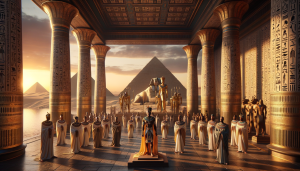
In the 16th century, to speak of the Songhai Empire was to speak of power itself. It was a titan, the largest and most powerful state in West African history, a sprawling dominion that stretched over a thousand miles from the Atlantic coast deep into the heart of the Sahel. Its great cities—Timbuktu, Gao, Djenné—were not provincial backwaters; they were world-renowned centers of scholarship, culture, and commerce, jewels of the Islamic world.
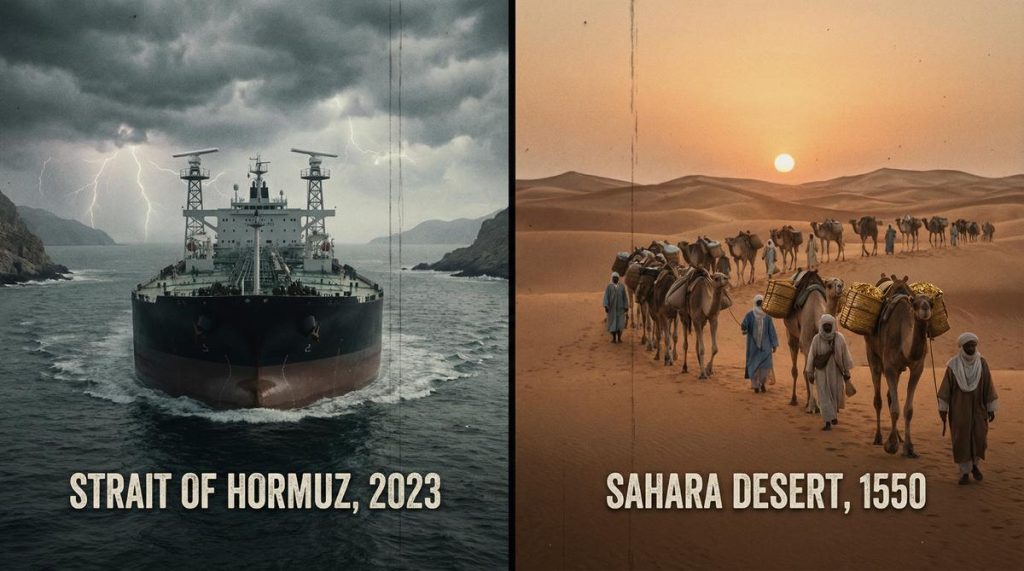
Imagine Timbuktu in the year 1550. It is a city of over 100,000 souls, a bustling, cosmopolitan metropolis where the air is thick with the scent of spices and the murmur of a dozen languages. In the legendary Sankore University, scholars—astronomers, mathematicians, physicians, and theologians—debate the finer points of law and philosophy. Its libraries held hundreds of thousands of manuscripts, hand-copied and bound in leather, a repository of knowledge that rivaled any in Europe. This was no primitive kingdom; it was a civilization at its zenith.
But this vast, glittering empire was built on a single, critical foundation: its absolute control of the trans-Saharan trade routes. For centuries, the economies of West Africa and North Africa had been locked in a symbiotic, life-giving dance. West Africa, particularly the regions of Bambuk and Bure, held gold—immense, almost mythical quantities of it. North Africa, from the salt pans of Taghaza deep in the desert, produced salt, a mineral as precious as gold for preserving food in the sweltering climate and essential for life itself. The caravans, some numbering as many as 10,000 camels, that snaked across the desert carrying these two commodities were the arteries of an entire civilization.
The Songhai emperors, particularly the legendary Askia Muhammad I who reigned from 1493 to 1528, became fabulously wealthy by taxing and protecting this trade. Askia the Great was more than a warlord; he was a visionary administrator. After his famous pilgrimage to Mecca, he returned with Muslim scholars and jurists, reorganizing his vast empire along sophisticated bureaucratic lines. He standardized weights and measures, established a professional army and navy of canoes to patrol the vital Niger River, and created a system of inspection that ensured the fairness and safety of the markets. Under his rule, the Songhai Empire entered a golden age of peace and prosperity. The emperors in their palaces in Gao, surrounded by unimaginable wealth, believed their power was absolute, their golden age endless. They were wrong.
The Day the World Stopped Moving
Across the desert, another ambitious ruler watched the river of gold flowing north with envious eyes. Sultan Ahmad al-Mansur of Morocco, flush with the prestige of his victory over the Portuguese at the Battle of the Three Kings, had a problem. He had a modern, expensive army to maintain, one equipped with the latest in European military technology. He needed gold, and he knew where it came from.
In 1590, against the advice of his own counselors who warned against attacking a fellow Muslim state, al-Mansur made a fateful decision. He dispatched an army of 4,000 of his most elite soldiers, led by a Spanish eunuch named Judar Pasha. This was no traditional army. It was a modern killing machine, armed not with swords and spears, but with thousands of European-made arquebuses and a half-dozen cannon. Their mission: to march for twenty weeks across the most unforgiving terrain on earth, the Sahara Desert, and seize the source of the Songhai’s wealth.
The journey was an epic of suffering. Men died of thirst, buried by sandstorms, and picked off by desert nomads. But Judar Pasha was relentless. In early 1591, a depleted but still formidable force emerged from the desert and marched on the heart of the Songhai Empire.
The Songhai emperor, Askia Ishaq II, was not idle. He gathered a massive force of over 40,000 warriors to meet the invaders. It was a traditional African army, a magnificent spectacle of cavalry and infantry, armed with spears, swords, and bows, confident in their overwhelming numbers and their centuries-old martial traditions. They met the Moroccans at a place called Tondibi, near the city of Gao, on March 13, 1591. It was a slaughter.
The Songhai warriors had never faced gunpowder on this scale. The noise of the arquebuses was terrifying, a deafening roar that seemed to tear the sky apart. The smoke choked them, and the lead balls ripped through their leather shields and unarmored bodies with horrifying ease. The disciplined volleys of the Moroccan fusiliers cut down the charging Songhai cavalry before they could even get close. In a desperate, brilliant tactical move, the Songhai drove a herd of a thousand cattle toward the Moroccan lines, a living battering ram to break their formation. But the cattle, terrified by the thunder of the gunfire, turned and stampeded back through the Songhai’s own ranks, trampling warriors and completing the utter rout.
The empire did not decline; it shattered in a single afternoon. The Battle of Tondibi was not just a military defeat; it was the death of a world. Timbuktu was sacked, its libraries looted and burned, its scholars killed or enslaved. Gao was captured. The central authority that had protected the trade routes for centuries vanished overnight. The caravans, fearing the chaos and the bandits that now ruled the desert, stopped. The gold-salt trade, the economic engine of a continent, collapsed. The great cities, starved of their commercial lifeblood, withered. Timbuktu, once a metropolis of 100,000, shrank to a dusty, impoverished outpost. The wealth was gone. The last caravan had made its final journey.
The Lesson of the Last Caravan
The Songhai Empire made a fatal, civilizational mistake. They believed their power was in their size, their wealth, their traditions, and the courage of their warriors. They failed to understand that their power was entirely dependent on the fragile arteries of trade that pulsed across the desert. They were utterly unprepared for a new kind of threat, a technological and strategic disruption that could sever those arteries in a single, bloody afternoon.
Today, we are making the same mistake, on a global scale. We have built an economy of breathtaking complexity, a marvel of logistics and finance, but it is a system of profound, hidden fragility. We are utterly dependent on just-in-time supply chains that snake across oceans, on financial systems that exist as digital abstractions, and on the free, uninterrupted flow of goods through a handful of narrow, vulnerable chokepoints. The Strait of Hormuz, through which 20% of the world’s oil flows, is just 21 miles wide at its narrowest point. The Suez Canal. The Strait of Malacca. The Taiwan Strait, through which the world’s most advanced semiconductors pass. These are our generation’s trans-Saharan trade routes.
Like the Songhai, we are fighting the last war. We worry about stock market corrections and interest rate hikes when the real, existential threat is the physical movement of goods grinding to a halt. We trust in our financial wizardry and our overwhelming military superiority, just as the Songhai trusted in their 40,000 spears. We have forgotten the simple, brutal lesson of Tondibi: when the caravans stop, the wealth is meaningless. The gold in the vaults of Gao could not save the empire when the salt could no longer reach it.
The Turn: The Path to Resilience
It is easy to look at this pattern—the pattern of history—and feel a sense of crushing despair. To see yourself as a pawn in a great and terrible game of empires, a helpless spectator to the collapse of vast, impersonal systems you cannot control.
But history teaches another, more powerful lesson, a lesson written not in the chronicles of kings but in the quiet endurance of ordinary people. When the great, centralized systems fail, they create a vacuum. And into that vacuum rushes the opportunity for something new, something more human-scaled and resilient. The Songhai people did not vanish. The survivors of the empire’s collapse weren’t the wealthy merchants of Timbuktu whose fortunes evaporated overnight. They were the villagers in the Niger River Valley, the farmers and the artisans who knew how to grow their own food, who maintained their local communities, and who possessed the timeless skills of self-reliance. The empire died. The people endured.
This is not a call to hide from the world, to retreat into a bunker of fear. It is a call to **build a better one**, starting in your own backyard, in your own community. It is a recognition that true wealth isn’t a number in a bank account that can be wiped out by a distant war or a market crash. True wealth is the knowledge in your head, the skills in your hands, and the strength of your community. It is the ability to thrive with or without the sanction of a distant emperor.
The Action: The Blueprint for Hope
You cannot personally negotiate a peace treaty in the Middle East. You cannot steer an oil tanker through a warzone. You cannot reprogram the Federal Reserve’s interest rate policy. But you are not helpless. The ultimate lesson of the last caravan is that when the great systems of empire prove their fragility, true prosperity and a lasting legacy belong to those who build their own, smaller, more resilient worlds.
Building that resilient future starts with a single, powerful, and deeply satisfying step: taking control of your own food supply. The **4ft Farm Blueprint** is not just about survival; it’s about sovereignty. It’s the first chapter in your family’s story of independence, a story where you are the builder, not the victim. It is the first stone you lay in the foundation of a world that you control, a world that can weather the storms of history. The Songhai merchant who lost his gold was ruined. The Songhai farmer who knew how to work the land fed his family. The choice is that stark. The choice is yours.
Click here to learn more and start building your own blueprint for resilience.
A special report from Shamus Gerry III
Also see: HomesteaderDepot.com | SelfRelianceReport.com | SurvivalStronghold.com | SevenHolistics.com | TheReadyReport.com | FreedomHealthDaily.com