A special report from Shamus Gerry III
The Hook: A Nation Shutting Down on Itself
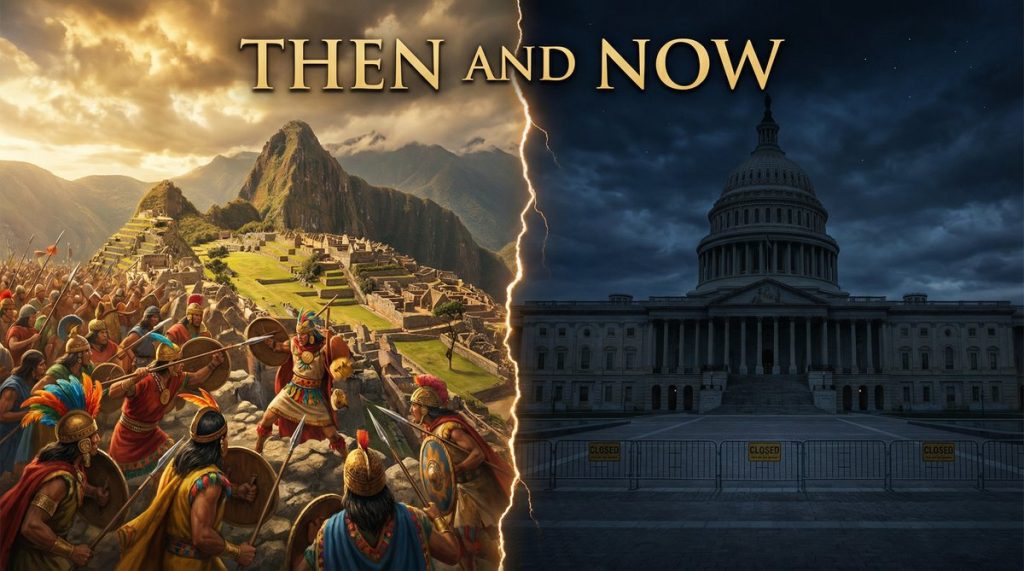
Washington is broken. As of midnight on February 14, 2026, large swaths of the Department of Homeland Security will grind to a halt. Senate Democrats, citing a crisis of conscience over immigration enforcement tactics and the lack of new restrictions on ICE, voted Thursday to block a crucial funding bill. The House had already left town. Senator Katie Britt of Alabama tried to pass a two-week extension, but Senator Chris Murphy of Connecticut blocked that, too. There is no deal in sight. FEMA, the Secret Service, the Coast Guard, the TSA — the agencies that stand between ordinary Americans and catastrophe — are being held hostage in a political standoff between two factions that have forgotten what they are supposed to be protecting.
This is not a new story. It is, in fact, one of the oldest stories in the world. And its most devastating chapter was written not in the halls of Congress, but high in the Andes mountains, five hundred years ago, by two brothers who destroyed the greatest empire in the Americas because neither one could bear to share power.
The Pivot: A Throne Divided Cannot Stand
In 1527, the Inca Empire — known to its people as Tawantinsuyu, “the four regions together” — was the largest and most sophisticated civilization in the Western Hemisphere. Stretching over 2,500 miles along the spine of South America, from modern-day Colombia to Chile, it was a marvel of engineering, agriculture, and centralized governance. Its road system rivaled Rome’s. Its agricultural terraces fed millions. Its emperor, the Sapa Inca, was considered a living god.
Then the god died. Huayna Capac, the eleventh Sapa Inca, succumbed to what historians now believe was smallpox — a European disease that had raced ahead of the European invaders themselves. He died without naming a clear successor. And in that single failure of leadership, the seeds of an empire’s destruction were sown.
The Story: The War of the Two Brothers
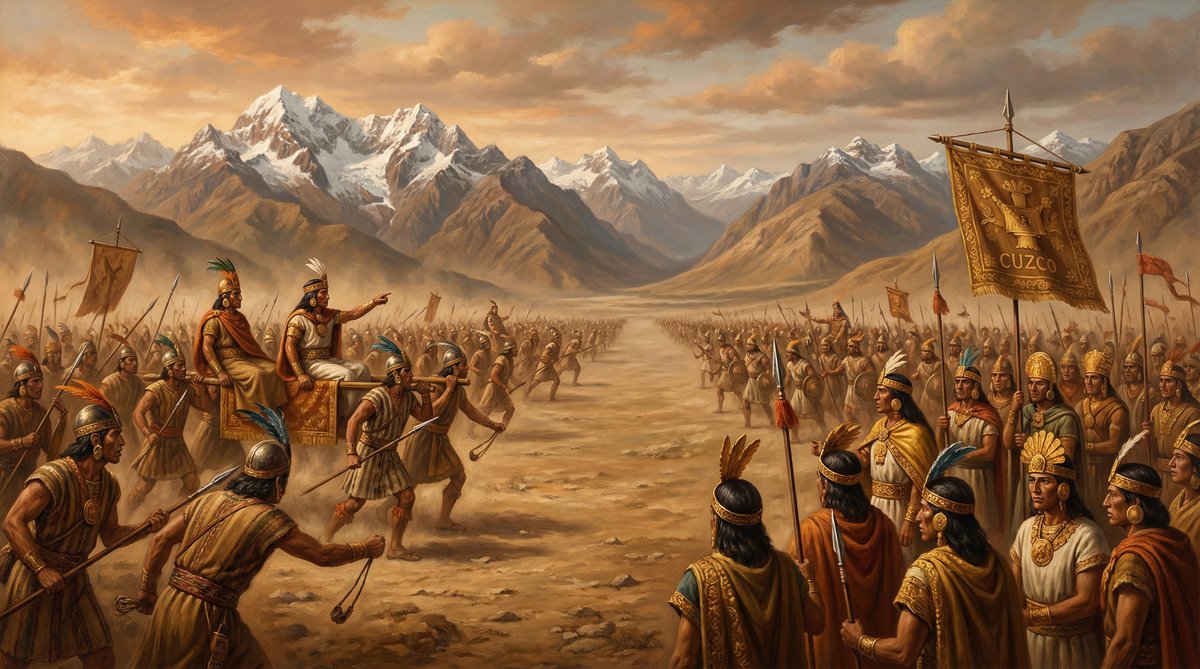
Huayna Capac left behind two sons with legitimate claims to the throne. Huáscar, the elder, was the governor of Cuzco, the sacred capital and political heart of the empire. He commanded the loyalty of the traditional Inca nobility, the priesthood, and the bureaucratic class. Atahualpa, the younger, was a brilliant and ruthless military commander stationed in the northern city of Quito. He had the unwavering loyalty of the empire’s massive professional army and three of its most talented generals: Chalcuchima, Quisquis, and Rumiñahui.
For a brief, fragile moment, the brothers attempted to rule jointly — Huáscar from Cuzco, Atahualpa from Quito. It was an arrangement born of necessity, not trust. It collapsed almost immediately. Huáscar, suspicious of his brother’s military power, made the first aggressive moves. Atahualpa, backed by his generals, responded with force. What followed was five years of devastating civil war that tore the empire apart.
The parallels to modern America are almost too precise to be coincidence. Huáscar represented the established political order — the capital, the institutions, the bureaucracy. Atahualpa represented the military and executive power — the force that projects authority but chafes under institutional restraint. Their conflict was not merely personal; it was structural. It was a fight between the political heart of the empire and its military arm, between the center of governance and the periphery of power. The empire’s resources were squandered. Its people were forced to choose sides. Its infrastructure was destroyed. Its social fabric was shredded.
In 1532, Atahualpa’s general Quisquis delivered the decisive blow, routing Huáscar’s forces outside Cuzco and capturing the rival emperor. Atahualpa had won. He was the undisputed Sapa Inca, ruler of the greatest empire in the Americas.
His reign lasted less than a year.
The Lesson: When Enemies Walk Through the Open Door
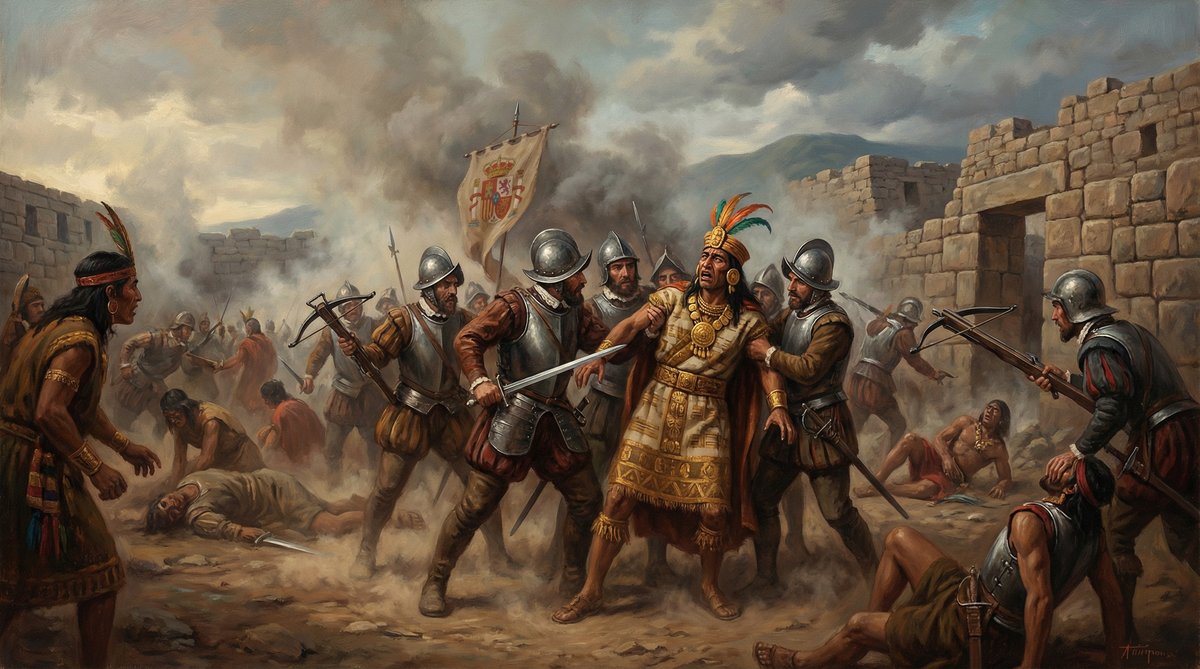
In November 1532, as Atahualpa celebrated his victory in the city of Cajamarca, a small band of 170 bedraggled, exhausted foreigners arrived at the city gates. They were Spanish conquistadors under the command of Francisco Pizarro, and they had been watching the civil war with the cold, calculating eyes of predators.
Atahualpa, flush with victory and surrounded by tens of thousands of warriors, agreed to meet the strangers. It was the most catastrophic miscalculation in the history of the Western Hemisphere. The Spanish ambushed his retinue in the town square, slaughtered thousands of unarmed Inca attendants, and captured the emperor himself. With their god-king in chains, the Inca people were paralyzed. No one dared attack the invaders for fear of what they would do to Atahualpa.
But the true genius of the Spanish conquest was not military — it was political. Pizarro exploited the divisions created by the civil war with surgical precision. By allying themselves with Huáscar’s faction, the Spanish were able to march into Cuzco not as conquerors, but as liberators. The empire that had been divided by its own leaders was consumed by a handful of foreign adventurers who simply walked through the door that the brothers had left wide open.
This is the mechanism that should terrify every American watching the DHS shutdown unfold. The danger is not the shutdown itself. The danger is what the shutdown signals — and what it invites. When a nation’s leaders are so consumed by their internal power struggle that they cannot agree on the basic function of keeping the government open, they are broadcasting a message to every adversary, every opportunist, every predator on the world stage: the door is open.
The Inca did not fall because the Spanish were strong. They fell because the Inca were divided. The civil war did not just weaken the empire’s military capacity; it shattered the social trust that held the empire together. Subjects who had been loyal to one brother were massacred by the other. Entire provinces switched allegiance. The road system that had been the empire’s greatest strength became a highway for invading armies. The centralized governance that had fed millions became a single point of failure — capture the emperor, and the entire system froze.
Today, the Department of Homeland Security — the agency created after September 11th specifically to prevent catastrophic attacks on American soil — is being shut down because two political factions cannot agree on immigration enforcement policy. FEMA disaster response will be curtailed. Coast Guard operations will be reduced. TSA screeners will work without pay. The Secret Service will continue to protect the President, but with a workforce operating under the shadow of uncertainty. And all of this is happening not because of an external threat, but because of an internal one: the inability of America’s ruling class to govern.
The Action: What the Inca Didn’t Do — and What You Must
The ordinary people of the Inca Empire had no contingency plan. They depended entirely on the centralized state for food distribution, infrastructure, and security. When the state collapsed, they had nothing to fall back on. They were helpless in the face of both civil war and foreign conquest.
You do not have to make the same mistake.
The lesson of the Inca Civil War is not that collapse is inevitable. It is that dependence on a dysfunctional system is the real danger. The brothers’ war did not destroy every village in the Andes. The communities that survived the conquest were the ones that had maintained their own food systems, their own local governance, their own capacity for self-defense. The ones that had outsourced everything to the central state were the first to fall.
This is why self-reliance is not a lifestyle choice — it is a survival strategy. The 4ft Farm Blueprint provides a proven, step-by-step system for creating a reliable food supply that does not depend on government agencies, supply chains, or political stability. It is the kind of practical, durable preparation that separates survivors from victims.
But food is only the beginning. True resilience requires knowledge, community, and a clear-eyed understanding of the threats we face. Here are the resources that can help you build a life that doesn’t depend on Washington’s ability to keep the lights on:
- Survival Stronghold — Tactical skills and strategies for protecting your family when institutions fail.
- Self-Reliance Report — Daily intelligence on the systemic risks that mainstream media won’t cover.
- Homesteader Depot — The tools, supplies, and knowledge base for building genuine independence.
- Seven Holistics — Natural health solutions that don’t require a functioning healthcare system.
- The Ready Report — Strategic preparedness intelligence for the informed citizen.
The Inca Empire was the most powerful civilization in the Americas. It had the best roads, the most productive agriculture, and the most disciplined army on the continent. None of it mattered when the people at the top turned on each other. The empire did not fall to a superior force. It fell to 170 men who were smart enough to exploit a self-inflicted wound.
The DHS shutdown is America’s self-inflicted wound. The question is not whether someone will try to exploit it. The question is whether you will be ready when they do.
History doesn’t repeat itself. But it does keep score.