The most critical chokepoint in the global economy has been sealed shut.
Since late February, the Strait of Hormuz has been effectively blockaded amid the escalating U.S.-Iran war. Roughly 20% of the world’s daily oil supply is now trapped. The economic shockwaves are already tearing through the global system.
The numbers are terrifying.
Crude oil has surged to a four-year high near $120 a barrel. U.S. jet fuel prices have skyrocketed 95% since the conflict began. In California, diesel has hit $5.61 a gallon. Across Europe, Asia, and Australia, governments are implementing emergency fuel rationing, canceling flights, and begging citizens to take the bus.
Meanwhile, the U.S. is burning $1 billion a day on military operations while staring down a $39 trillion national debt and a new 15% global blanket tariff. The American consumer is being squeezed from every direction.
We are watching a superpower overextend its military to control a vital waterway, only to trigger an economic crisis at home.
It feels like a modern disaster. But it is an ancient pattern.
The Empire That Owned the World’s Wealth
In 500 BC, the Achaemenid Persian Empire was the undisputed master of the known world.
Stretching from the Indus Valley to the Balkans, it was the largest empire history had ever seen. At its core was the Persian Gulf — the ancient equivalent of the Strait of Hormuz. By controlling this vital maritime artery, the Persians dominated global trade, moving spices, textiles, and precious metals across Eurasia.
Under Darius the Great, the empire was an economic juggernaut. He built a massive infrastructure of roads and canals, funded by the immense wealth flowing through the Gulf.
But then, the Persians made a fatal miscalculation.
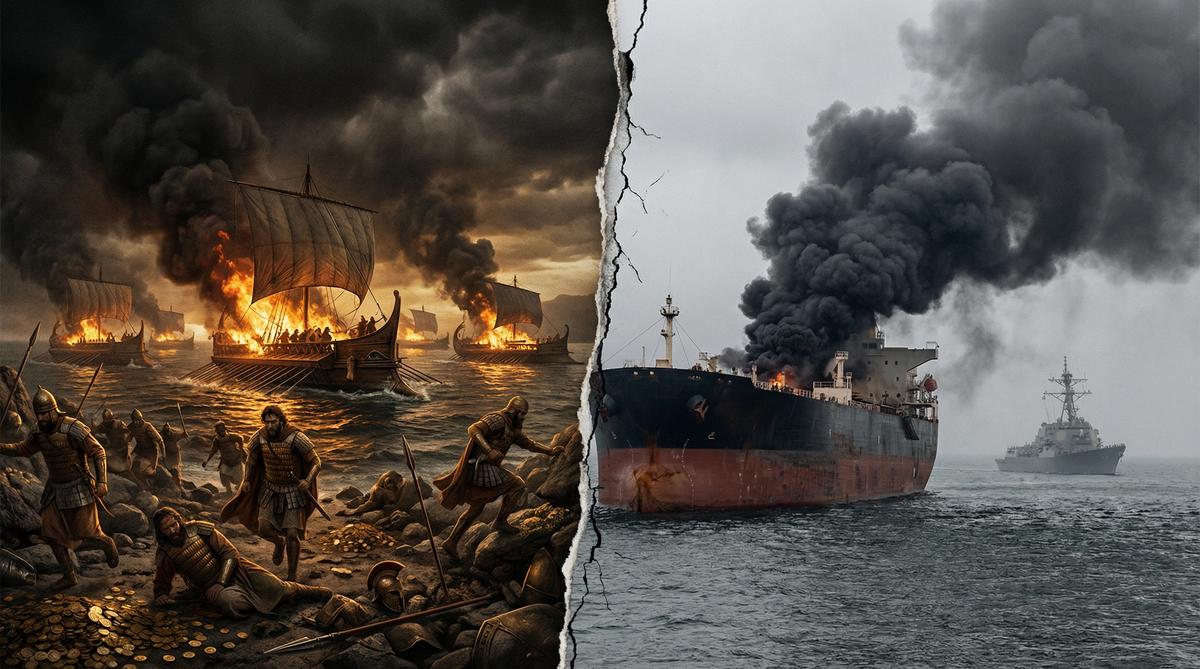
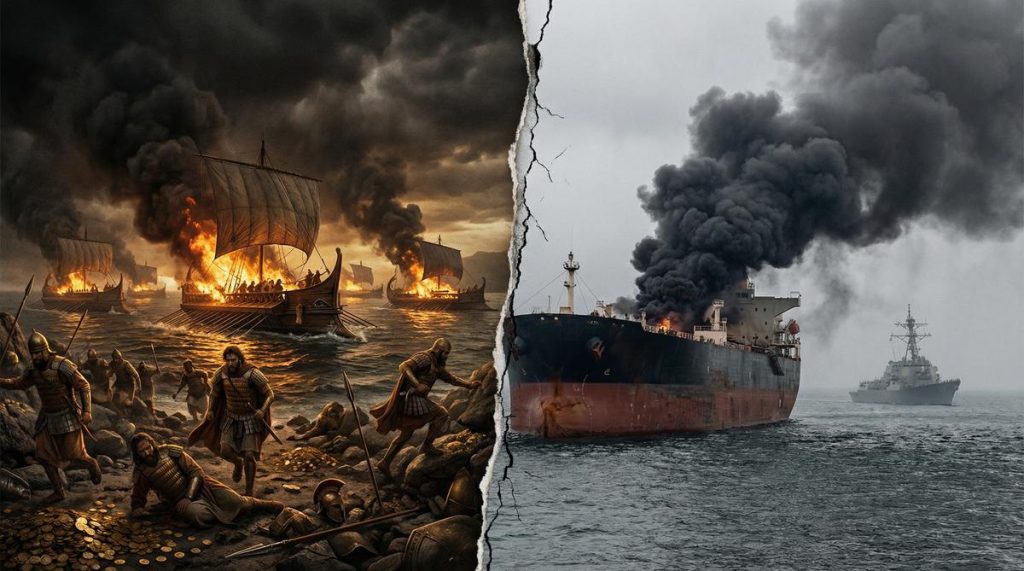
Instead of securing their economic base, Darius and his son Xerxes launched massive, ruinously expensive military campaigns to conquer Greece. They overextended their supply lines thousands of miles from home and drained the royal treasury to fund wars that produced nothing.
Xerxes’ invasion of Greece in 480 BC required feeding and supplying an army historians estimate at 200,000 men — a logistical and financial nightmare that depleted the Persian treasury for a generation.
To pay for these foreign wars, the Achaemenid rulers squeezed their citizens with crushing taxes. The once-thriving trade routes began to choke under the weight of imperial demands.
The empire was rotting from the inside out.
As the economy faltered, internal revolts erupted across the empire’s 20 provinces. The regions, bled dry by taxation and inflation, began to fracture. The Persian military, once the most feared force on earth, became bloated, expensive, and ineffective.
When Alexander the Great finally arrived in 334 BC, he didn’t defeat a strong empire.
He simply kicked in the door of a rotting structure.
The Achaemenid Empire — which had controlled the world’s wealth and its most vital waterways for over 200 years — collapsed under the weight of its own overextension. The treasury at Persepolis, which Alexander looted, contained 120,000 talents of gold. It had all been spent on wars that made the empire weaker, not stronger.
The Cost of Overextension
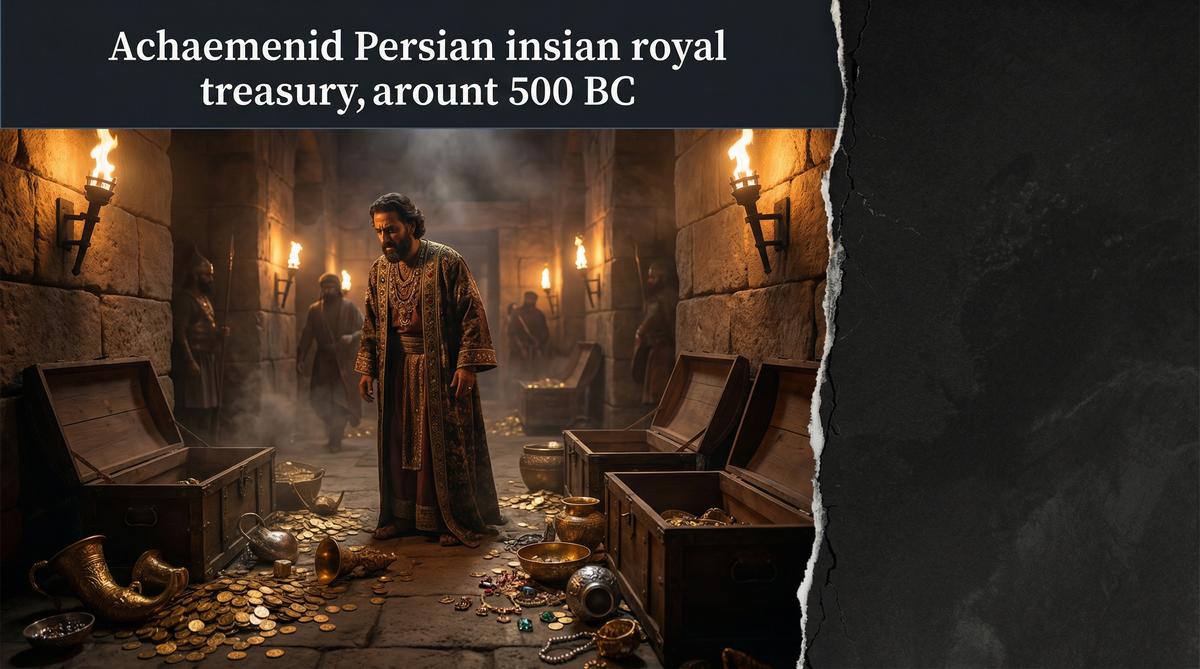
America is currently walking the exact same path as the Achaemenid Persians.
We are projecting military power across the globe — specifically in the Persian Gulf — while our domestic economy crumbles under the weight of debt and inflation. The $1 billion a day we are spending on the U.S.-Iran war is our version of Xerxes’ disastrous Greek campaign.
We are bleeding our treasury dry to control a chokepoint, while the homeland suffers.
The closure of the Strait of Hormuz is not just a geopolitical crisis; it is an economic reckoning. The surging oil prices, the 15% global tariffs, and the warnings from retail giants like Walmart and Home Depot are the modern equivalent of the crushing taxes that broke the Persian citizens.
The U.S. national debt has crossed $39 trillion. Interest payments alone now exceed $1 trillion per year. Recession odds have climbed to 40%. The S&P 500 is down 4% in 2026 — its worst start since the pandemic.
When an empire overextends its military and destroys its currency, the end result is always the same: economic collapse and internal fracture.
The global supply chain is breaking. The era of cheap energy and endless consumer goods is ending.
The Path to Resilience
It is easy to look at the closure of the Strait of Hormuz, the soaring gas prices, and the looming recession, and feel a sense of despair. To feel like a hostage to geopolitical forces beyond your control.
But history teaches another, more powerful lesson.
When the great, centralized systems overextend and fail, they create a vacuum. And into that vacuum rushes the opportunity for something new.
The survivors of the Achaemenid collapse weren’t the ones who relied on the empire’s trade routes. They were the ones who built local resilience. They were the ones who focused on their own communities, who strengthened their own skills, and who created independent networks of support that didn’t rely on the royal treasury.
When the centralized system fails, it is not the end of the world.
It is the beginning of a localized one.
This is not a call to hide in fear. It is a call to build a better, more resilient life, starting in your own backyard.
The Blueprint for Hope

Building a resilient future starts with a single, powerful step: taking control of your own resources. You cannot control the Strait of Hormuz, but you can control what happens on your own property.
The 4ft Farm Blueprint is not just about growing food; it’s about sovereignty. It’s the first chapter in your family’s story of independence — a story where you are the builder, not the victim of global supply chain shocks. Every raised bed you plant is a direct hedge against the oil shock and inflation caused by a war 7,000 miles away.
As the cost of living skyrockets, true wealth is found in what you can produce, not what you can buy. Equip yourself with the tools and knowledge at Homesteader Depot to build a life that is insulated from the chaos of Washington and the Middle East.
The stress of living in an overextended empire is a chronic toxin — and it is measurable in your body. Protect your family’s physical and mental well-being with the natural protocols from Seven Holistics. True sovereignty begins with a healthy, resilient body.
For real-time intelligence on how this energy crisis is reshaping the economic landscape, The Ready Report is tracking the timeline and what to do before the next shock hits.
The empire may be overextended. Your family doesn’t have to be.
Start building today.