
In the biting cold of November 2025, as Ukraine stands on a knife’s edge between a brutal war and a fragile peace, a political earthquake has struck the heart of Kyiv. Andriy Yermak, President Volodymyr Zelensky’s chief of staff and the second most powerful man in the country, has resigned in disgrace. His downfall came just hours after anti-corruption agents raided his home, a stunning development in a sprawling investigation into a kickback scheme involving the nation’s critical energy infrastructure. [1]
For a leader who rode to power on a tidal wave of anti-corruption sentiment, this is a devastating blow. Zelensky, the wartime president, now faces a crisis of legitimacy from within, even as he confronts the existential threat from without. His inner circle, the very people entrusted to save the nation, are now accused of plundering it. The timing could not be worse, with high-stakes peace negotiations with the United States and Russia hanging in the balance.
This is not just a modern political drama; it is a timeless tragedy, a pattern of decay that has toppled empires throughout history. To understand the true danger facing Ukraine, we must travel back 3,180 years to the opulent but rotting court of the last great pharaoh of the New Kingdom: Ramesses III.
The Pivot: Egypt’s Warrior King and His Corrupt Court
In 1158 BCE, Ramesses III was the shield of Egypt. He had twice repelled the invasions of the “Sea Peoples,” a mysterious confederation of seafaring marauders who had laid waste to civilizations across the Mediterranean. He was a warrior king, the last bastion of a golden age. But while Ramesses fought to keep the enemy at the gates, a cancer was eating away at the heart of his empire.
His treasury was empty. His officials were corrupt. His people were starving. And in the gilded halls of his own harem, his closest confidants were sharpening their knives. Ramesses III was about to learn a fatal lesson: the most dangerous enemies are not those outside the walls, but those who sit at your own table.
The Story: Empty Granaries, Workers’ Strikes, and a Royal Assassination
Ramesses III’s reign was a paradox of external strength and internal decay. While he celebrated his victories over the Sea Peoples with grand inscriptions at his temple at Medinet Habu, the economic reality was grim. The constant warfare had drained the state’s resources. The vast temple estates, which controlled a third of Egypt’s arable land, were riddled with corruption, their granaries plundered by a bloated and unaccountable priesthood.
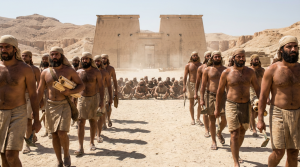
This systemic rot had devastating consequences for the common people. In the 29th year of his reign, the elite artisans of Deir el-Medina—the men who built the magnificent tombs in the Valley of the Kings—laid down their tools in the first recorded labor strike in human history. [2] Their grain rations were 18 days late. They marched on the temples, shouting, “We are hungry!” They were not revolutionaries; they were skilled craftsmen demanding the wages they were owed. The vizier, confronted by the angry mob, admitted the state’s failure: the pharaoh’s granaries were effectively empty. [3]
While the workers starved, a far more sinister plot was unfolding within the royal palace. Queen Tiye, one of Ramesses’ secondary wives, was consumed by ambition. She was determined that her son, Pentawer, would inherit the throne instead of the chosen heir, the future Ramesses IV. She wove a web of conspiracy that extended from the highest echelons of the court to the lowest servants.
Pebekkamen, a chief of the pantry, became the central organizer, smuggling messages out of the restricted harem. He recruited army officials, scribes, and even the overseer of the King’s treasury, who provided a pass to give the assassins access to the pharaoh. The plot, known today as the Harem Conspiracy, was a testament to the pervasive corruption of the era. [4]
In 1155 BCE, the conspirators struck. For centuries, it was believed Ramesses III had survived the attack, but modern CT scans of his mummy reveal a horrifying truth: his throat was slit to the bone, severing his trachea and major blood vessels. He died almost instantly. The pharaoh, the victor of countless battles, was murdered by his own household. [5]
The plot ultimately failed. Ramesses IV seized the throne and put the conspirators on trial. But the trial itself became a showcase of the empire’s decay. Several of the judges, entrusted to deliver justice, were caught cavorting with the accused women. They were punished by having their noses and ears cut off, a gruesome symbol of a justice system that had become as corrupt as the criminals it was meant to judge. [6]
The Lesson: Corruption is the Disease that Kills Empires at War
The parallels between the crisis facing Zelensky and the fall of Ramesses III are a chilling warning across the millennia. A leader who rises on a promise to fight corruption finds himself betrayed by his inner circle at the moment of greatest national peril.
| Feature | Ukraine (2025) | Ancient Egypt (1155 BCE) |
|---|---|---|
| The Leader | Volodymyr Zelensky, wartime president | Ramesses III, warrior pharaoh |
| External Threat | Russian invasion | Sea Peoples invasion |
| Internal Crisis | Anti-corruption campaign | Temple and state corruption |
| The Betrayal | Chief of Staff Andriy Yermak resigns after corruption raid | Queen Tiye’s Harem Conspiracy to assassinate the pharaoh |
| The Scandal | Kickback scheme in critical energy infrastructure | Embezzlement of grain from temple granaries |
| Public Anger | Anti-government protests over corruption | First recorded labor strikes in history over unpaid wages |
| Justice System | Anti-corruption agencies raid top officials | Trial judges themselves are caught in corruption |
| The Core Problem | A system so rotten it threatens to collapse even as it fights for survival | A system so rotten it assassinates its own leader |
Ramesses III’s story teaches us a brutal lesson: military victory is meaningless if the foundations of the state have rotted away. Corruption is not a distraction from an existential war; it is a second front. It drains resources, destroys morale, and erodes the trust between the people and their leaders. It creates the internal weakness that invites external defeat.
Zelensky, like Ramesses III, is discovering that the monsters you fight abroad are no more dangerous than the vipers you nurse in your own court. When the people who are supposed to be managing the war effort are busy enriching themselves, the entire enterprise is doomed.
The Action: Build Your Own Granary
History is not a prophecy, but it is a map of human failure. The patterns are undeniable. When governments become consumed by war and riddled with corruption, they can no longer be trusted to provide for their people. The granaries, whether ancient or modern, will always run empty.
Do not wait for the system to save you. It is too busy saving itself. The time to prepare is now. The ultimate act of defiance against a failing system is self-reliance.
Start by securing your family’s food supply. The 4ft Farm Blueprint is the first critical step. It teaches you how to create a sustainable, high-yield food source in a space no larger than a closet, a vital asset when the supply chains break and the store shelves are bare.
This is not about being a doomsday prepper; it is about being a student of history. The lesson of Ramesses III is clear: you must build your own granary, because the pharaoh’s is already being looted.
Expand your knowledge and resilience by exploring the resources from our trusted partners:
– SurvivalStronghold.com: Your guide to surviving any crisis.
– SelfRelianceReport.com: In-depth analysis and practical advice for the self-reliant individual.
– SevenHolistics.com: Natural health solutions for a world in crisis.
– HomesteaderDepot.com: The tools and supplies you need to build a self-sufficient life.
Do not be a victim of history’s repeating tragedies. Learn the lesson, take the action, and secure your future.
References
[1] CNN. (2025, November 28). Zelensky’s top aide and key peace negotiator resigns after anti-corruption raid of his home. https://www.cnn.com/2025/11/28/world/andriy-yermak-ukraine-corruption-raid-intl
[2] Wikipedia. (n.d.). Deir el-Medina strikes. https://en.wikipedia.org/wiki/Deir_el-Medina_strikes
[3] Grandet, Pierre. (2014). Early-Twentieth-Dynasty Officialdom. In Ancient Egyptian Administration (pp. 813-850). Brill.
[4] Wikipedia. (n.d.). Harem conspiracy. https://en.wikipedia.org/wiki/Harem_conspiracy
[5] Hawass, Zahi, & Saleem, Sahar N. (2016). Scanning the Pharaohs: CT Imaging of the New Kingdom Royal Mummies. The American University in Cairo Press.
[6] de Buck, A. (1937). The Judicial Papyrus of Turin. Journal of Egyptian Archaeology, 23(2), 152-164.